Every other topic in the DSE Biology course relies on two tools introduced here: the seven characteristics of organisms, used to decide whether something is alive, and the scientific method with variables, which is tested in the experimental-design questions of Paper 1 Section B almost every year.
這一課是整個 DSE 生物課程的地基。課題本身不深,但其餘二十多個課題都會反覆用到兩個工具:判斷「某東西是否生物」的七大特徵,以及實驗設計題幾乎每年必考的科學方法與變量。
1. Characteristics of Organisms 生物的特徵
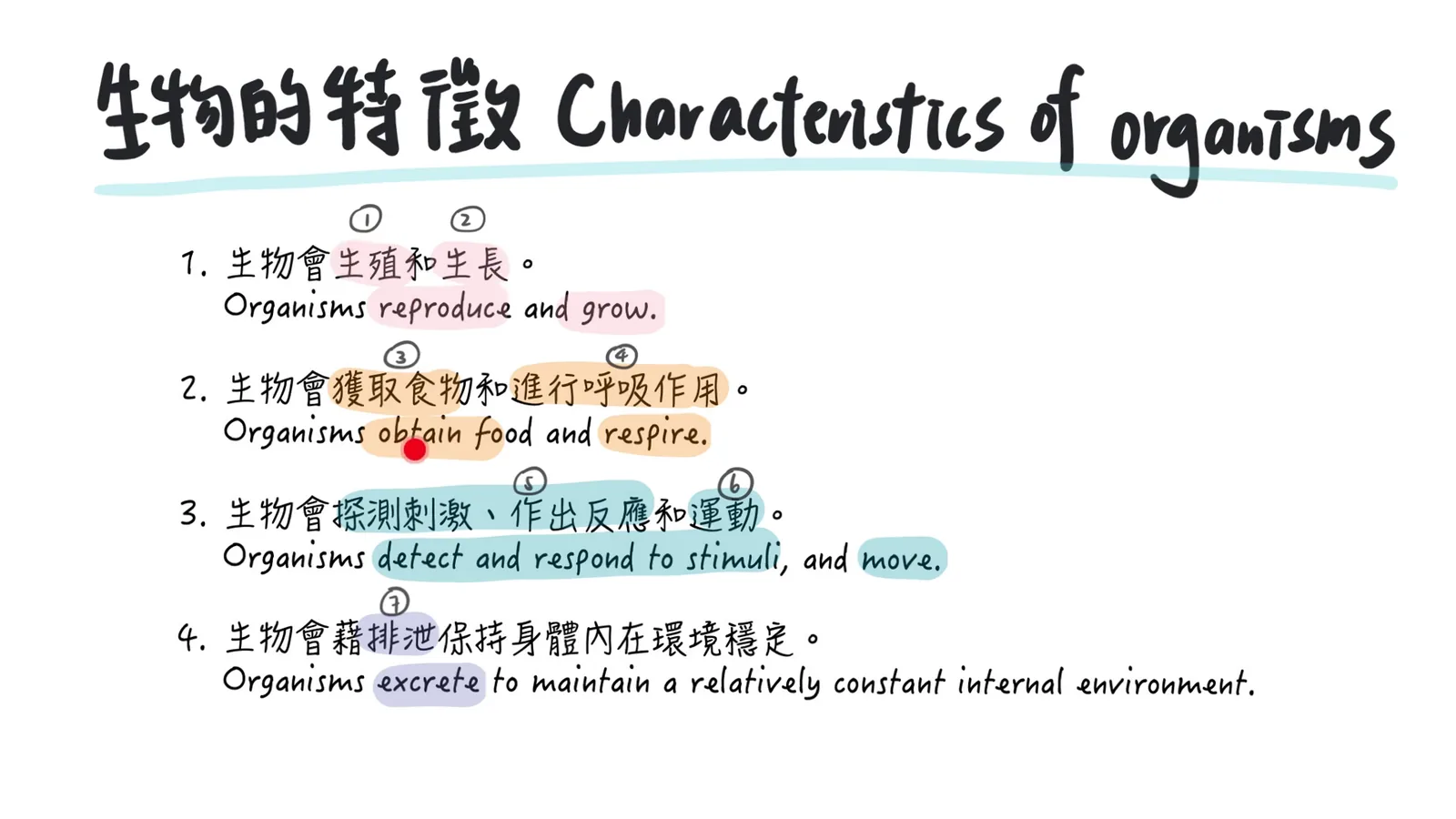
An object is regarded as an organism only if it shows all seven of the following characteristics. S02 · 0:20
| # | Characteristic | What it involves | 中文 |
|---|---|---|---|
| 1 | Reproduction | producing the next generation (new individuals) | 生殖 |
| 2 | Growth | increase in size(體型增大) and increase in complexity(複雜性增加) | 生長 |
| 3 | Obtaining food | by feeding(攝食), or by photosynthesis(光合作用) in plants | 獲取食物 |
| 4 | Respiration | breaking down food to release energy(釋放能量) | 呼吸作用 |
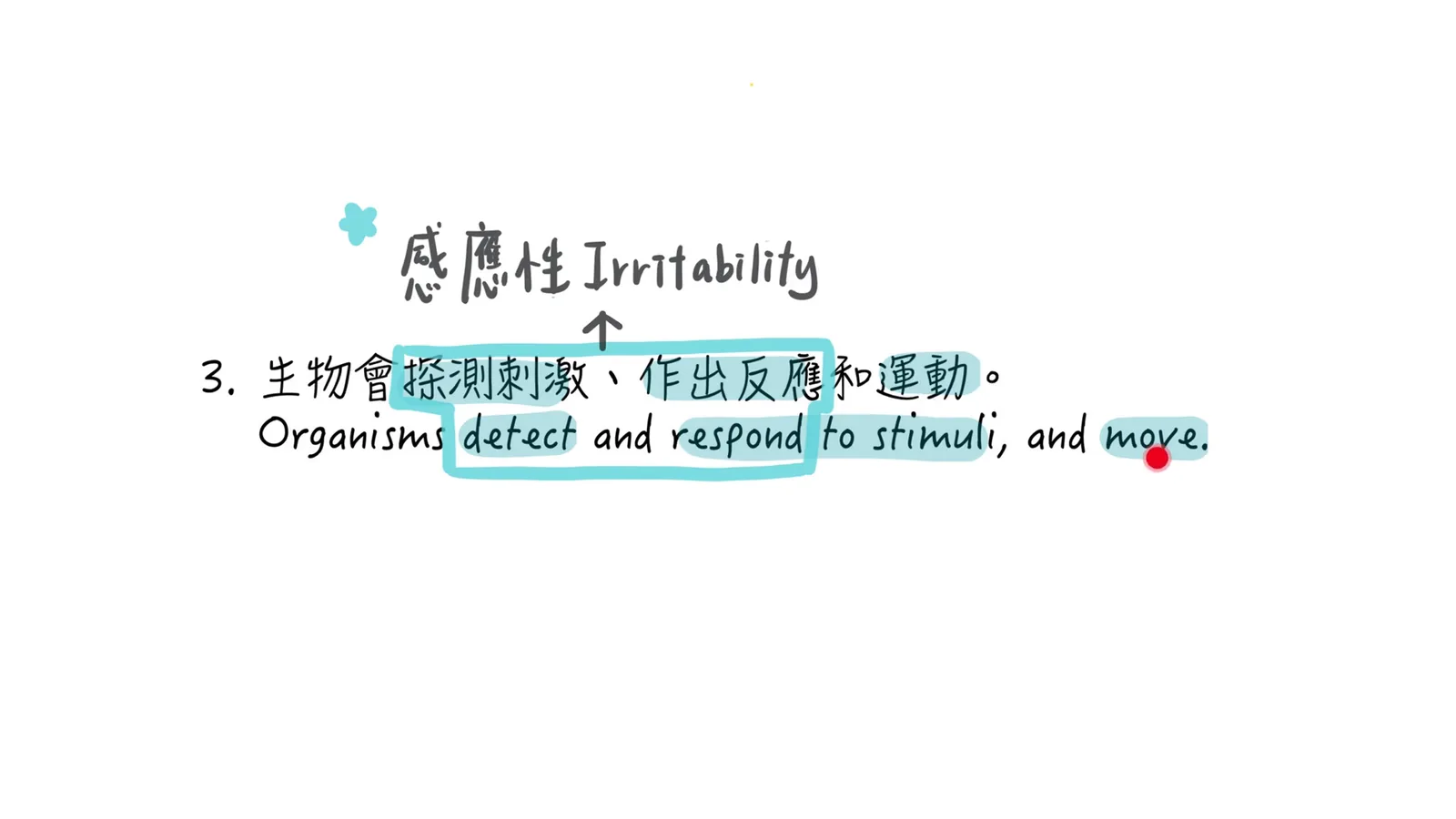
| 5 | Detecting and responding to stimuli | also called irritability S05 · 1:39 | 感應性 |
| 6 | Movement(運動) | animals move about; plants show growth responses such as phototropism(向光性) | 運動 |
| 7 | Excretion(排泄) | removing metabolic wastes(代謝廢物) to maintain a relatively constant internal environment(相對恆定的內在環境) | 排泄 |
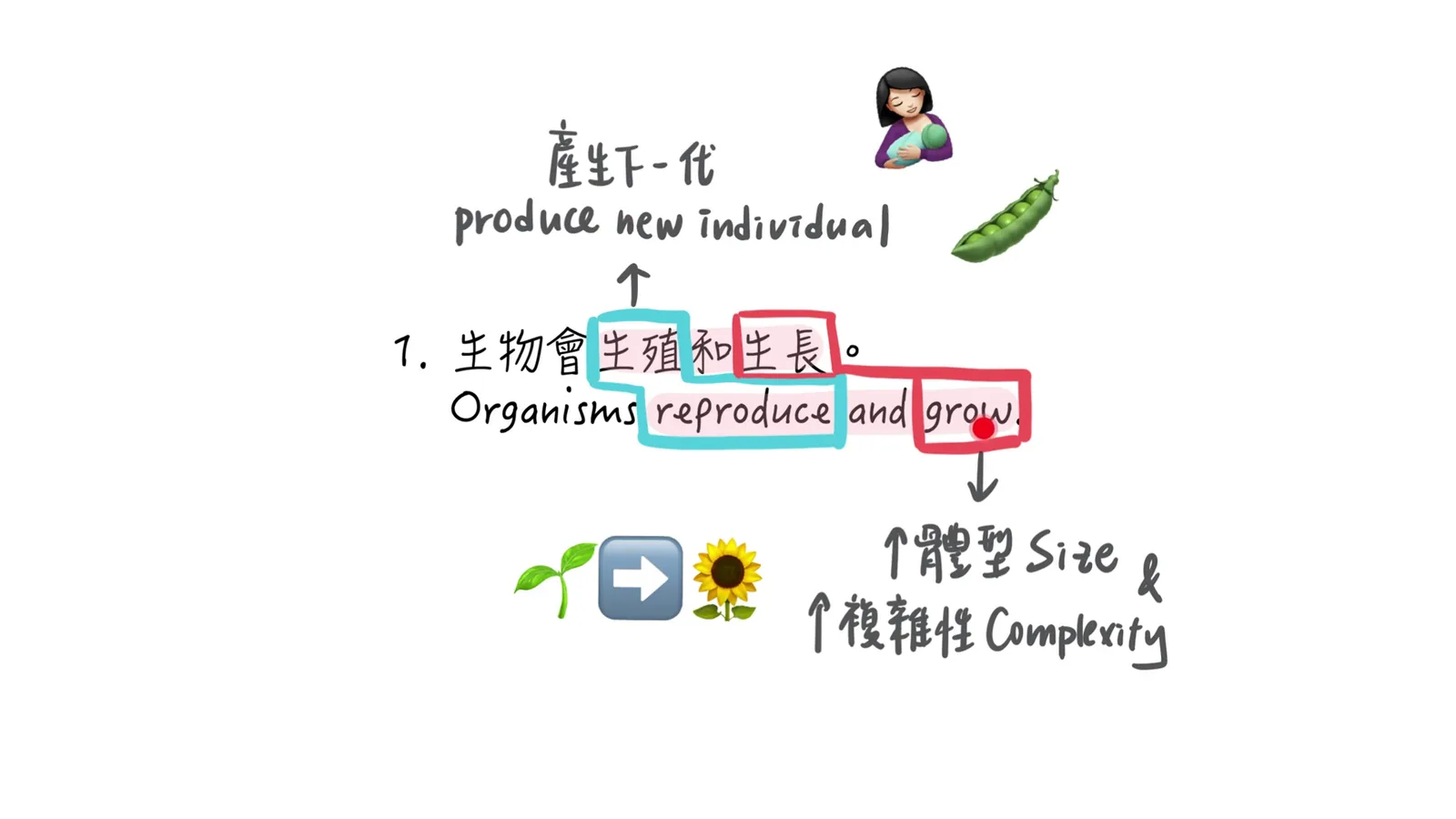
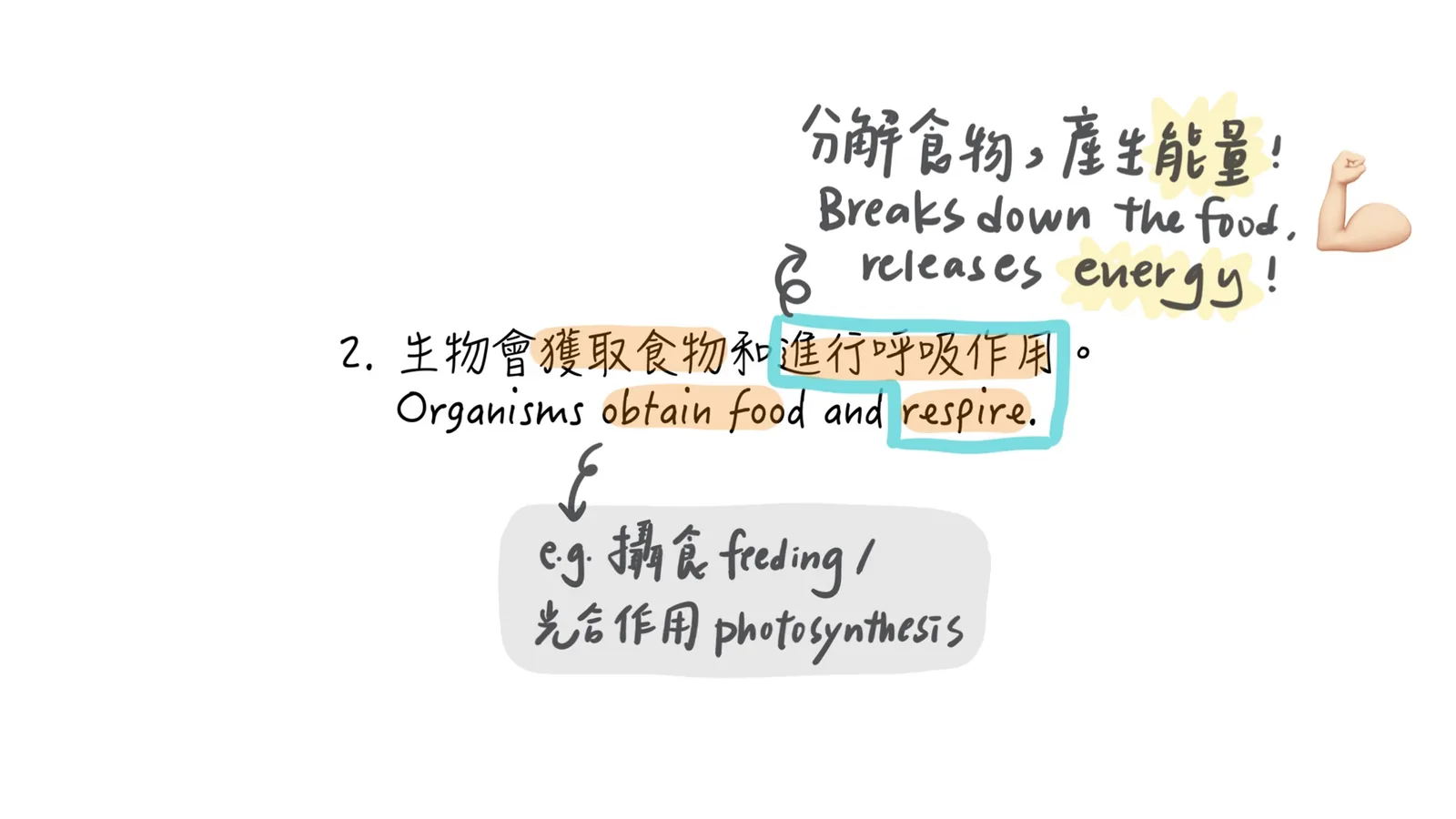
- Examinable definition: increase in size AND increase in complexity
- "It gets bigger" alone scores half the marks
- Complexity = more cells, and cells differentiated into tissues and organs S03 · 0:44
- Respiration = breakdown of food to release energy inside cells
- Taking in oxygen, giving out CO₂ = gas exchange(氣體交換)
- DSE will not accept one for the other S04 · 1:02
1.1 Excretion versus Egestion
This is the most frequently examined trap in the chapter. S06 · 2:17
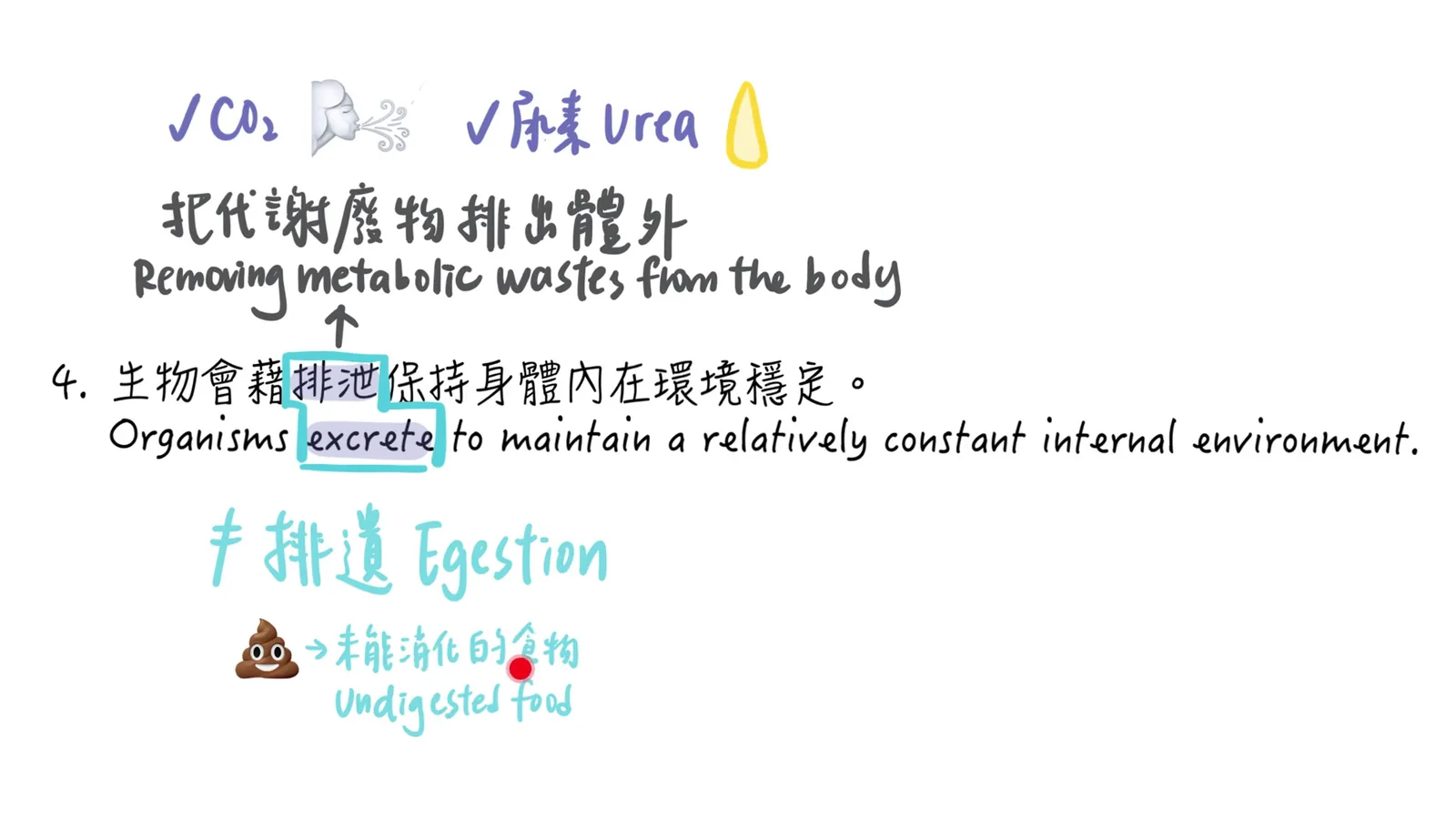
| 比較項目 | Excretion | Egestion(排遺) |
|---|---|---|
| What is removed | metabolic wastes | undigested food(未消化的食物) |
| Examples | carbon dioxide(二氧化碳), urea(尿素), sweat | faeces(糞便) |
| Route | breathing out, urinating, sweating | defecation(排便) |
| One of the seven characteristics? | Yes | No |
The purpose of excretion is not simply to get rid of unwanted substances: it maintains a relatively constant internal environment. This links directly to the later topic Homeostasis.
排泄的目的不是單純「排走廢物」,而是維持內在環境相對恆定。這一點與日後「體內平衡 Homeostasis」一課直接相連。
- Faeces never entered the cells and never took part in metabolism
- It is undigested food residue only: no metabolism, no metabolic waste
- Therefore egestion, not excretion S06 · 2:17
2. The Scientific Method 科學方法
The process can be summarised in six steps. S07 · 3:21 S09 · 5:37
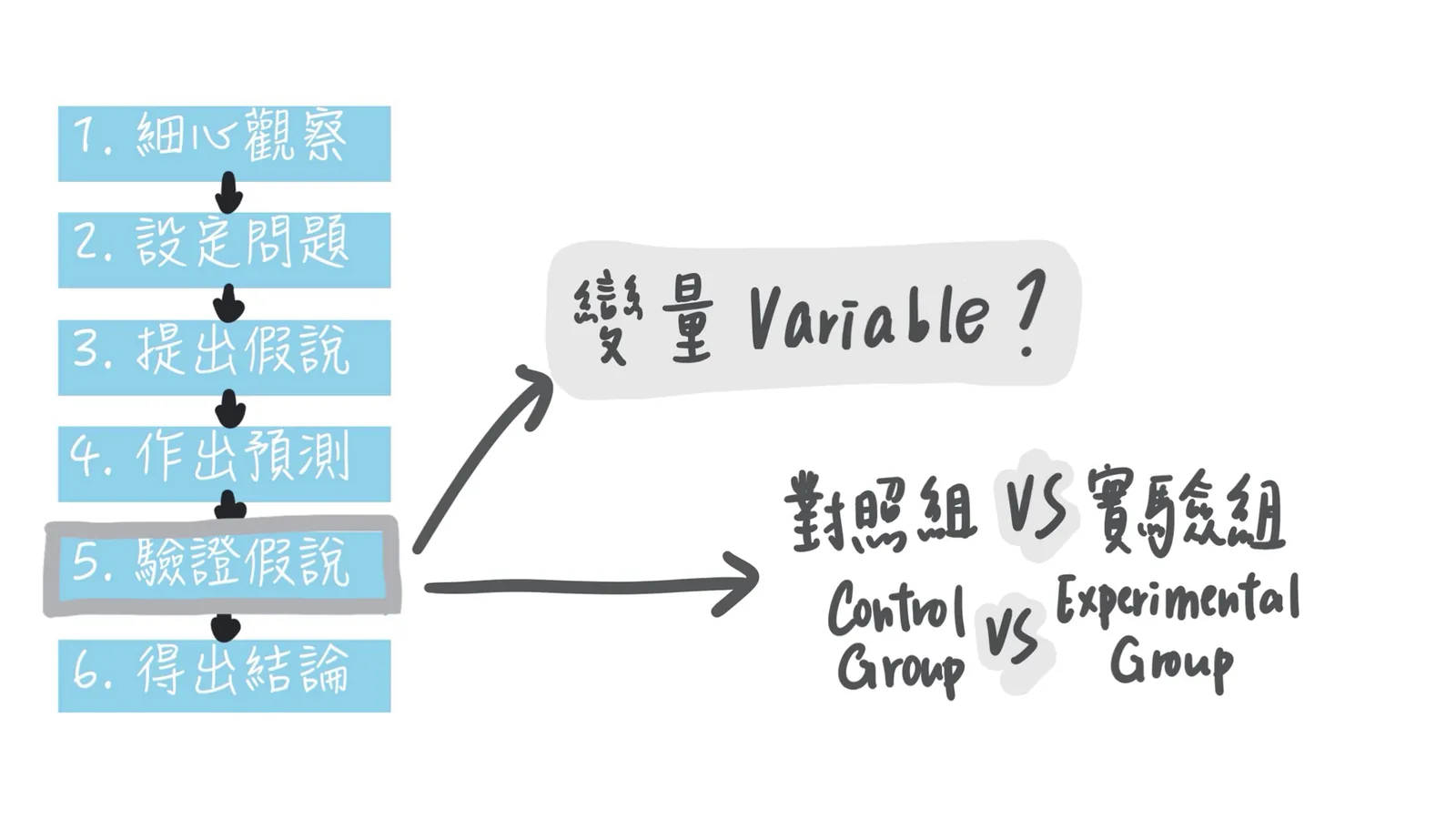
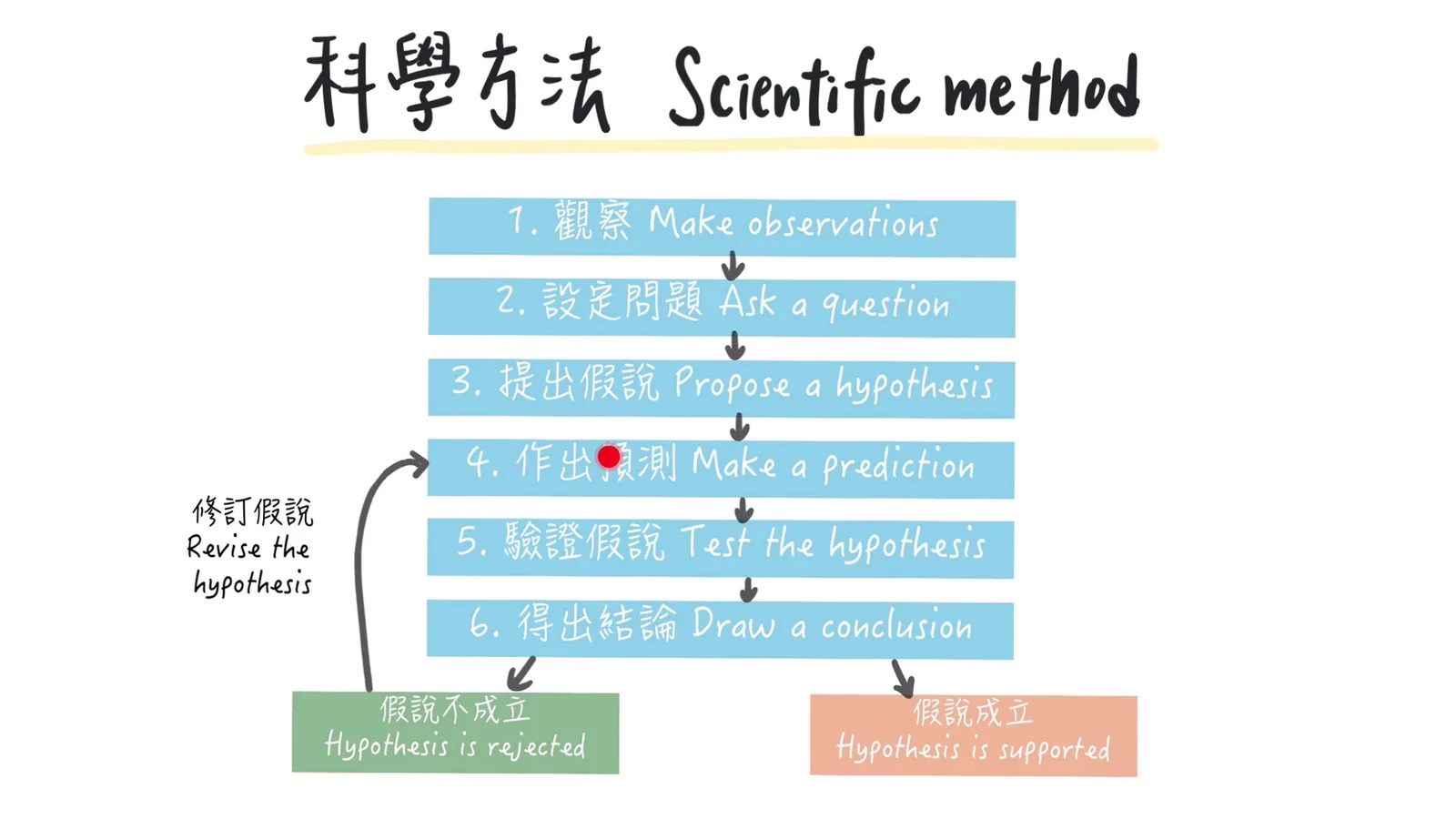
- Observation 細心觀察
- Formulating a question 設定問題
- Formulating a hypothesis 提出假說
- Making a prediction 作出預測
- Testing the hypothesis 驗證假說 — designing and carrying out an experiment
- Drawing a conclusion 得出結論
A conclusion can do only one of two things: S07 · 3:21
- support the hypothesis(支持假說) — it is accepted for the time being
- refute the hypothesis(推翻假說) — the hypothesis(假設) is revised, a new prediction(預測) is made, and the experiment is repeated
這是循環,不是單向流程:結論推翻假說就要修訂、再預測、再做實驗。因此科學知識永遠是「暫定的」。
3. Hypothesis 假設
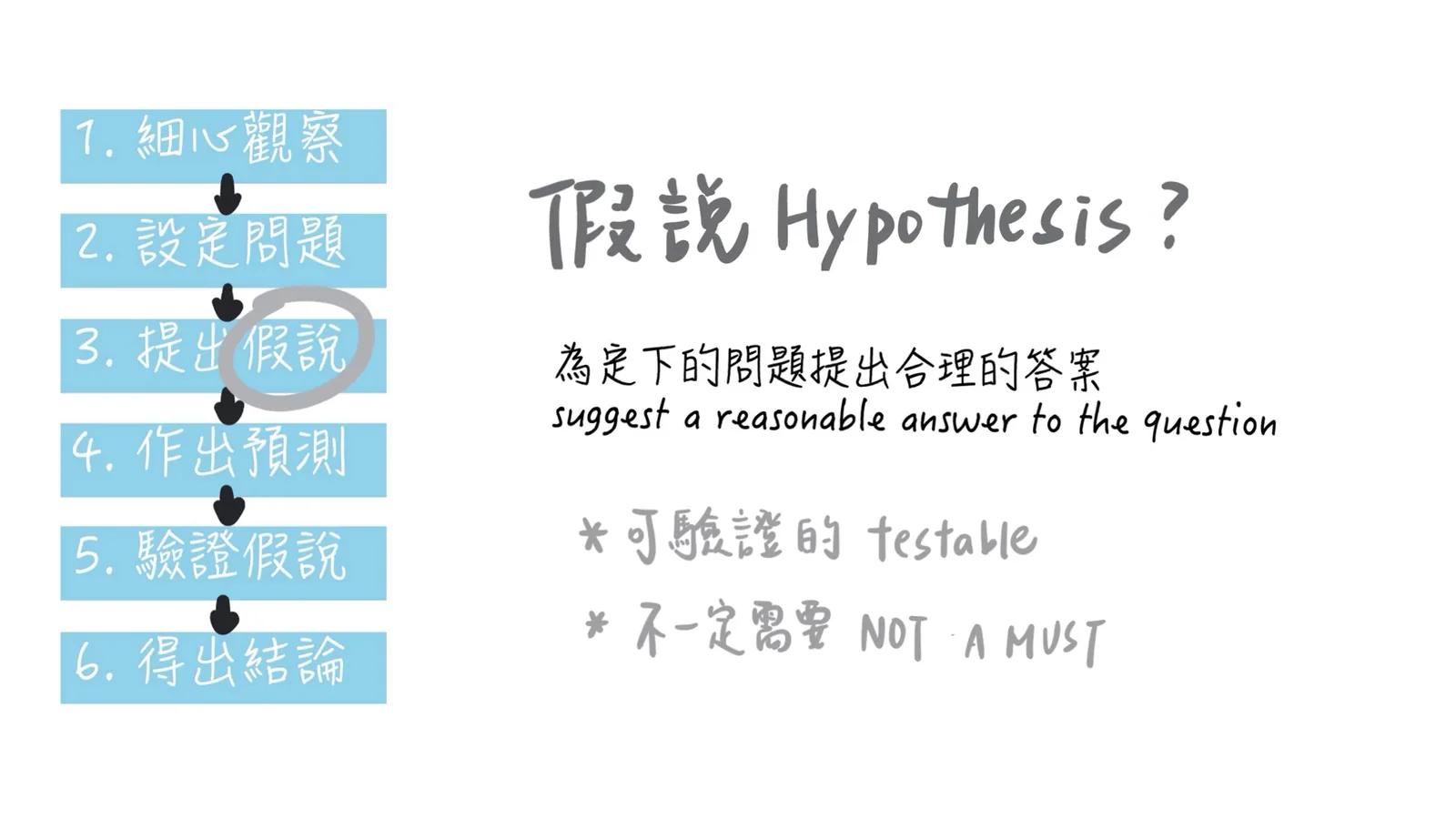
A hypothesis is a reasonable answer to a question — essentially the scientist's proposed position on that question. Three properties are examinable:
- It must be testable(可驗證); otherwise no experiment can be designed.
- It is not a guess. A guess needs no justification; a hypothesis is built on observation and prior knowledge.
- Not every investigation needs one. Descriptive or comparative questions — for example, how the population of an organism changed in a district over ten years, or which of three brands of biological washing powder removes stains best — require no prior position, so no hypothesis is formulated.
- Observation: meat left in the open develops maggots
- Question: why do maggots appear?
- Hypothesis: maggots are produced by flies on the meat
- Valid because testable — cover the meat with gauze to keep flies off S08 · 4:13
4. Variables 變量
A variable(變量) is a factor that must be considered in an experiment. There are three types, and the number of each type is examinable. S10 · 5:52
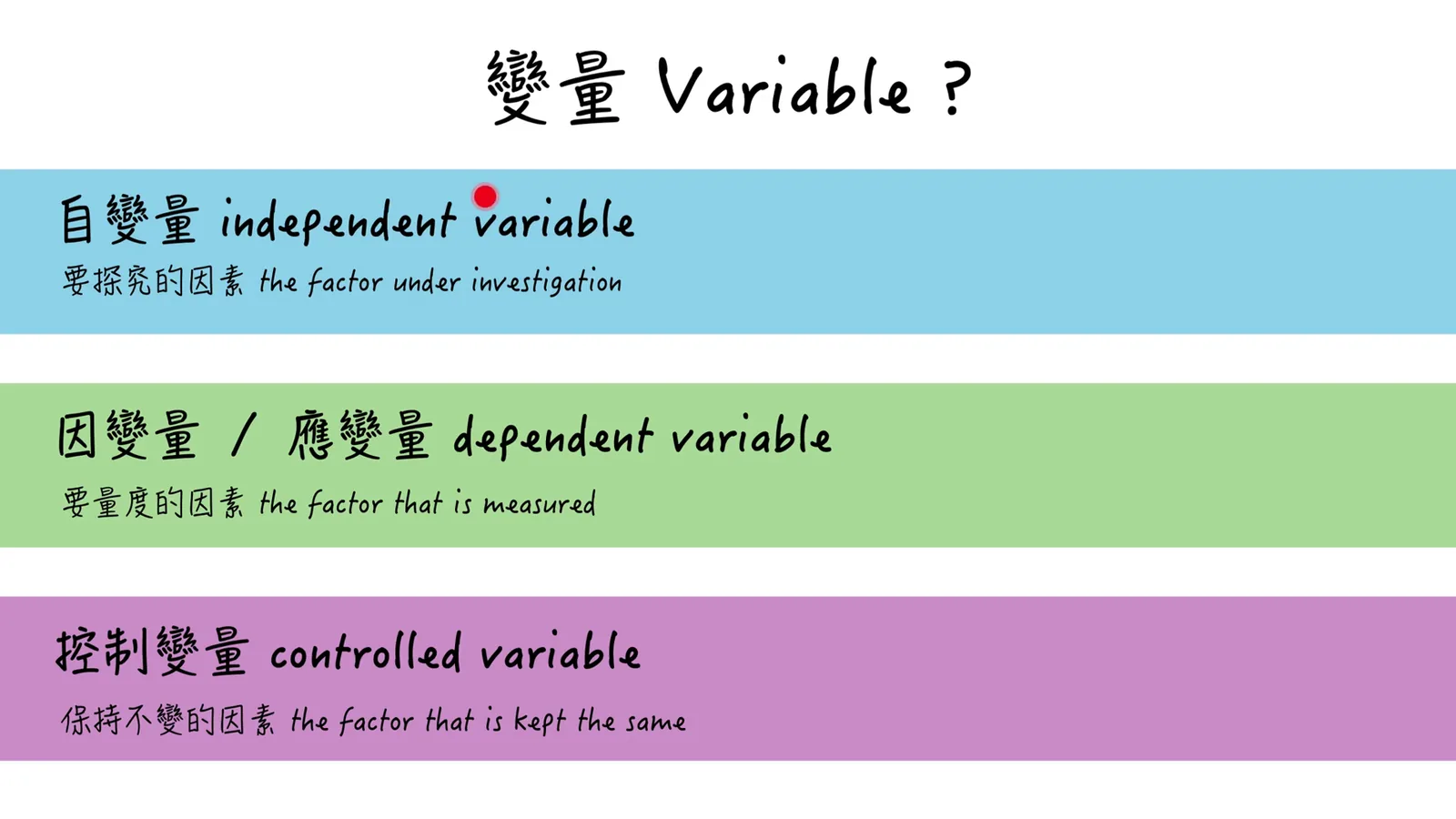
| Type | English | Definition | How many |
|---|---|---|---|
| 自變量 | Independent variable(自變量) | the factor under investigation(要探究的因素), deliberately changed by the investigator | exactly one |
| 因變量/應變量 | Dependent variable(因變量/應變量) | the factor measured as the result | exactly one |
| 控制變量 | Controlled variable(控制變量) | factor kept the same because it could affect the result | any number |
4.1 Worked example: effect of humidity on the rate of water loss
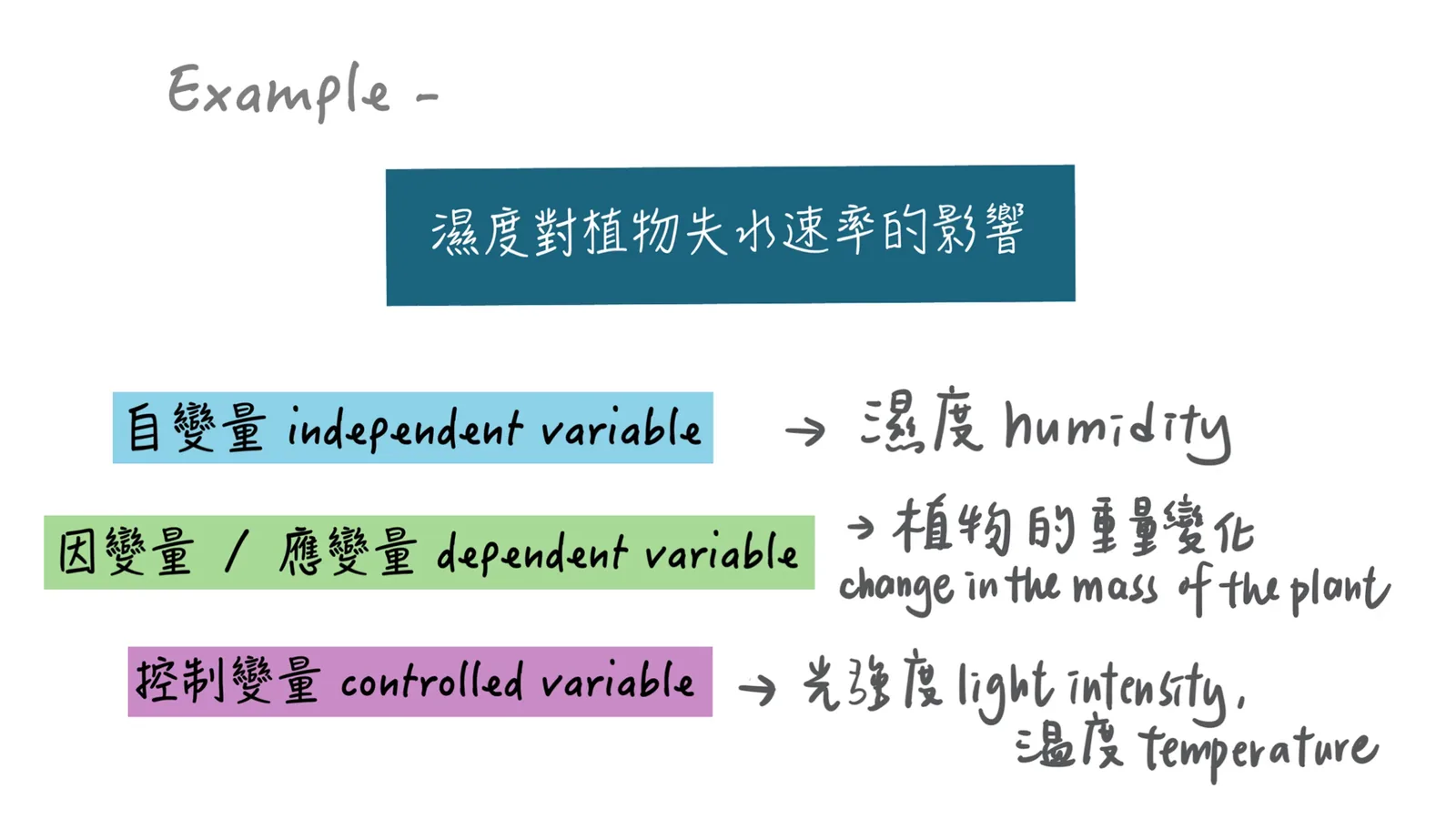
| Variable | In this experiment | Reason |
|---|---|---|
| Independent | humidity(濕度) | this is the factor under investigation |
| Dependent | change in mass of the plant | the rate of water loss(失水速率) is calculated from it |
| Controlled | light intensity(光強度), temperature(溫度) | both affect the rate of water loss and must be fixed |
- Controlled variable = a condition kept constant, e.g. temperature
- Control group(對照組) = a second set-up(裝置) that lacks the factor
- One is a condition, the other is a group of apparatus
- The Chinese terms differ by one character — constantly confused
控制變量是「實驗中要保持不變的因素」(例如溫度);對照組是「另一組裝置」。前者是條件,後者是一組實驗。
5. Control Group and Experimental Group 對照組與實驗組
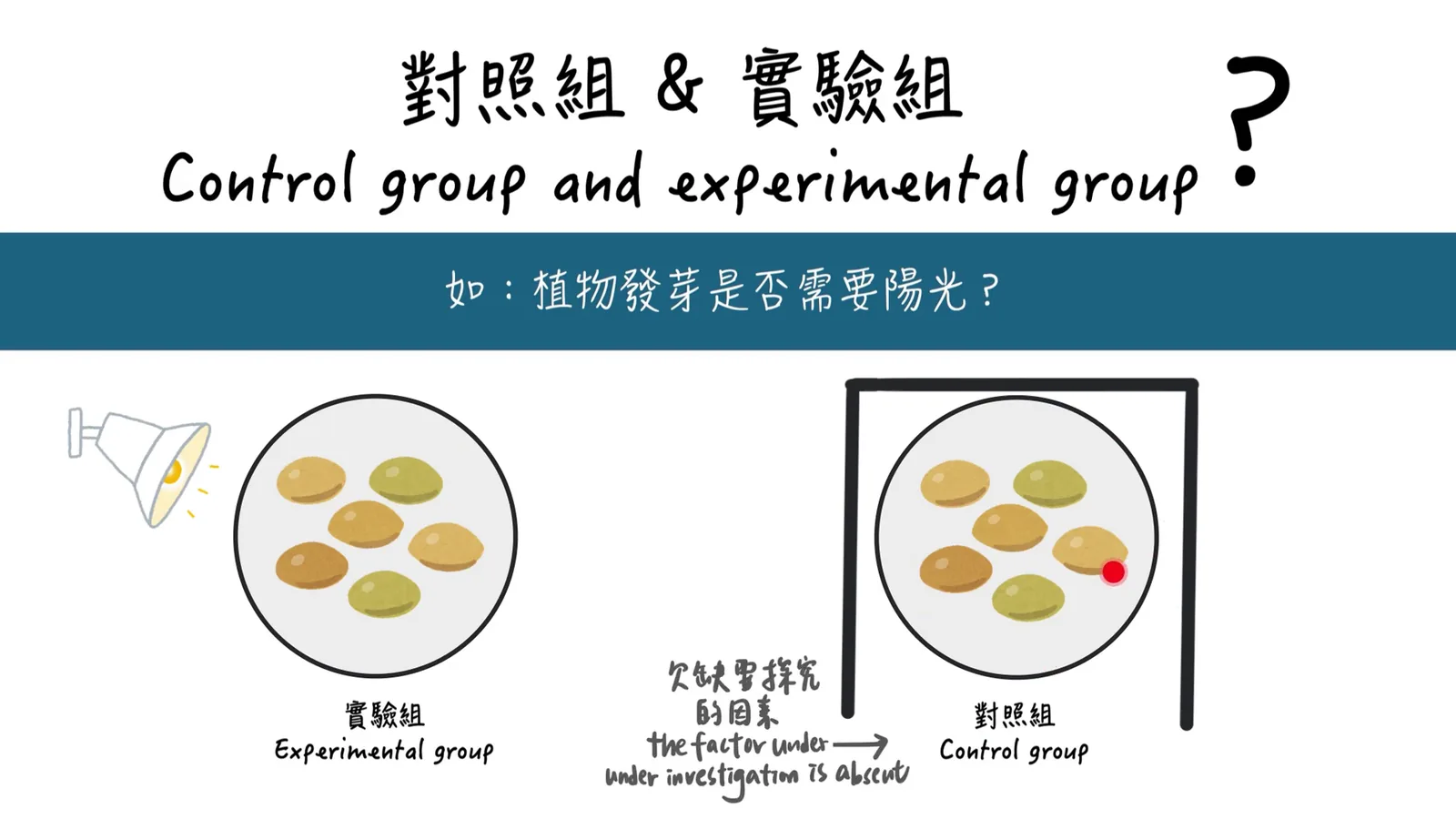
- Experimental group(實驗組) — has the factor under investigation
- Control group — lacks the factor under investigation (the factor under investigation is absent)
Worked example: is sunlight needed for seed germination?
| 組別 | Set-up | Has the factor (sunlight)? |
|---|---|---|
| Experimental group | seeds + sunlight | Yes |
| Control group | seeds + light-proof box(不透光盒) | No |
Why a control group is essential: the experimental group alone cannot show that germination happened because of light. A second set-up without light supplies the comparison that lets the result be attributed to the factor. Controlled variables deal with other factors; the control group deals with the presence or absence of the factor itself. Both are needed.
6. Nature of Science 科學本質
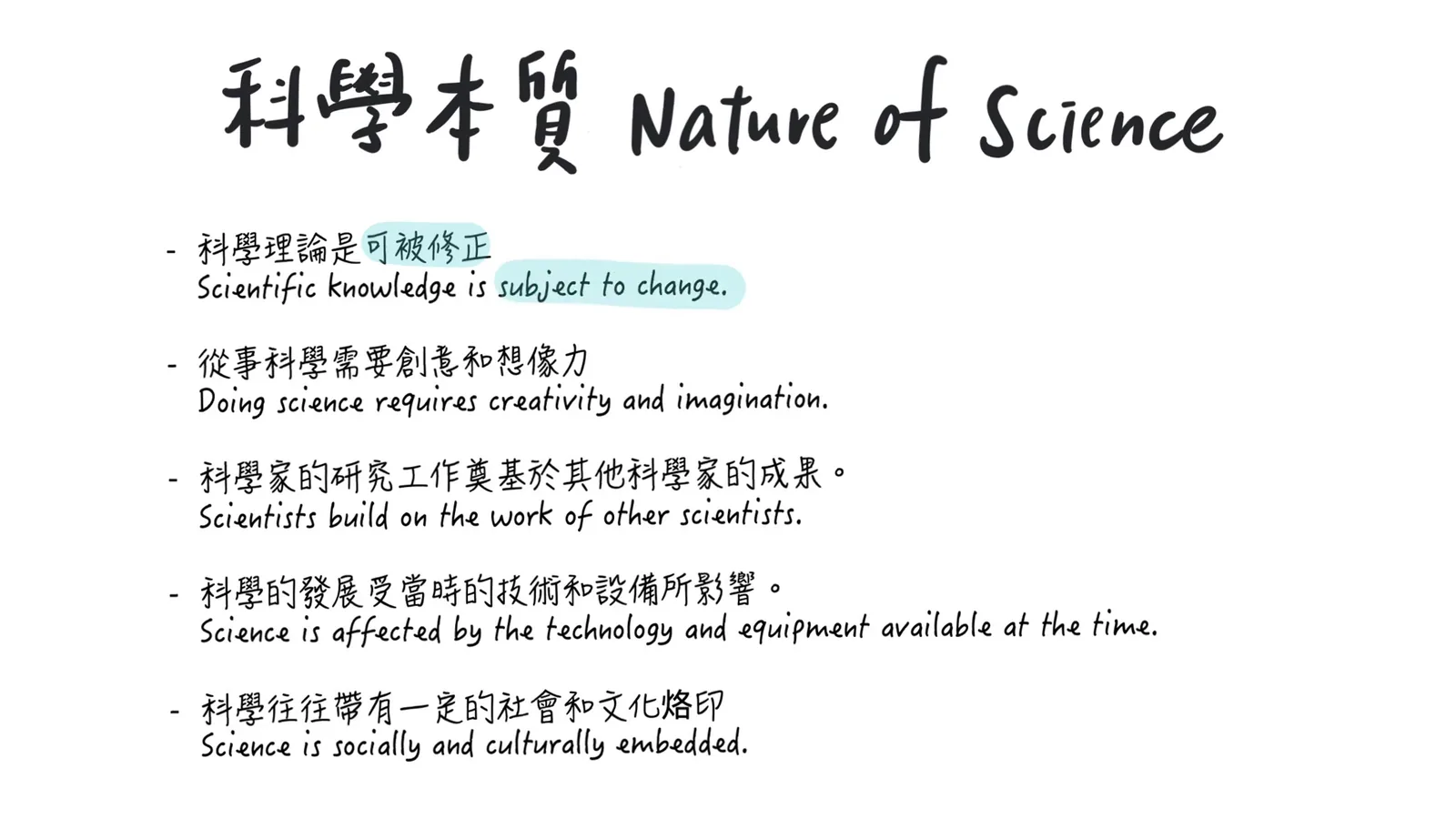
| # | Statement | 中文 |
|---|---|---|
| 1 | Scientific knowledge is subject to change | 科學理論可被修正 |
| 2 | Doing science requires creativity and imagination | 從事科學需要創意和想像力 |
| 3 | Scientists build on the work of other scientists | 科學家的研究奠基於其他科學家的成果 |
| 4 | Science is affected by the technology and equipment available at the time | 科學的發展受當時的技術和設備影響 |
| 5 | Science is socially and culturally embedded(受社會文化影響) | 科學往往帶有社會和文化的烙印 |
Point 4 is the one most often examined. The light microscope and later the electron microscope allowed the internal structure of cells to be seen, and the cell theory followed from that improvement in equipment.
7. Exam Traps 常錯陷阱(速查)
| Trap | The fix |
|---|---|
| Breathing out CO₂ called "respiration" | That is gas exchange. Respiration is the breakdown of food to release energy. S04 · 1:02 |
| Faeces described as excretion | Undigested food is egested. If it never entered metabolism it is not a metabolic waste(代謝廢物). S06 · 2:17 |
| Controlled variable swapped with control group | A variable is a factor kept constant; a group is a set-up lacking the factor. S10 · 5:52 S12 · 7:54 |
| Two independent variables in one experiment | Only one is allowed, or the result cannot be attributed. |
| Control group described as "no apparatus" | It must be identical to the experimental group except for the factor under investigation. S12 · 7:54 |
| Growth defined only as "getting bigger" | Must include increase in complexity. S03 · 0:44 |
8. How this chapter connects forward
The teacher closed by pointing out that these ideas recur, in more depth, in later topics: S01 · 0:00
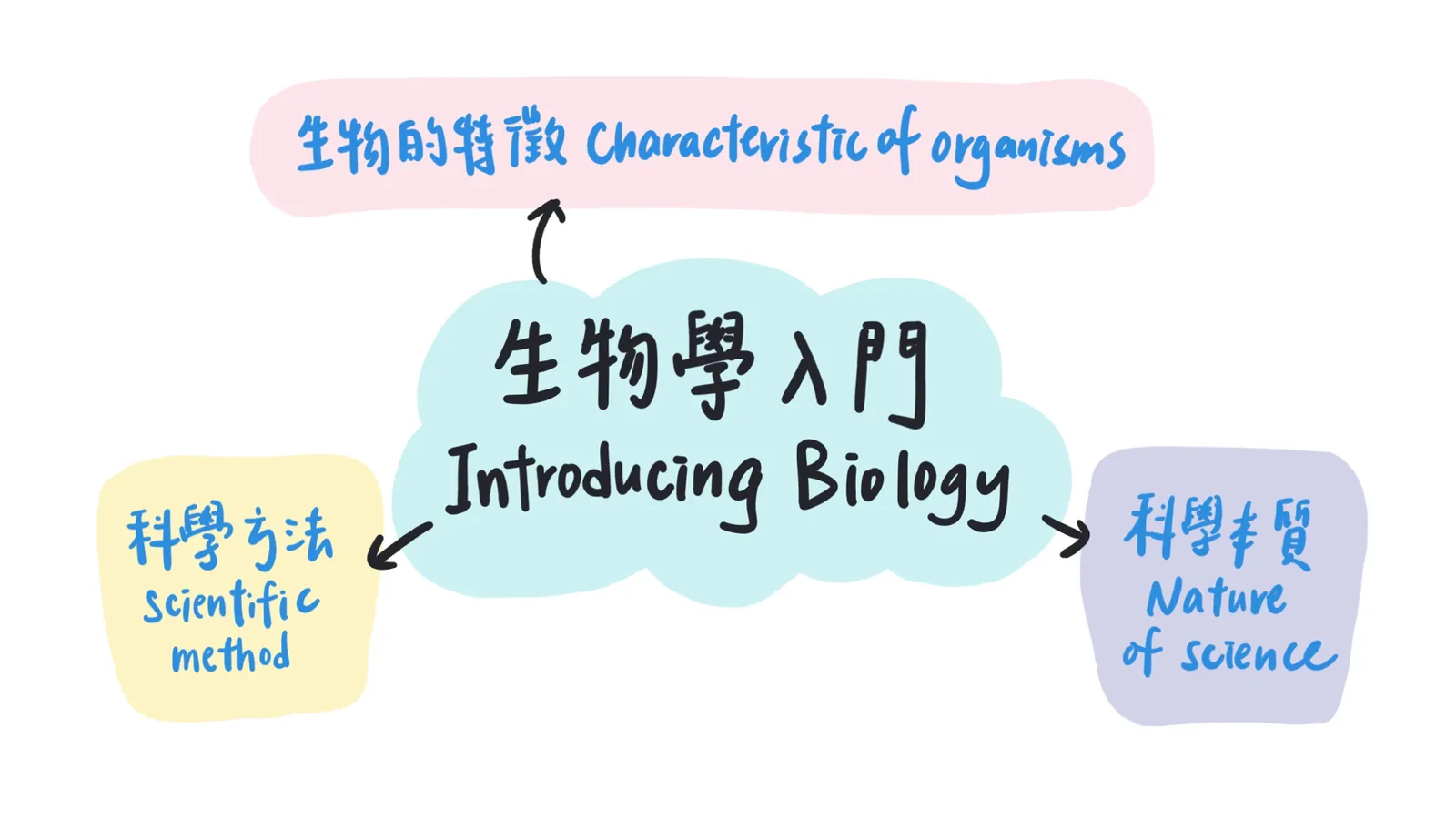
- Excretion and a constant internal environment(內在環境) → Homeostasis
- Scientific method(科學方法) and variables → experimental-design questions in Paper 1, and the SBA investigation report
- Obtaining food and respiration → Nutrition, Photosynthesis, Respiration
因此這一課不宜略過,宜先把變量的寫法練熟。老師亦提到變量的詳細書寫技巧另有專段講解。