Bacterial (prokaryotic) cell wall is made of cellulose→The cell wall of bacteria is NOT made of cellulose(細菌(原核細胞)嘅細胞壁唔係由纖維素組成)
坊間筆記成日將「細胞壁=纖維素」套落所有細胞。植物細胞壁先係纖維素;細菌嘅細胞壁唔係(成份超出 DSE 範圍,只需答唔係纖維素)。老師喺投影片特登用 ✗ 標明 cellulose 係錯。
出處 Source:L02 投影片 S21(原核細胞 Prokaryotic cells);官方範圍 Topic I(b)
Animal cells have no vacuoles→Animal cells have small and few vacuoles(動物細胞有液泡——只係少量、細粒)
坊間筆記成日話「動物細胞冇液泡」。老師明確講:動物細胞有液泡,只係好少量同好細粒;植物細胞先至有大液泡 large vacuole。答「冇」會被判錯。
出處 Source:L02 投影片 S12(Animal Cell:Vacuole — Small and few in animal cells)
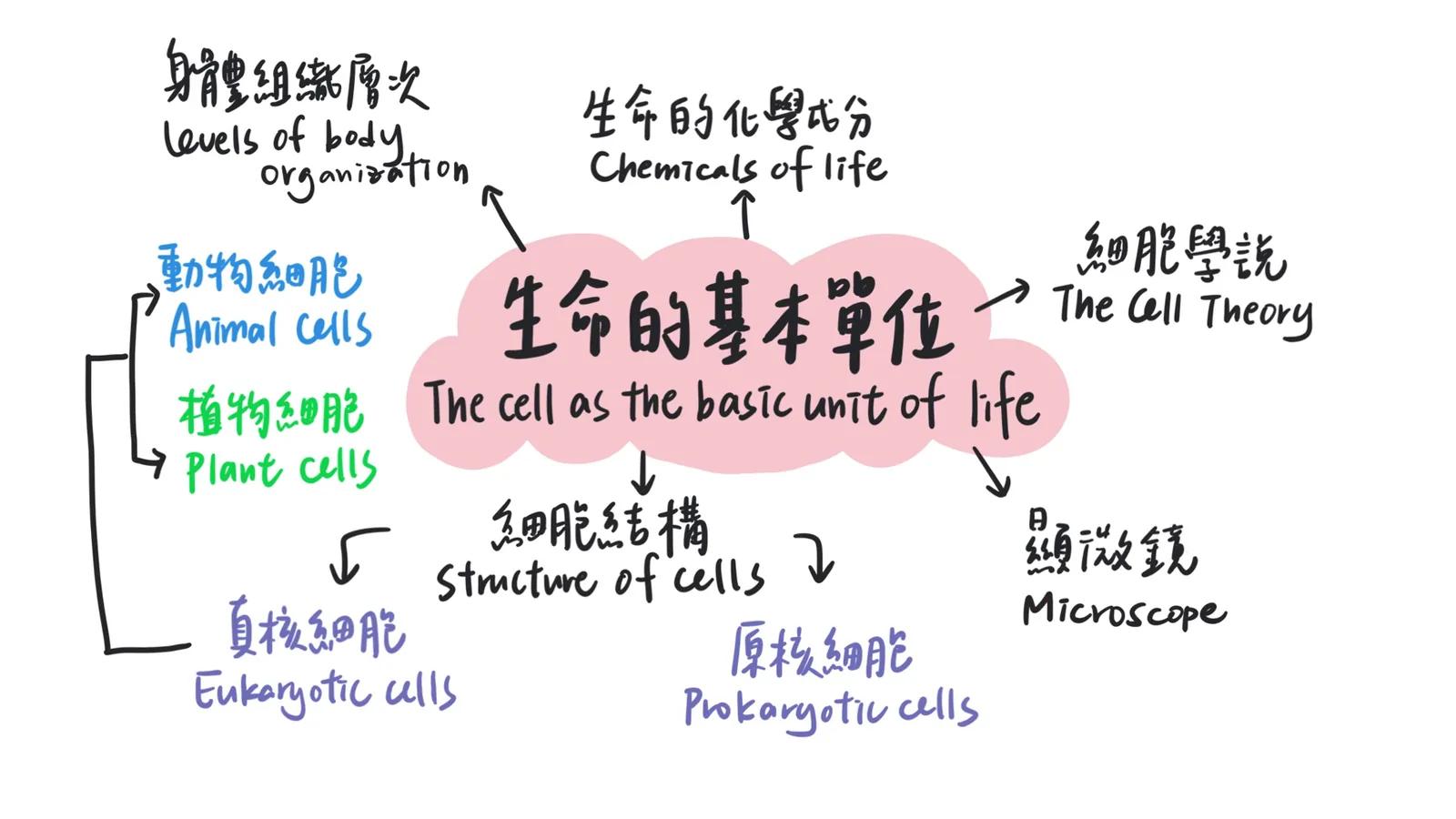
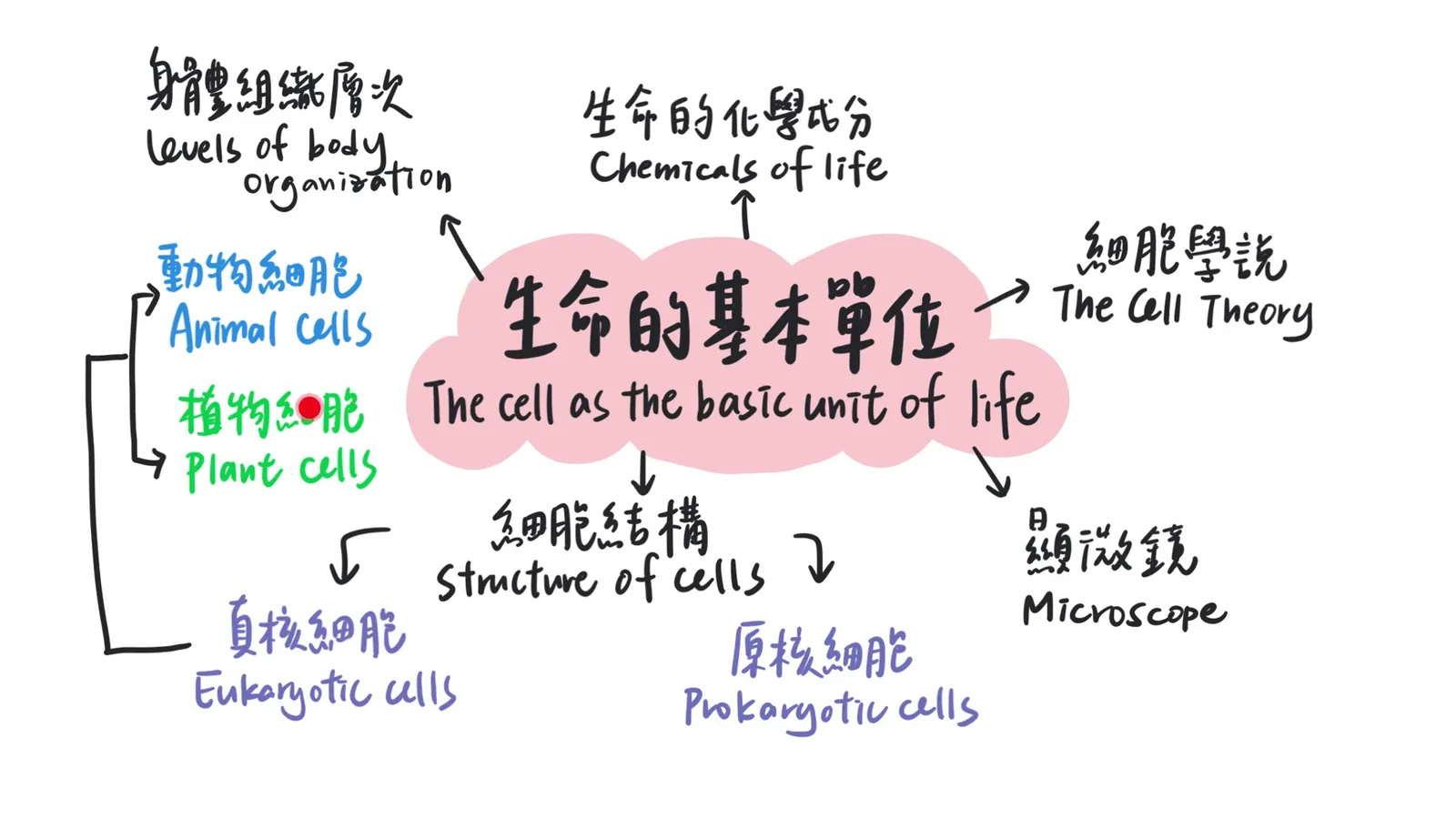
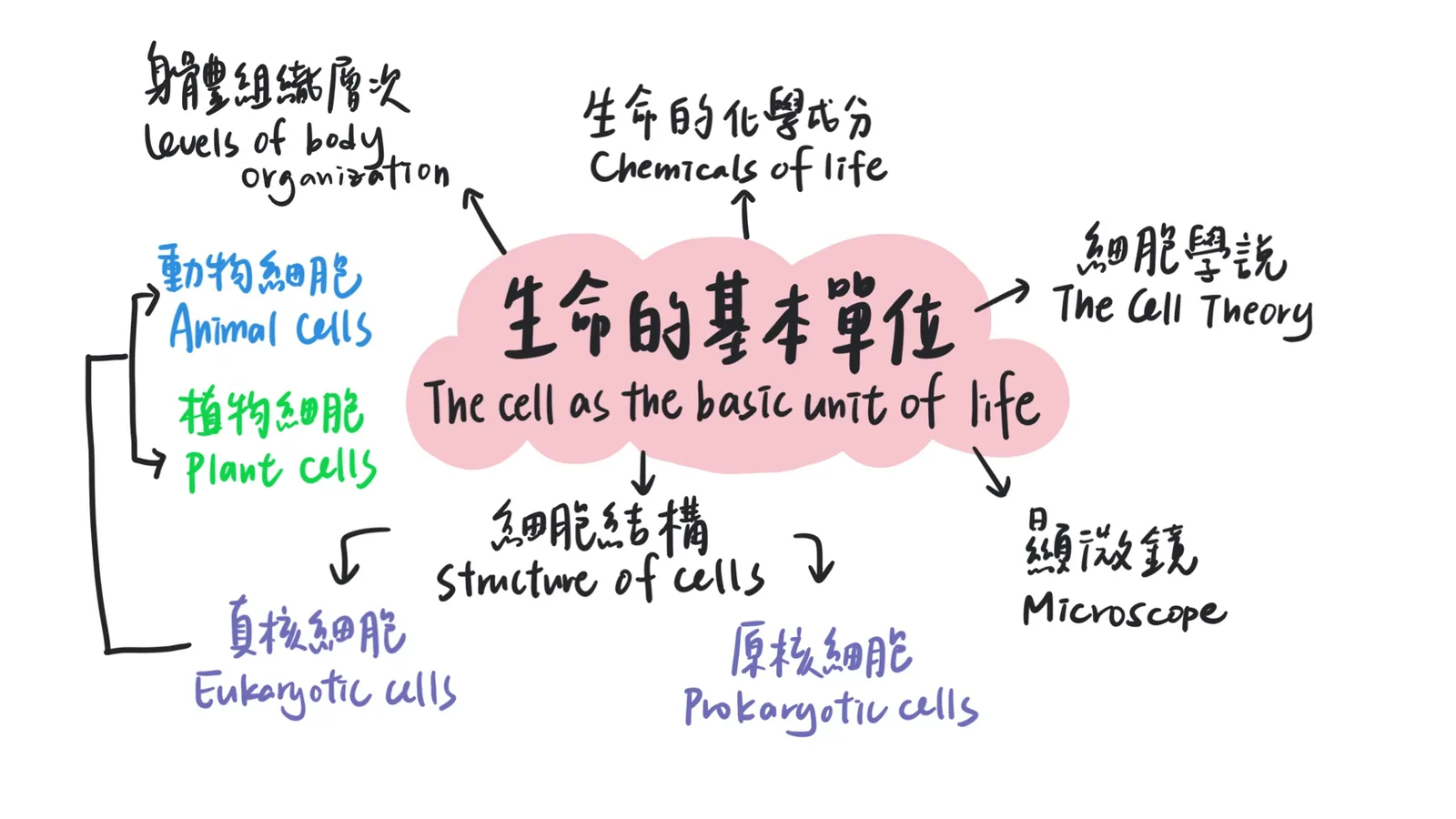
Everything met later in this course — digestion, gas exchange, transport in plants — happens inside cells. This lesson builds the foundation: what living matter is made of, the cell theory(細胞學說), the tools used to see cells, and the structures of animal, plant and prokaryotic cells. S01 · 0:00
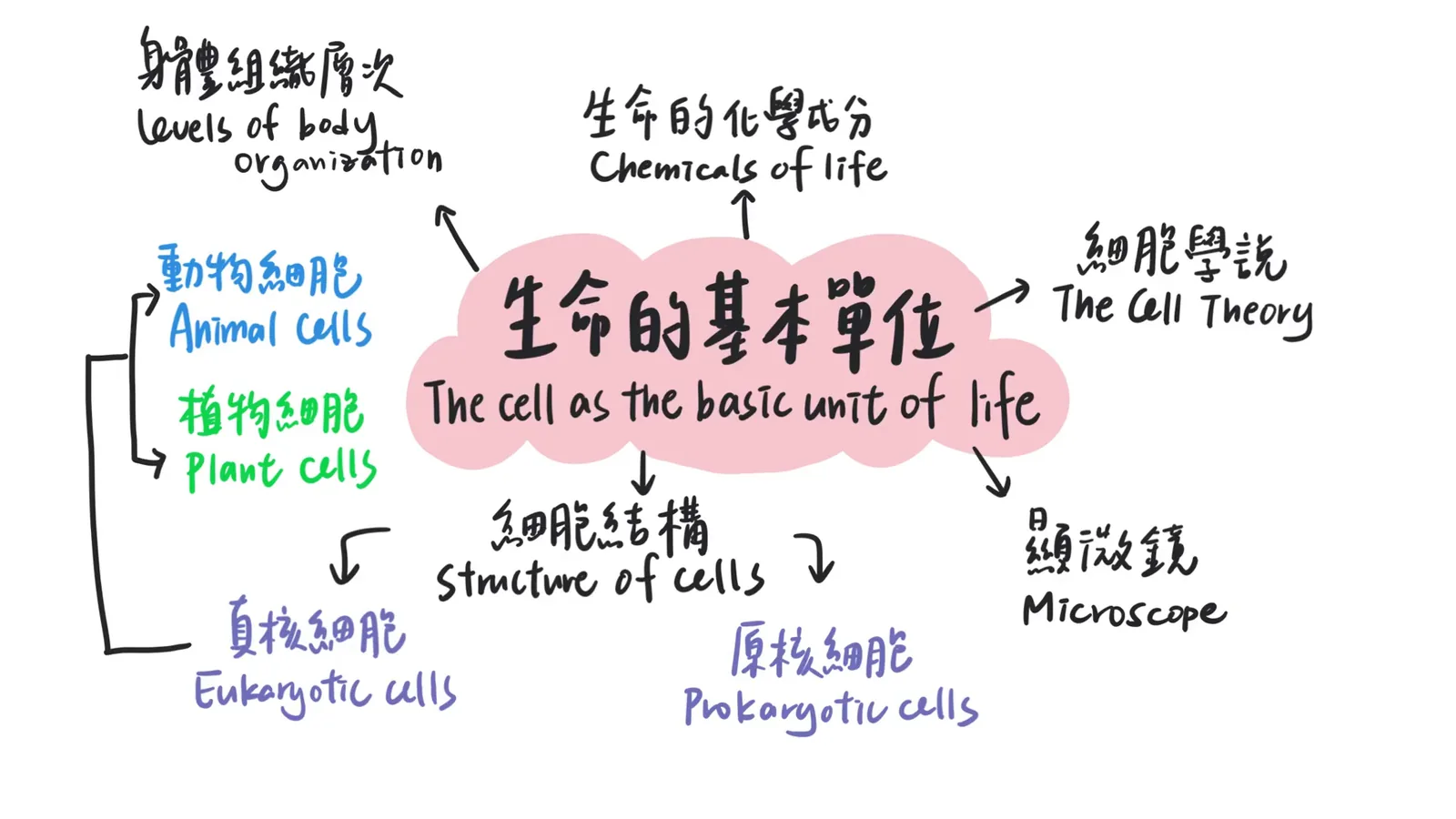
這一課是整個課程的地基:先講生命由什麼物質構成(有機物/無機物),再講細胞學說,然後是觀察細胞的工具(光學/電子顯微鏡),最後是動物細胞、植物細胞、原核細胞的結構,以及由細胞到生物的組織層次。之後每一課都在這個框架上蓋樓。
1. Chemicals of life 生命的化學基礎 S02 · 0:06
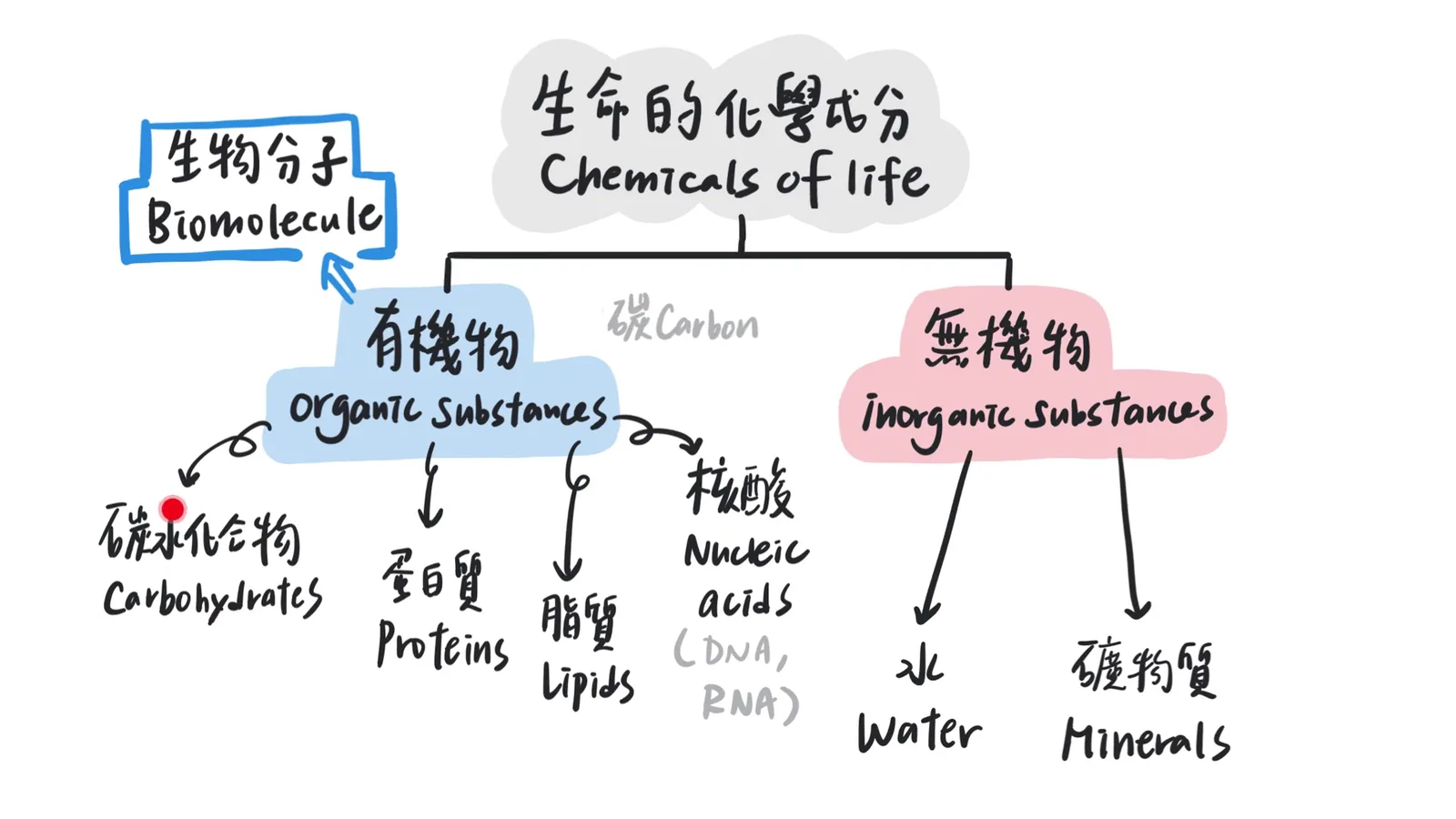
Living matter is built from two groups of chemicals. S02 · 0:06
| Group | Meaning | Examples |
|---|---|---|
| Organic substances 有機物 | carbon-containing 含碳 | carbohydrates 碳水化合物, proteins 蛋白質, lipids 脂質, nucleic acids 核酸 (DNA and RNA) |
| Inorganic substances 無機物 | no carbon basis | water 水, minerals 礦物質 |
The four organic groups are together called biomolecules 生物分子. The role of each one is covered in later lessons.
有機物=含碳物質,四大類:碳水化合物、蛋白質、脂質、核酸(DNA、RNA),合稱生物分子。無機物先記水同礦物質。每種嘅詳細功能留待之後課題。
2. The Cell Theory 細胞學說 S03 · 0:48
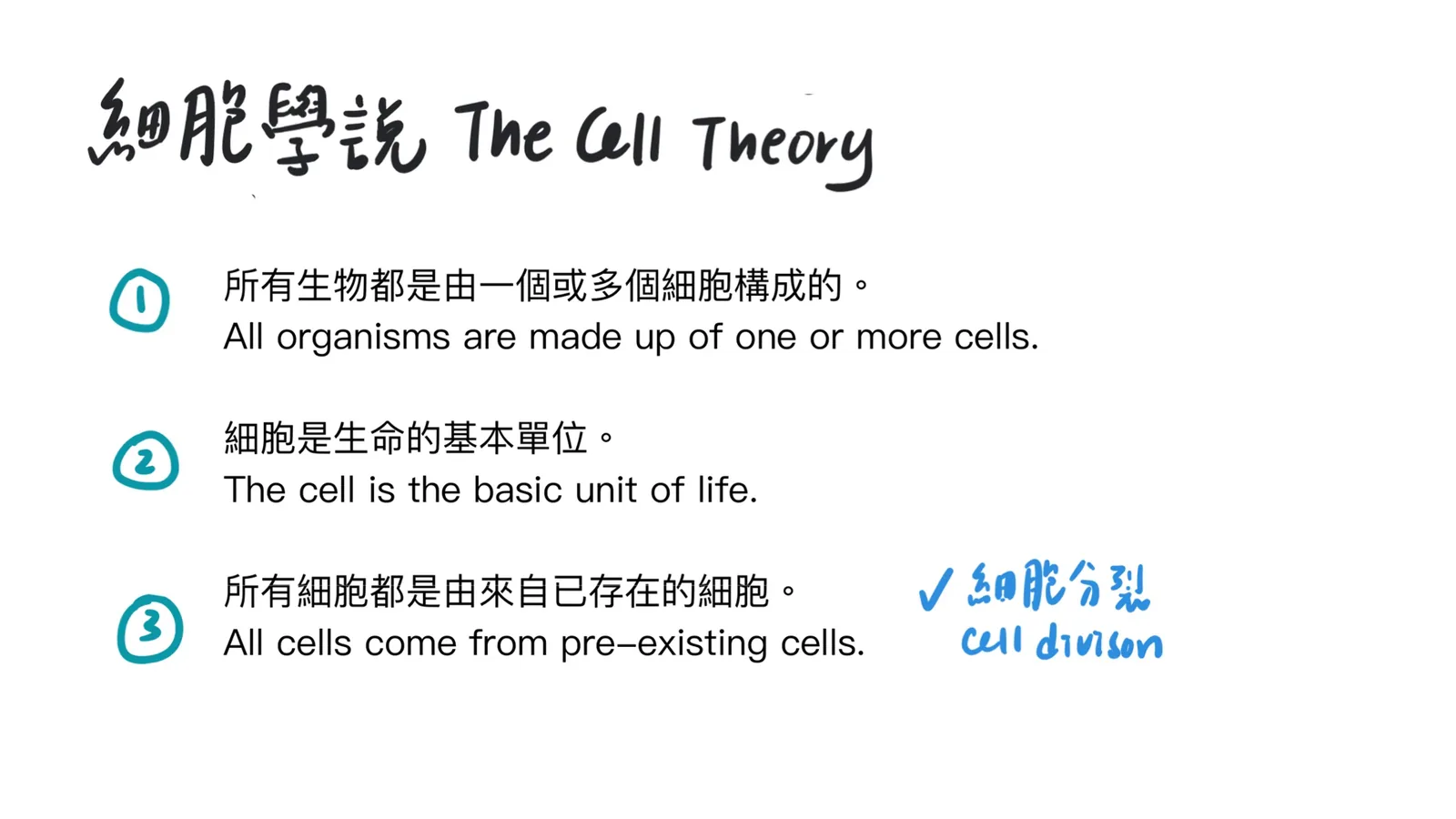
Three statements — learn them word for word, because they can be asked directly. S03 · 0:48
- All organisms are made up of one or more cells.
- The cell is the basic unit of life.
- All cells come from pre-existing cells — new cells arise by cell division, never from nothing.
三句要一字一句背:① 所有生物由一個或多個細胞組成;② 細胞係生命嘅基本單位;③ 所有細胞來自已存在嘅細胞(靠細胞分裂產生,唔係無中生有)。
3. The microscope 顯微鏡
Cells are far too small for the naked eye, so this course leans on two families of microscopes. The official guide also expects the practical skills: preparing temporary mounts, observing, and drawing under the light microscope(光學顯微鏡).
Light microscope vs electron microscope 光學與電子顯微鏡 S05 · 1:36
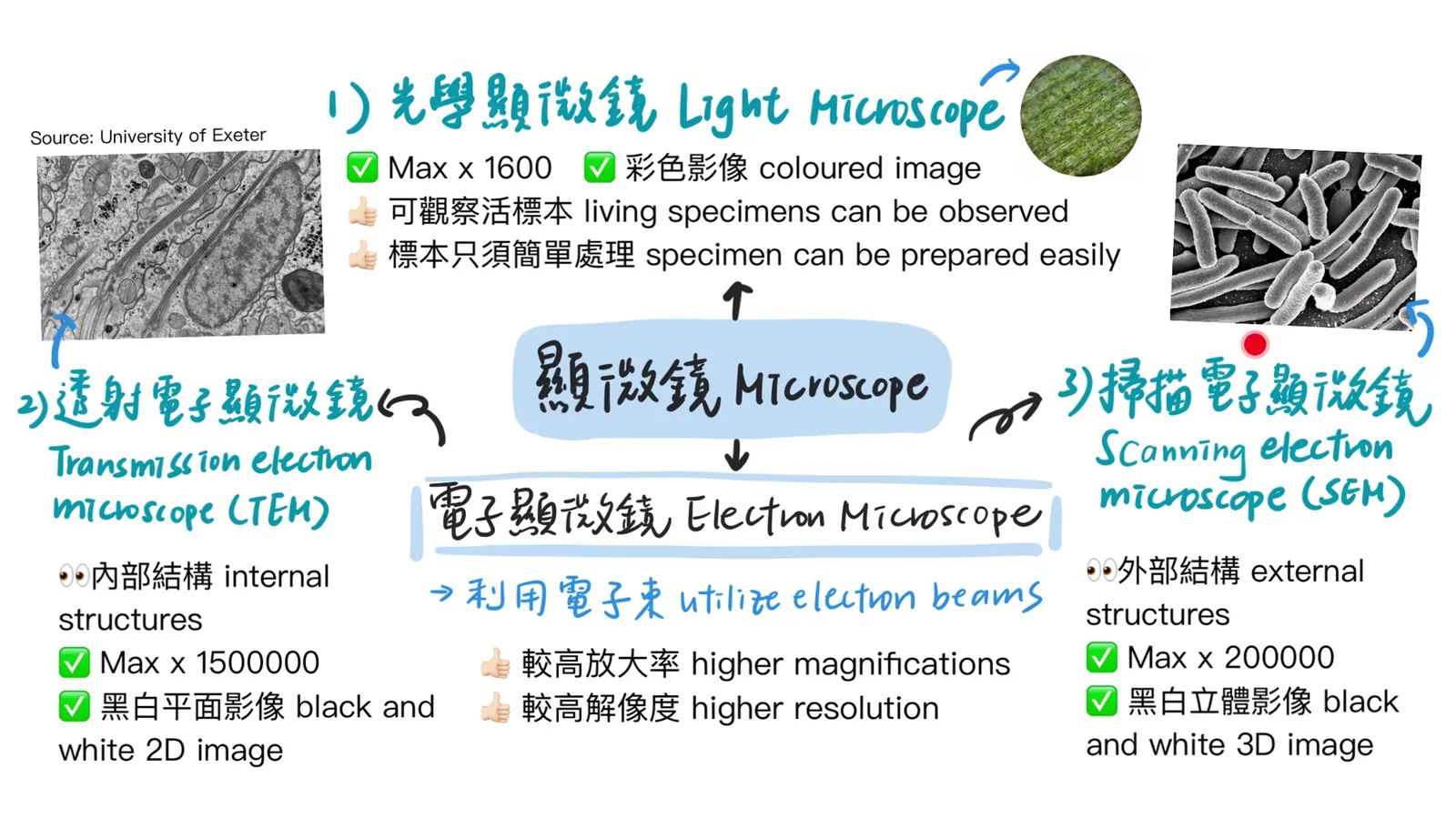
| Light microscope 光學顯微鏡 | Electron microscope 電子顯微鏡 | |
|---|---|---|
| Image formed by | light 光 | electron beams 電子束 |
| Maximum magnification | ×1600 | ×1,500,000 (TEM) or ×200,000 (SEM) |
| Image | coloured 彩色 | black and white 黑白 only |
| Living specimen | can be observed 可以觀察活標本 | cannot — preparation kills the cell 會殺死細胞 |
| Preparation of specimen | simple 簡單 | complex 繁複 |
The electron microscope wins on higher magnification 較高放大率 and higher resolution 較高解像度 — the ability to show fine details separately.
光鏡用光、彩色影像、可以睇活標本、標本製作簡單,但最高只有 ×1600。電鏡用電子束,放大率同解像度都高得多,但只有黑白影像,製作過程繁複而且會殺死細胞。兩款各有好處,唔好以為電鏡全面勝出——「可以觀察活標本」正係光鏡嘅殺著。
TEM and SEM 透射與掃描電子顯微鏡 S05 · 1:36
| TEM 透射電子顯微鏡 | SEM 掃描電子顯微鏡 | |
|---|---|---|
| Shows | internal structures 內部結構 | external structures 外部結構 |
| Maximum magnification | ×1,500,000 | ×200,000 |
| Image | black and white, 2-D 平面 | black and white, 3-D 立體 |
- T = Transmission = through = look inside(內部結構,2-D)
- S = Scanning = surface = look outside(外部結構,3-D)
- Both give black-and-white images only
兩款電鏡都係黑白。分別記一個字:Transmission 透射=睇內部、平面;Scanning 掃描=掃表面、立體。最高倍數唔好調轉:TEM ×1,500,000 遠高過 SEM ×200,000。
Structure of the light microscope 光學顯微鏡的結構 S06 · 3:30
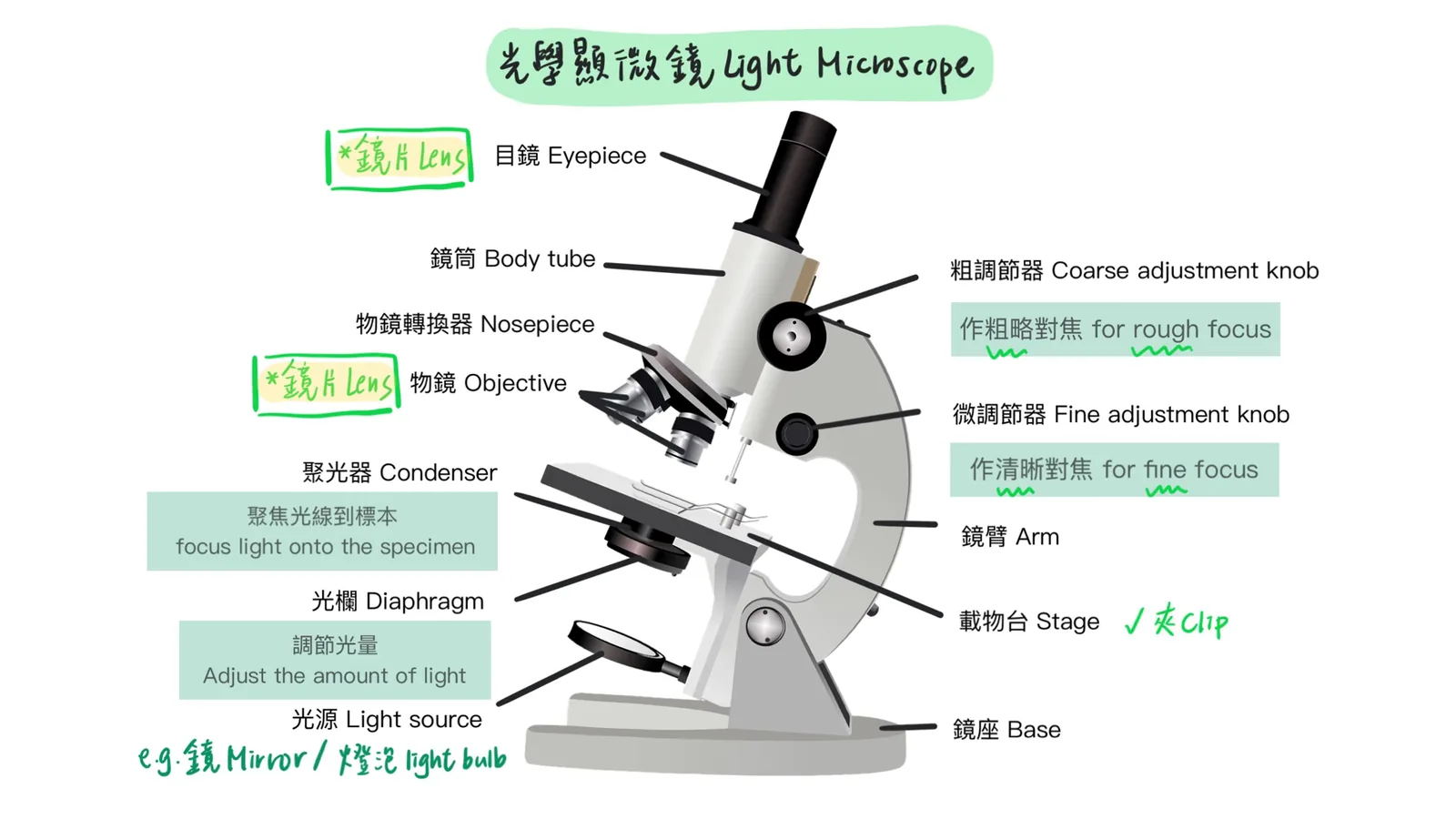
| Part | Function |
|---|---|
| Eyepiece 目鏡 | the first lens 鏡片 at the top — the part you look into |
| Body tube 鏡筒 | holds the eyepiece above the objectives |
| Objective 物鏡 | the second lens — magnifies the specimen |
| Nosepiece 物鏡轉換器 | revolving holder — turn it to select a different objective |
| Coarse adjustment knob 粗調節器 | for rough focus 粗略對焦 (the larger knob) |
| Fine adjustment knob 微調節器 | for fine focus 清晰對焦 (the smaller knob, moves the stage(載物台) a little) |
| Stage 載物台 | holds the slide 玻片, kept in place by clips 夾 |
| Condenser 聚光器 | focuses light onto the specimen 聚焦光線到標本 |
| Diaphragm 光欄 | adjusts the amount of light 調節光量 |
| Light source 光源 | a mirror 鏡 or a light bulb 燈泡 |
| Arm 鏡臂 and Base 鏡座 | when carrying: one hand holds the arm, the other supports the base |
呢個表要背。最易混淆嘅兩個:condenser 聚光器(將光聚焦落標本)同 diaphragm 光欄(調節光量多寡)。兩個旋鈕:coarse 粗對焦、fine 微對焦。搬顯微鏡一定係一手握鏡臂、一手托鏡座。
Total magnification 總放大率 S07 · 5:37
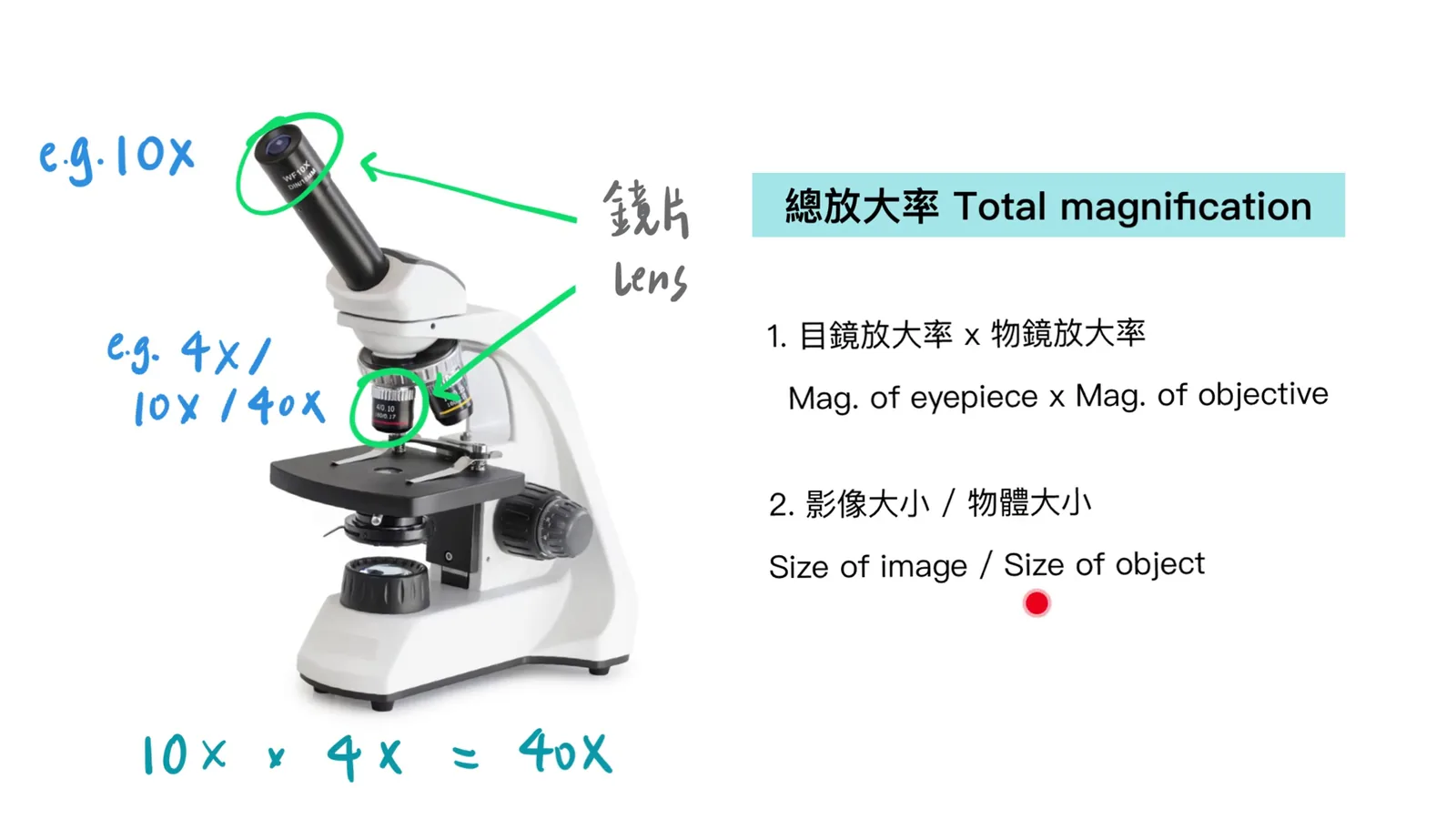
Total magnification = magnification of the eyepiece × magnification of the objective S07 · 5:37
Example: a ×10 eyepiece with a ×4 objective gives ×40 in total.
Because magnification is a ratio, there is a second formula:
Magnification = size of image ÷ size of object
- Asked for total magnification(總放大率) → multiply the two lens values
- Asked for the actual size of the object → rearrange: size of object = size of image ÷ magnification
- The size of the image is measured from the drawing with a ruler
第一條式計總放大率(目鏡 × 物鏡)。第二條式係「放大率=影像大小 ÷ 物體大小」,通常總放大率同影像大小都易搵,所以條式多數用嚟計返物體嘅真實大小:物體大小=影像大小 ÷ 放大率。
Using the high-power objective 高倍鏡觀察技巧 S08 · 6:44
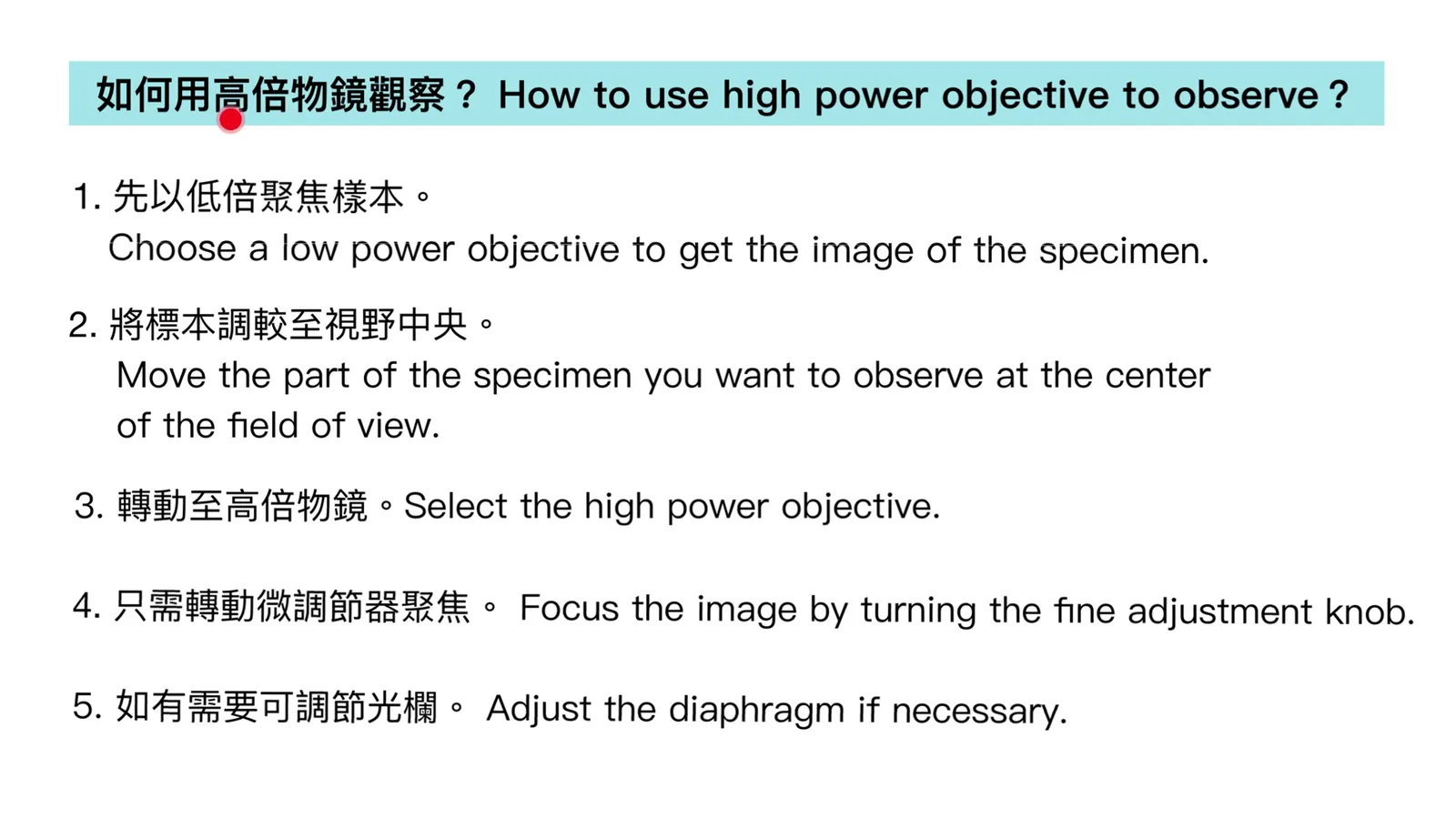
Five steps, in this order S08 · 6:44:
- Choose a low power objective to get the image of the specimen — never start at high power.
- Move the desired part of the specimen to the centre of the field of view 移到視野中央.
- Select the high power objective.
- Focus the image by turning the fine adjustment knob only — a coarse turn at high power can crash the objective into the slide.
- Adjust the diaphragm if necessary — the image is dimmer at high power, so allow in more light.
次序:低倍先搵到影像 → 將想睇嘅部分移到視野中央 → 轉高倍物鏡 → 只可以用微調節器對焦 → 有需要就調較光欄(高倍會暗)。實驗卷成見考「排次序」同「點解唔可以用粗調節器」。
The image under the microscope 顯微鏡下的影像 S09 · 7:39
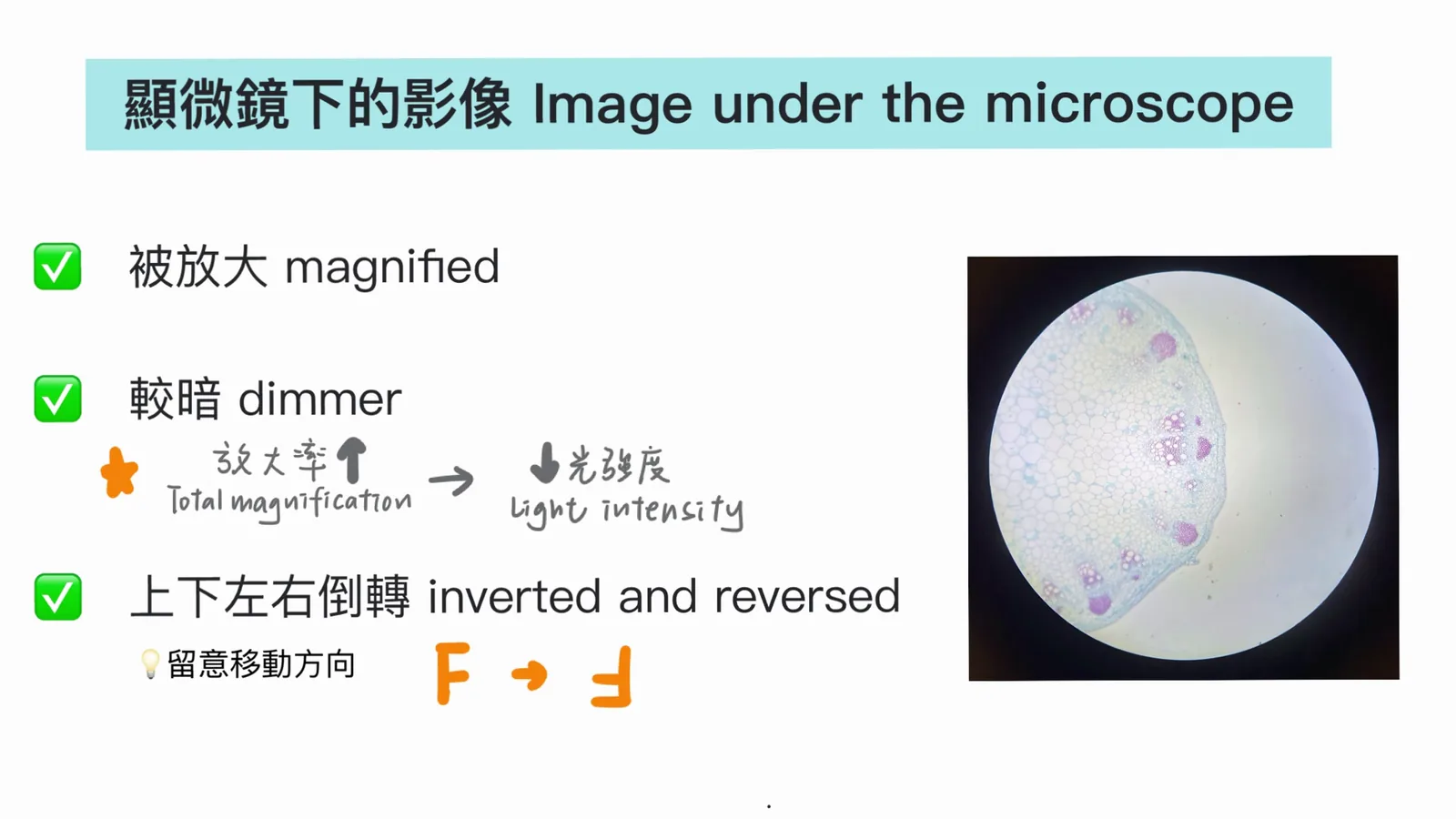
Three features, all examinable S09 · 7:39:
- Magnified 被放大
- Dimmer 較暗 — the higher the magnification, the fewer light rays enter the eye; open the diaphragm to compensate
- Inverted and reversed 上下左右倒轉 — the image is rotated 180°, so the letter p is seen as d
Because the image is inverted and reversed, the image always moves in the opposite direction to the slide: to move the image to the right, move the slide to the left; to move the image down, move the slide up.
三個特徵:被放大、較暗(越高倍光線越少,要開大光欄補救)、上下左右倒轉(p 字望落似 d 字)。因為倒轉咗,影像移動方向同玻片永遠相反:想影像向右,玻片向左推;想影像向下,玻片向上升。
Preparing temporary mounts 製作臨時玻片 S10 · 8:39
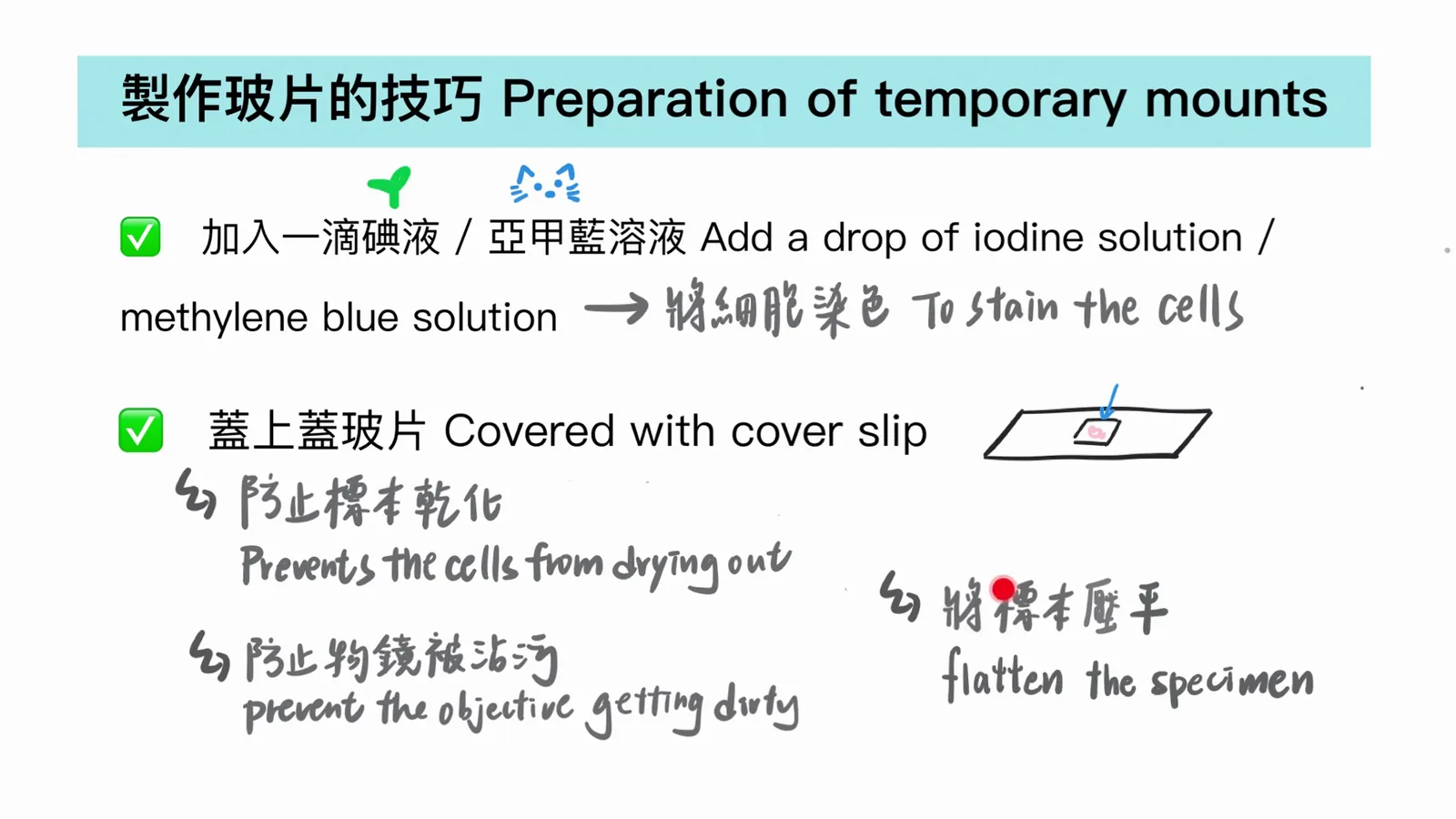
Stain the cell 染色 — most cells are almost colourless, so a stain is added S10 · 8:39:
- plant cells → iodine solution 碘液
- animal cells → methylene blue 亞甲藍溶液
Cover with a coverslip 蓋上蓋玻片 — three functions:
- prevents the cell from drying out 防止細胞乾涸
- prevents the specimen from touching the objective — keeps the objective clean 保護物鏡不被沾污
- flattens the specimen 攤平標本
染色:植物細胞用碘液、動物細胞用亞甲藍溶液(唔好調轉)。蓋玻片三大功能:防止乾涸、防止標本直接掂到物鏡(保護物鏡)、攤平標本。三點都要識寫全。
4. Eukaryotic cells: animal and plant 真核細胞:動物與植物
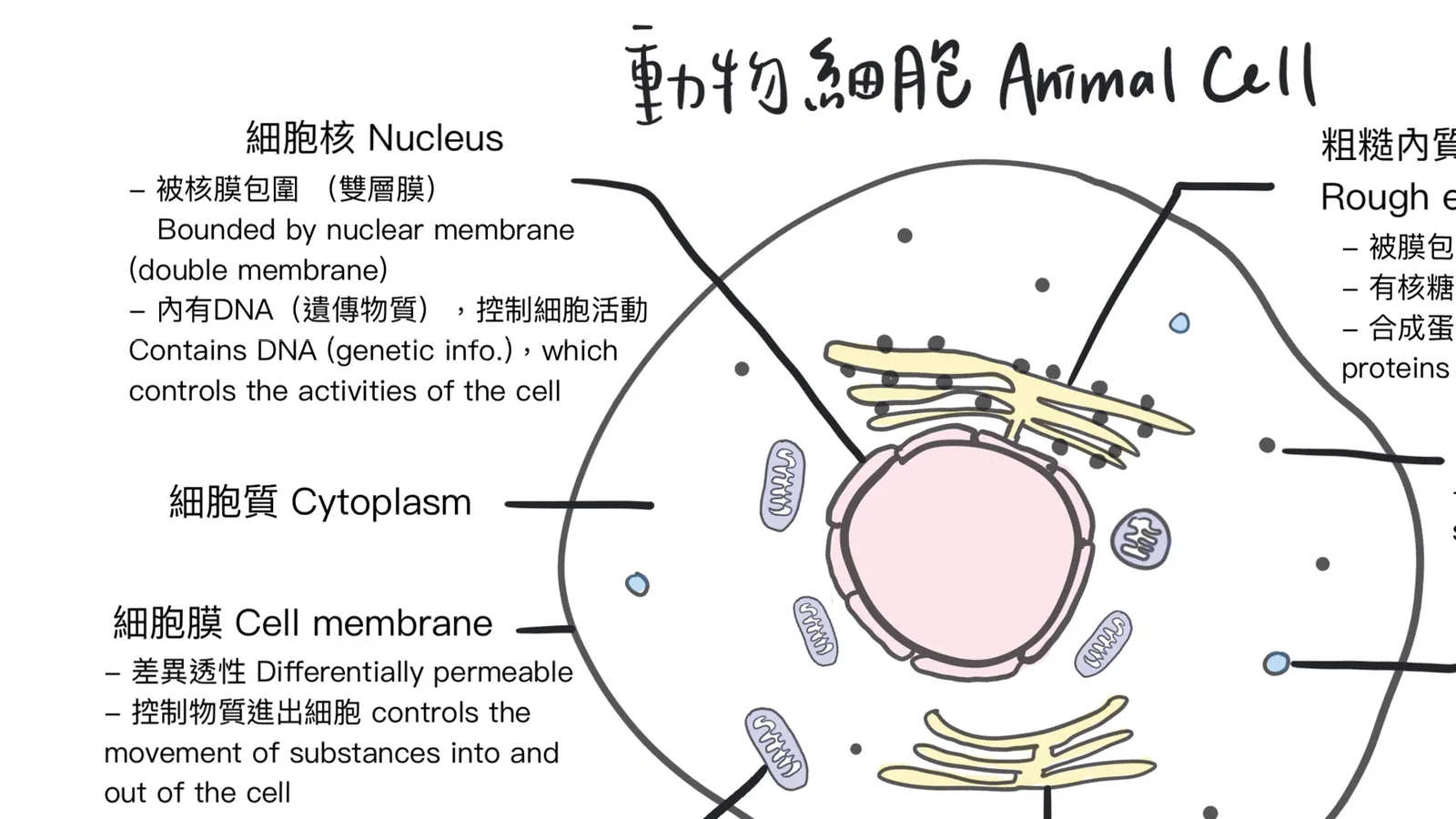
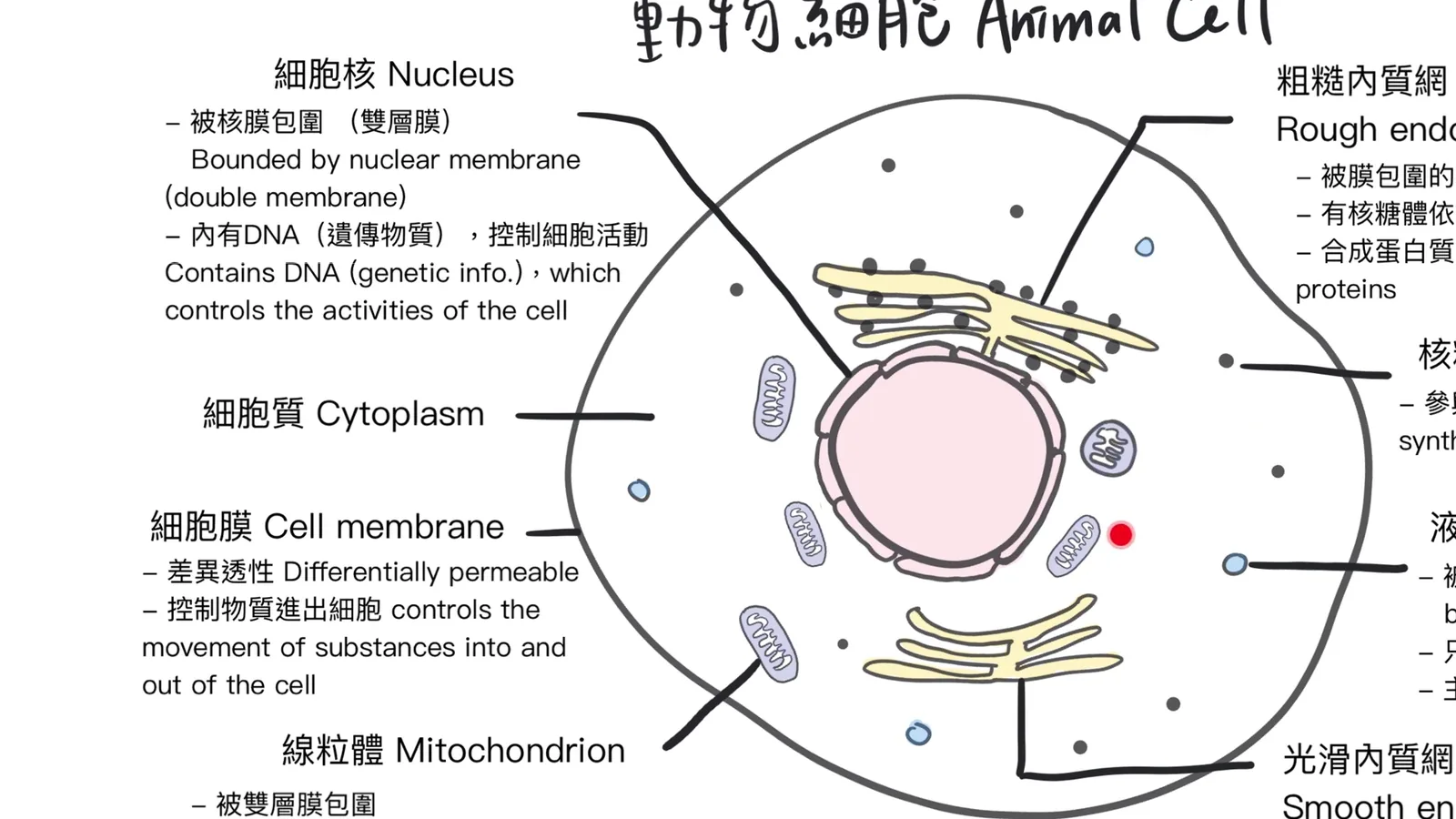
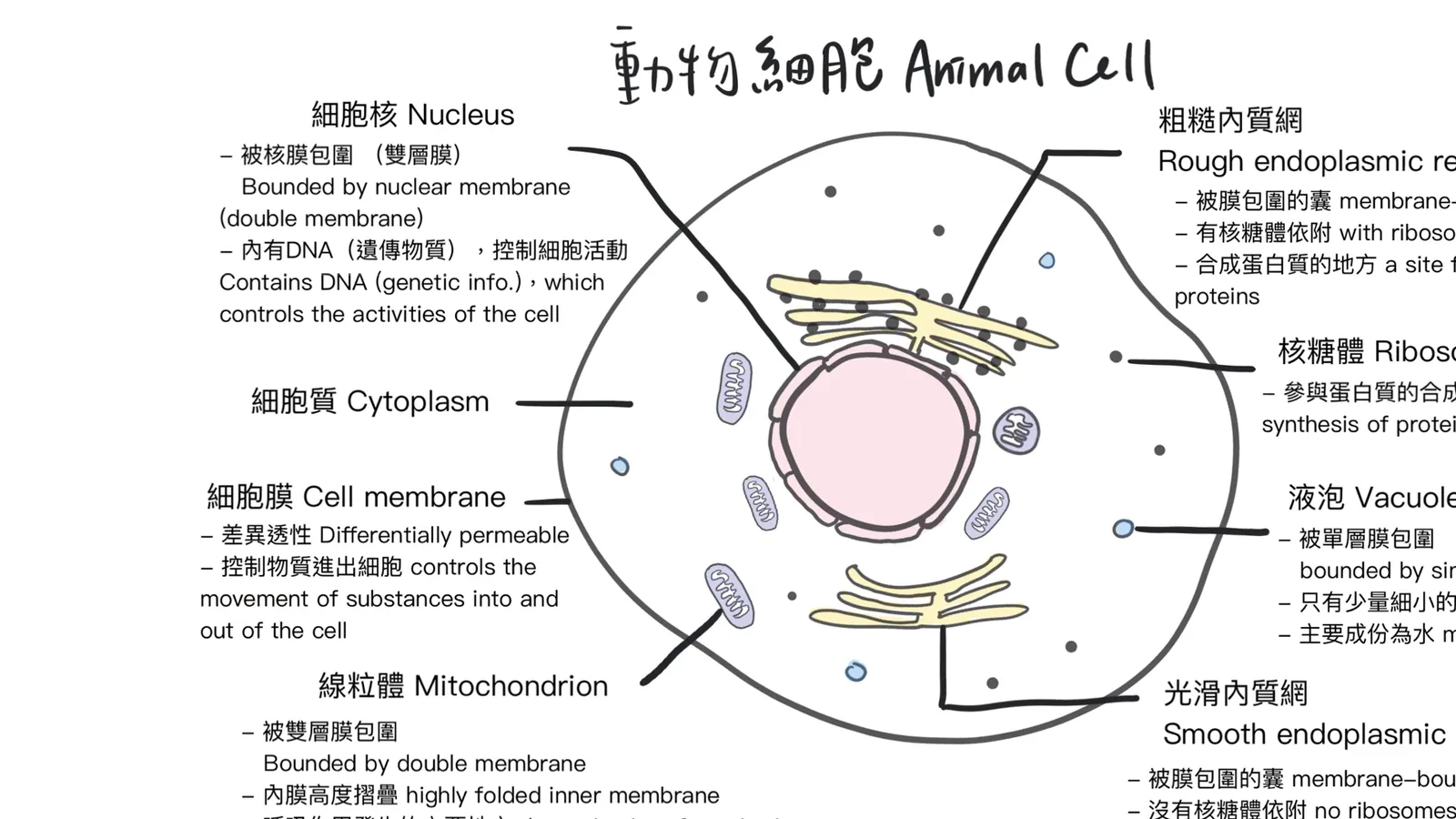
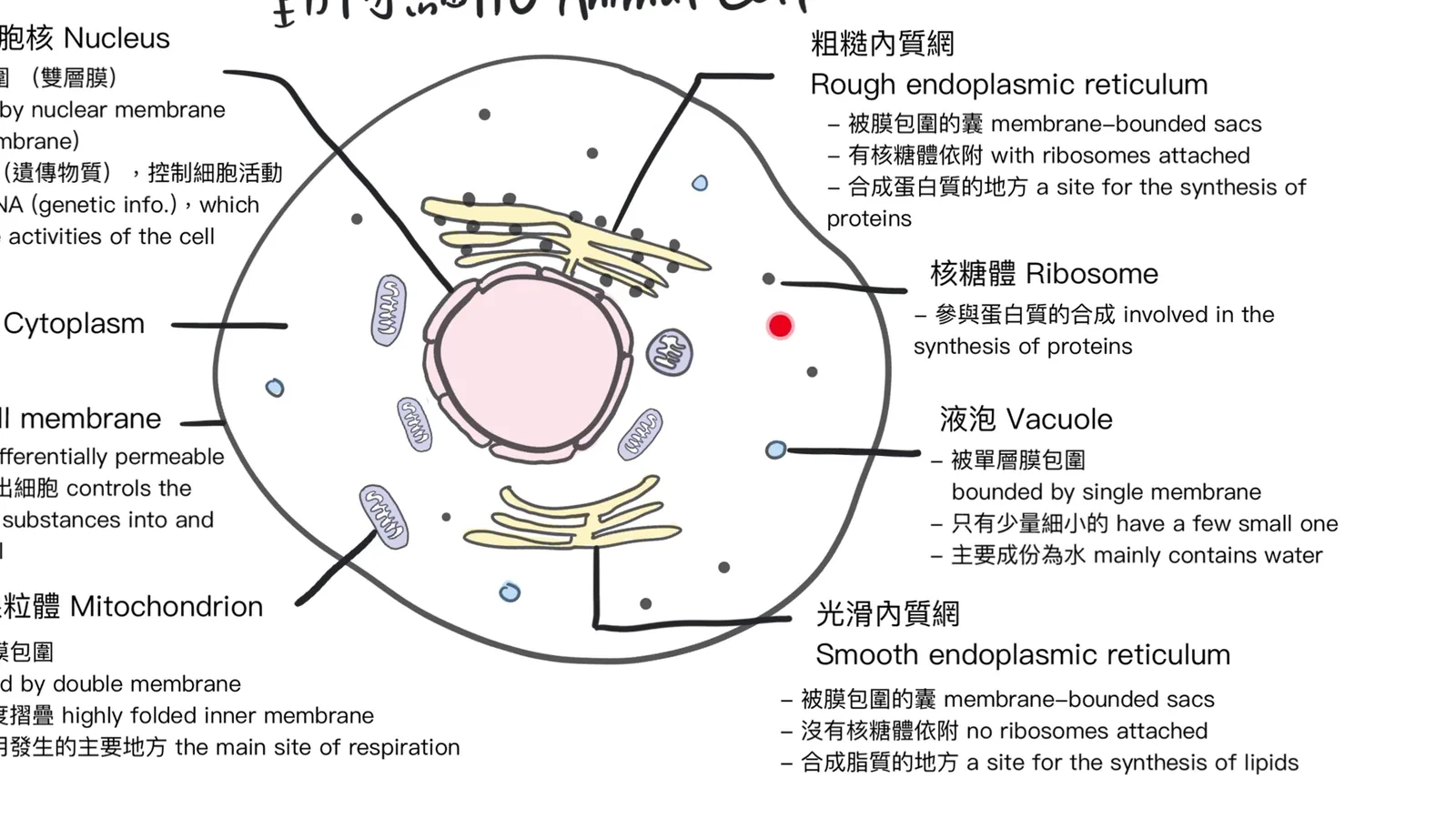
The animal cell 動物細胞 S12 · 9:43
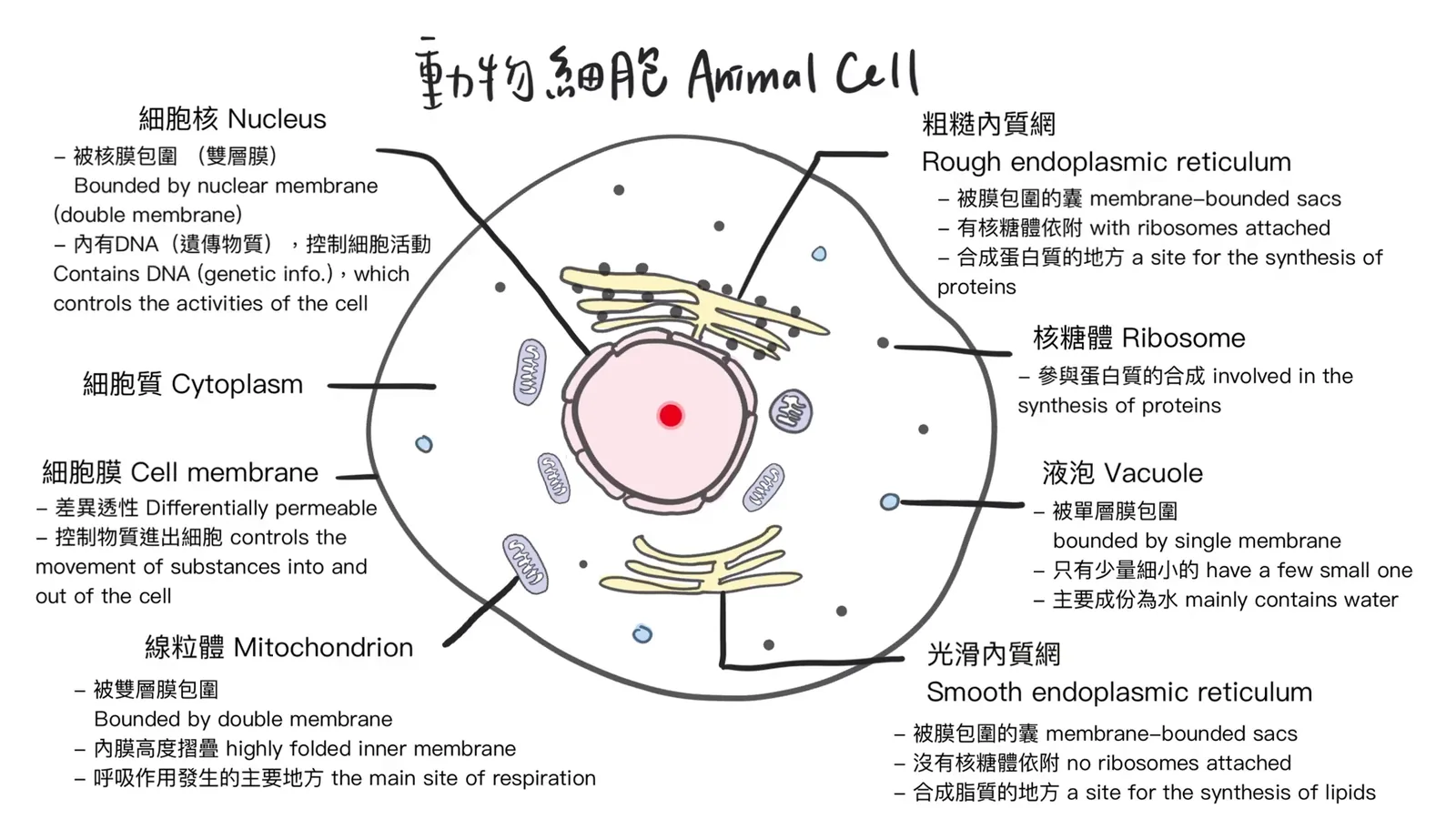
| Structure | Features | Function |
|---|---|---|
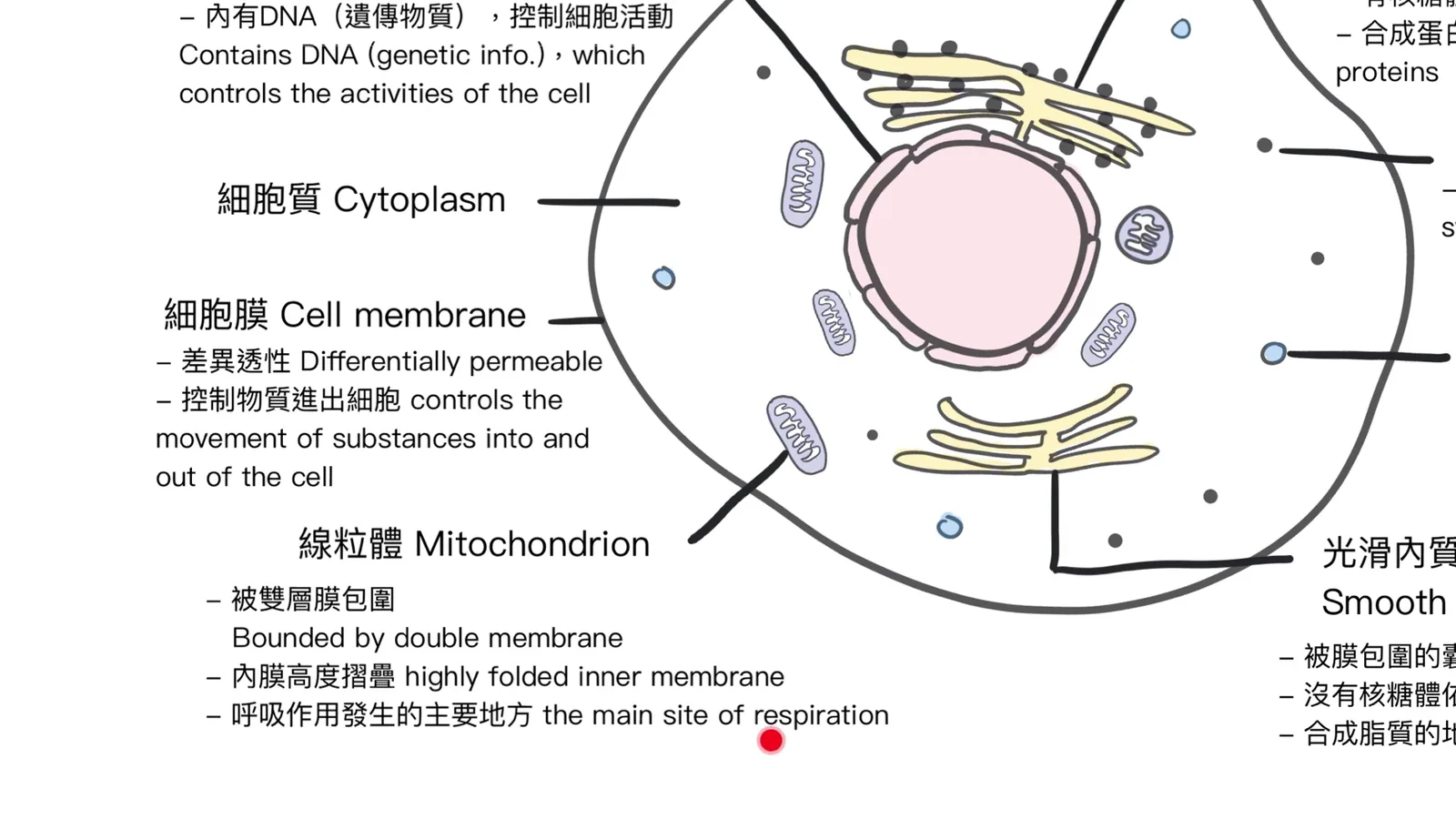
| Nucleus 細胞核 | surrounded by the nuclear membrane 核膜, a double membrane 雙層膜 | contains DNA (genetic material), which controls the cell activities 控制細胞活動 |
| Cytoplasm 細胞質 | fluid that fills up the whole cell 充滿整個細胞 | holds the organelles; site of many cell activities |
| Cell membrane 細胞膜 | differentially permeable 差異透性 | controls the movement of substances into and out of the cell |
| Mitochondrion 線粒體 | bounded by a double membrane; inner membrane is highly folded 內膜高度摺疊 | main site of respiration 呼吸作用主要場地 — releases energy for cell activities |
| Rough ER 粗糙內質網 | membrane-bound sacs with ribosomes attached 有核糖體依附 | site of protein synthesis 合成蛋白質 |
| Smooth ER 光滑內質網 | membrane-bound sacs without ribosomes 冇核糖體 | site of lipid synthesis 合成脂質 |
| Ribosome 核糖體 | tiny dots, free in the cytoplasm or attached on rough ER | involved in the synthesis of proteins |
| Vacuole 液泡 | surrounded by a single membrane 單層膜; contains cell sap 細胞液 (mainly water) | small and few in animal cells 動物細胞內少量、細小 |
動物細胞八大結構。最易亂嘅三組:① 粗糙內質網(有核糖體依附、整蛋白質)vs 光滑內質網(冇核糖體、整脂質)——千祈唔好調轉。② 核膜係雙層膜。③ 動物細胞有液泡,只係細同少;大液泡先係植物專利。
- Double membrane 雙層膜: nuclear membrane 核膜, mitochondrion 線粒體, chloroplast 葉綠體
- Single membrane 單層膜: vacuole 液泡
- No membrane 無膜: ribosome 核糖體
雙層膜三兄弟:核膜、線粒體、葉綠體。單層膜:液泡。完全冇膜:核糖體。呢個分類選擇題好常見。
The plant cell 植物細胞 S18 · 12:43
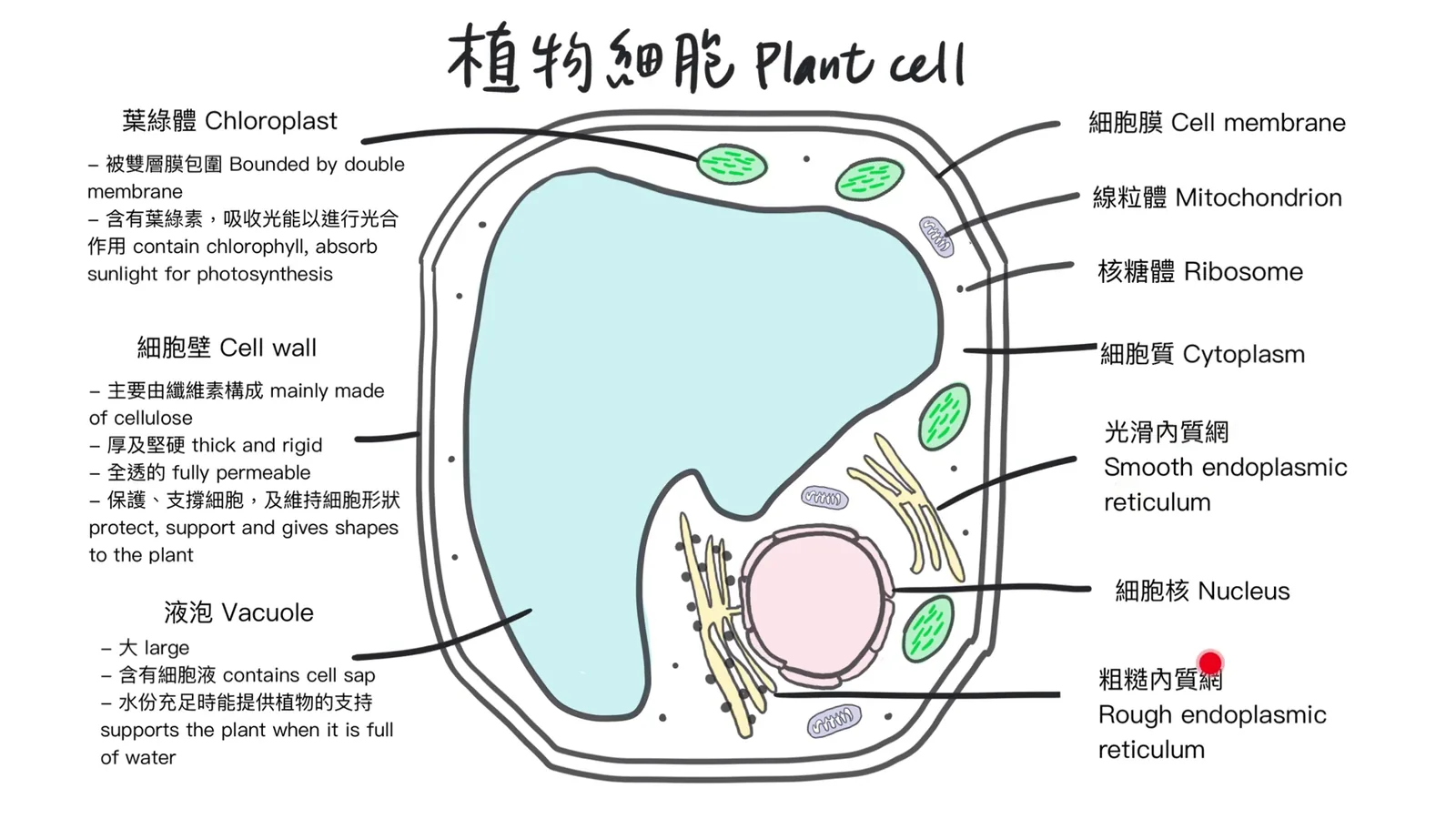
The plant cell has everything the animal cell has, plus three extra structures S18 · 12:43:
| Structure | Features | Function |
|---|---|---|
| Chloroplast 葉綠體 | bounded by a double membrane; contains chlorophyll 葉綠素 | absorbs sunlight for photosynthesis 吸收光能進行光合作用 |
| Cell wall 細胞壁 | made of cellulose 纖維素; thick and rigid 厚而堅硬; fully permeable 全透性 | protects and supports the plant cell and gives it a regular shape 保護、支撐、定形 |
| Large vacuole 大液泡 | surrounded by a single membrane; contains cell sap 細胞液 (mainly water) | supports the plant cell 當水分充足時支撐植物 |
植物細胞 = 動物細胞嗰套 + 三樣特有:葉綠體(雙層膜、有葉綠素、吸光做光合作用)、細胞壁(纖維素造、厚而硬、全透性、保護支撐定形)、大液泡(單層膜、細胞液、支撐植物)。
- The cell wall is fully permeable — all substances pass through freely
- The cell membrane is differentially permeable — it selects what passes
唔好調轉:細胞壁係全透(咩都過得),細胞膜先係差異透性(有選擇)。呢個係經典陷阱位。
Animal cell vs plant cell 動物與植物細胞對比 S19 · 14:31
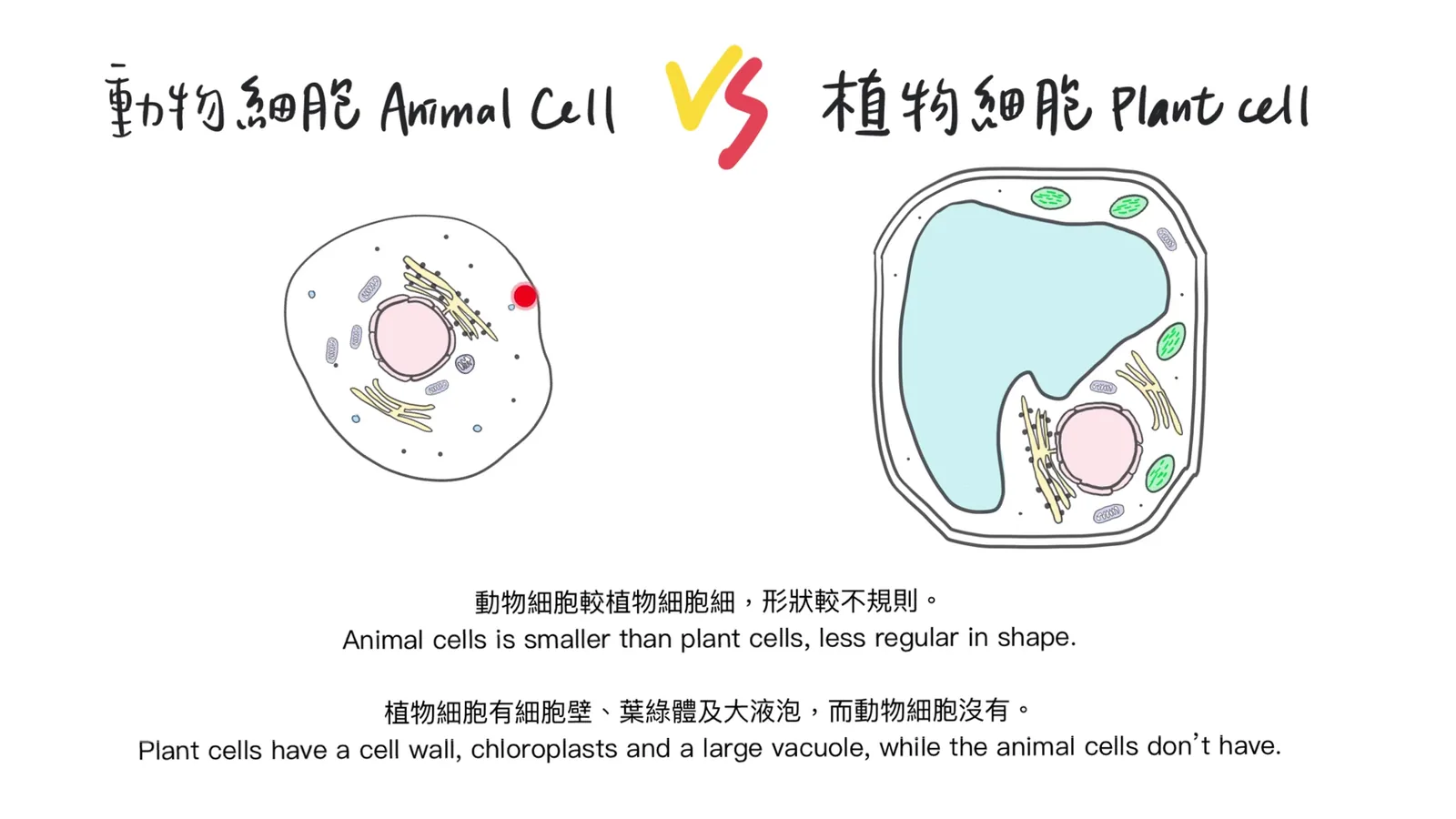
| Animal cell 動物細胞 | Plant cell 植物細胞 | |
|---|---|---|
| Size | smaller 較細 | larger 較大 |
| Shape | irregular 不規則 — no cell wall to hold the shape | regular 較規則 |
| Cell wall, chloroplasts | absent 沒有 | present 有 |
| Vacuoles | small and few 少量、細小 | one large central vacuole 大液泡 |
Plant cells have a cell wall, chloroplasts and a large central vacuole, while the animal cells do not have them. S19 · 14:31
對比四行:動物細胞較細、形狀不規則(冇細胞壁撐住)、冇細胞壁同葉綠體、液泡少而細。注意措辭:唔係「動物細胞冇液泡」,係「冇大液泡」。
Some cells have more... 細胞器數量因功能而異 S20 · 14:55
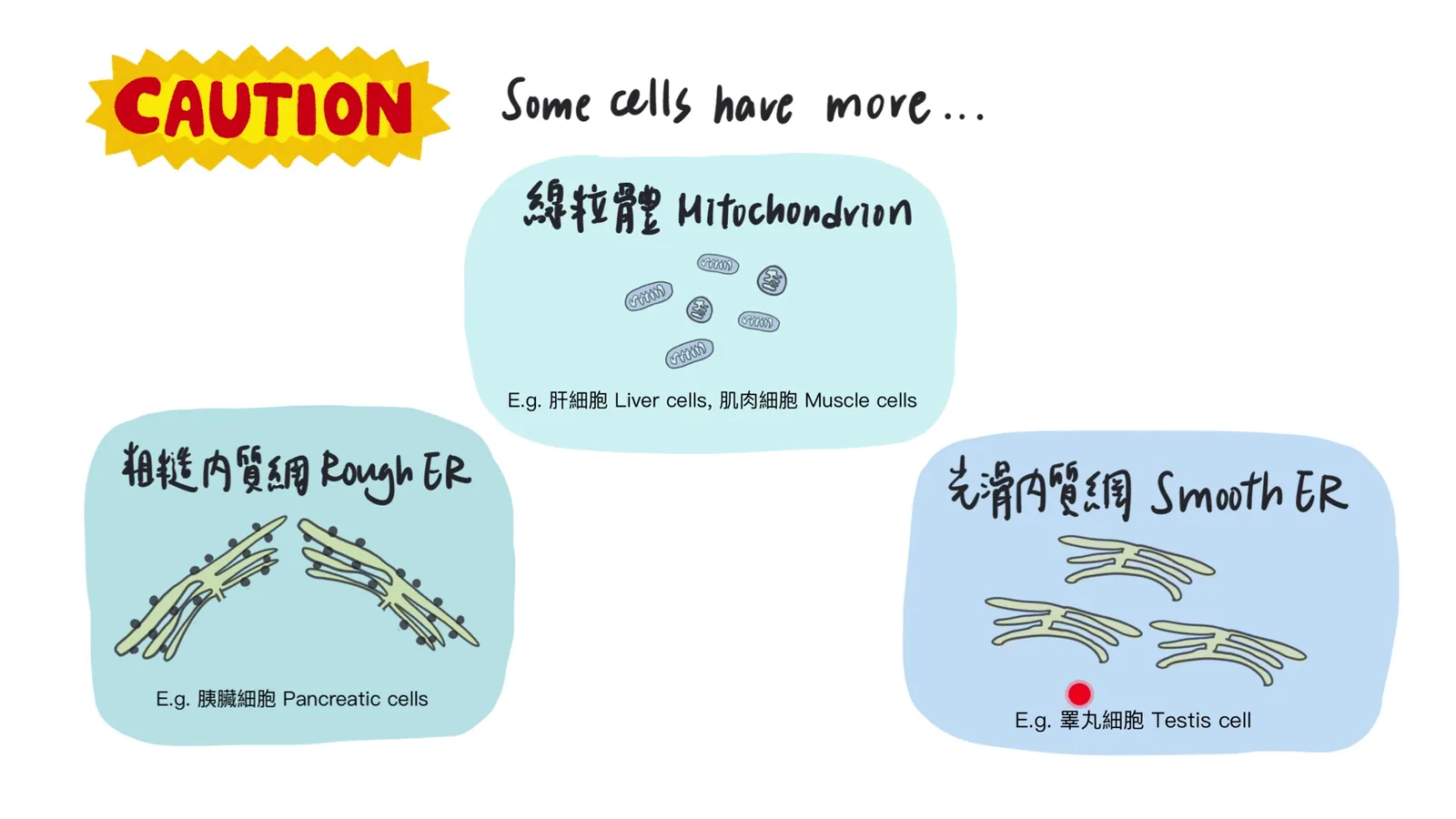
The number of organelles in a cell matches the job the cell does S20 · 14:55:
| Cells have more of | Because | Examples |
|---|---|---|
| Mitochondria 線粒體 | need a lot of energy released by respiration | liver cells 肝細胞, muscle cells 肌肉細胞 |
| Rough ER 粗糙內質網 | make a lot of protein (enzymes, protein hormones) | pancreatic cells 胰臟細胞 |
| Smooth ER 光滑內質網 | make lipid-based hormones (steroids) | testis cells 睾丸細胞 |
結構跟功能走:肝細胞、肌肉細胞要多啲能量 → 多線粒體;胰臟細胞分泌酶(蛋白質)→ 多粗糙內質網;睪丸細胞整脂質類激素 → 多光滑內質網。考題會問「邊類細胞會多邊種細胞器」,照呢個邏輯推就得。
5. Prokaryotic cells 原核細胞 S21 · 15:51
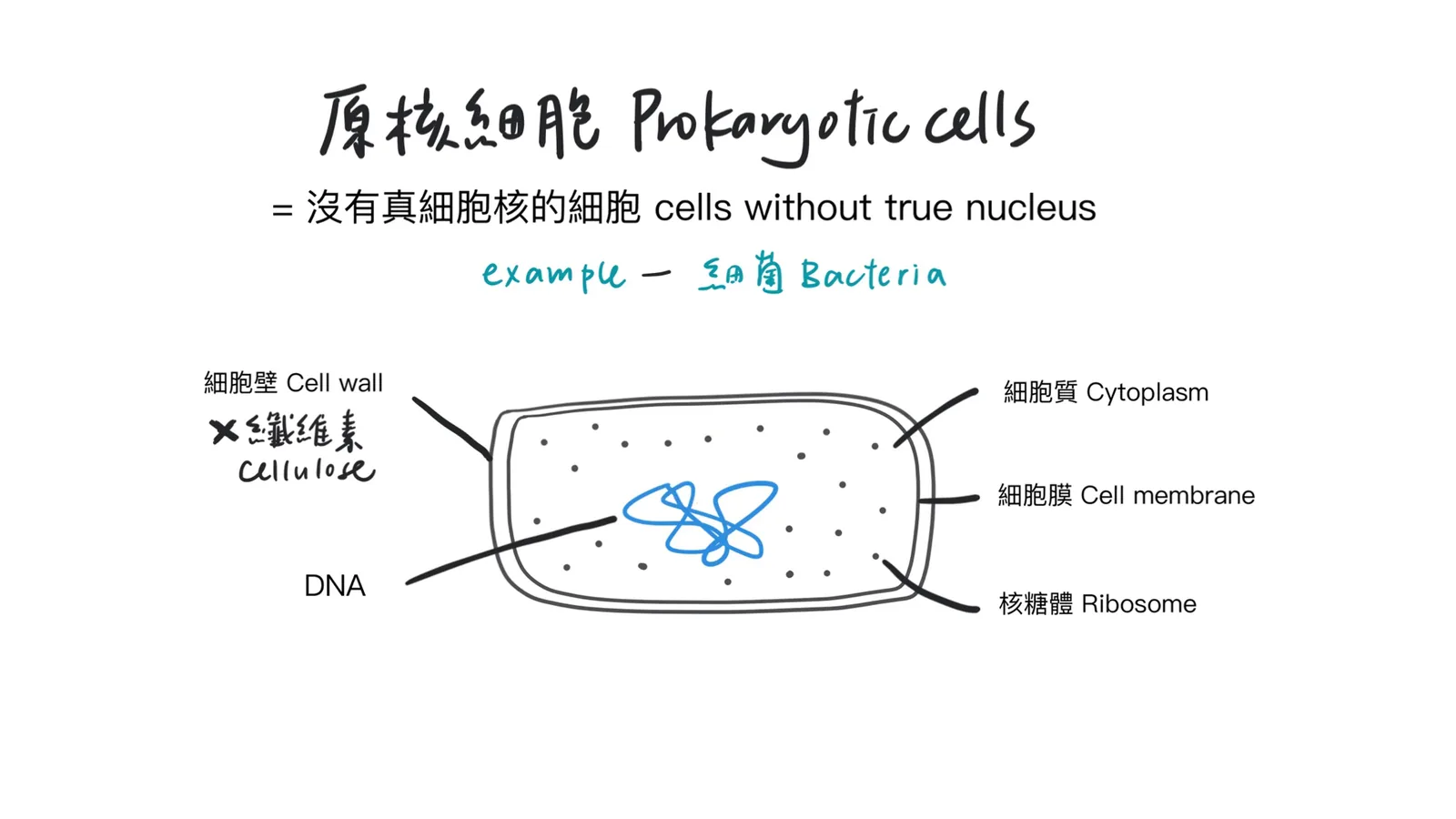
Prokaryotic cells 原核細胞 are cells without a true nucleus 沒有真細胞核的細胞 — the bacteria 細菌 are the classic example. Their structure is much simpler S21 · 15:51:
| Structure | Present? | Notes |
|---|---|---|
| Cell wall 細胞壁 | yes | but NOT made of cellulose 唔係纖維素組成 |
| Cell membrane 細胞膜 | yes | as in other cells |
| Cytoplasm 細胞質 | yes | DNA lies free in it DNA 直接攤喺細胞質 |
| Ribosome 核糖體 | yes | the only organelle present |
| Nucleus 細胞核 | no 沒有 | no nuclear membrane at all |
| Membrane-bound organelles 被膜包圍的細胞器 | no 沒有 | no mitochondria, no chloroplasts |
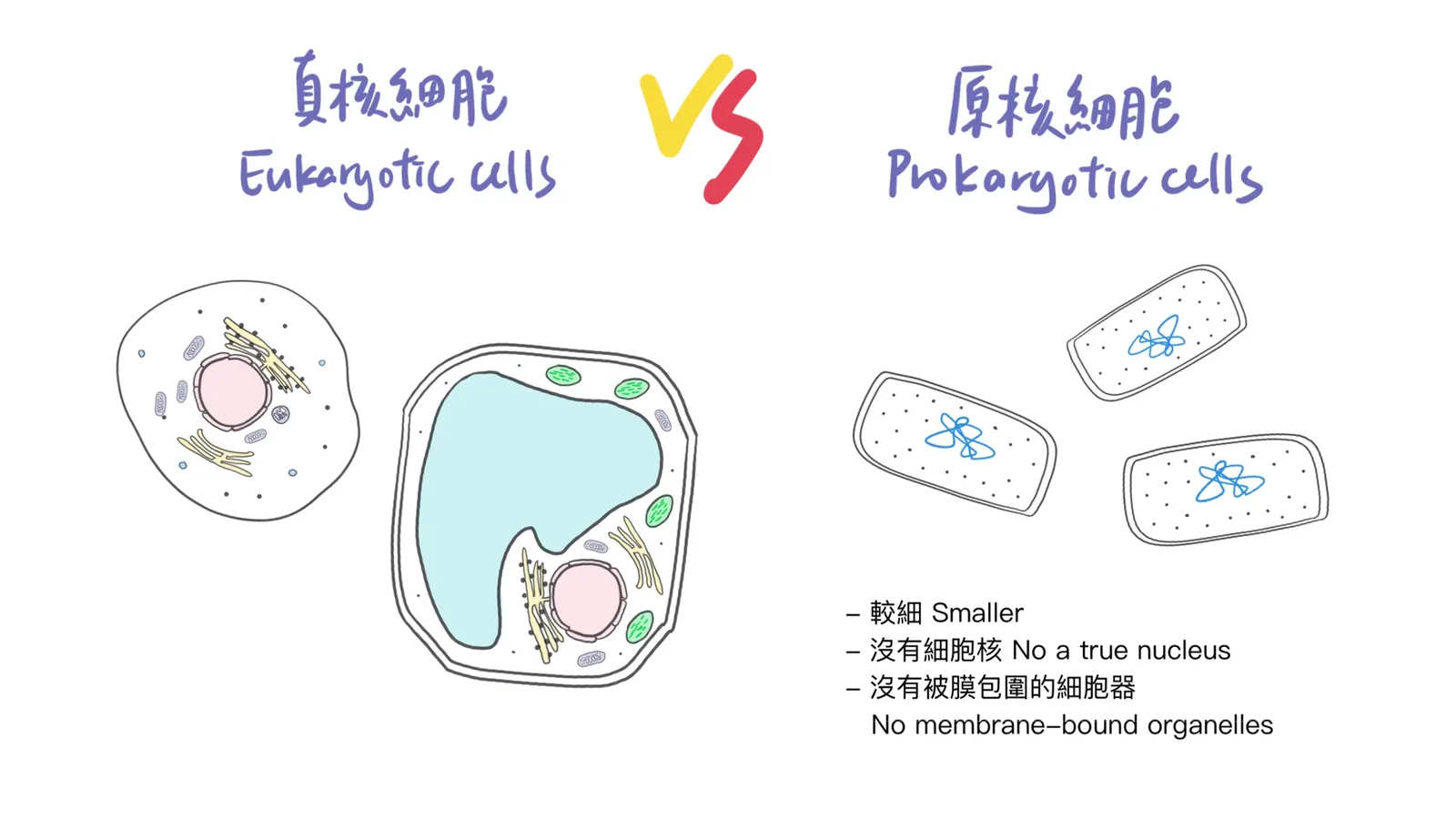
Prokaryotic cells are also smaller than eukaryotic cells. S22 · 16:34
原核細胞=冇真細胞核嘅細胞,例子係細菌。有細胞壁(唔係纖維素造!)、細胞膜、細胞質、核糖體;DNA 冇核膜包住,直接攤喺細胞質度。冇任何被膜包圍嘅細胞器(即係冇線粒體、冇葉綠體),而且體積比真核細胞細。
Eukaryotic vs prokaryotic 真核與原核對比 S22 · 16:34
| Eukaryotic cells 真核細胞 | Prokaryotic cells 原核細胞 | |
|---|---|---|
| Nucleus | a true nucleus 有真細胞核 | no nucleus 沒有細胞核 |
| Membrane-bound organelles | present 有 | absent 沒有 |
| Size | larger 較大 | smaller 較小 |
真核 vs 原核三大分別:有冇真細胞核、有冇被膜包圍嘅細胞器、體積大細。動物細胞同植物細胞都係真核;細菌係原核。
6. Levels of body organisation 身體的組織層次 S24 · 17:10
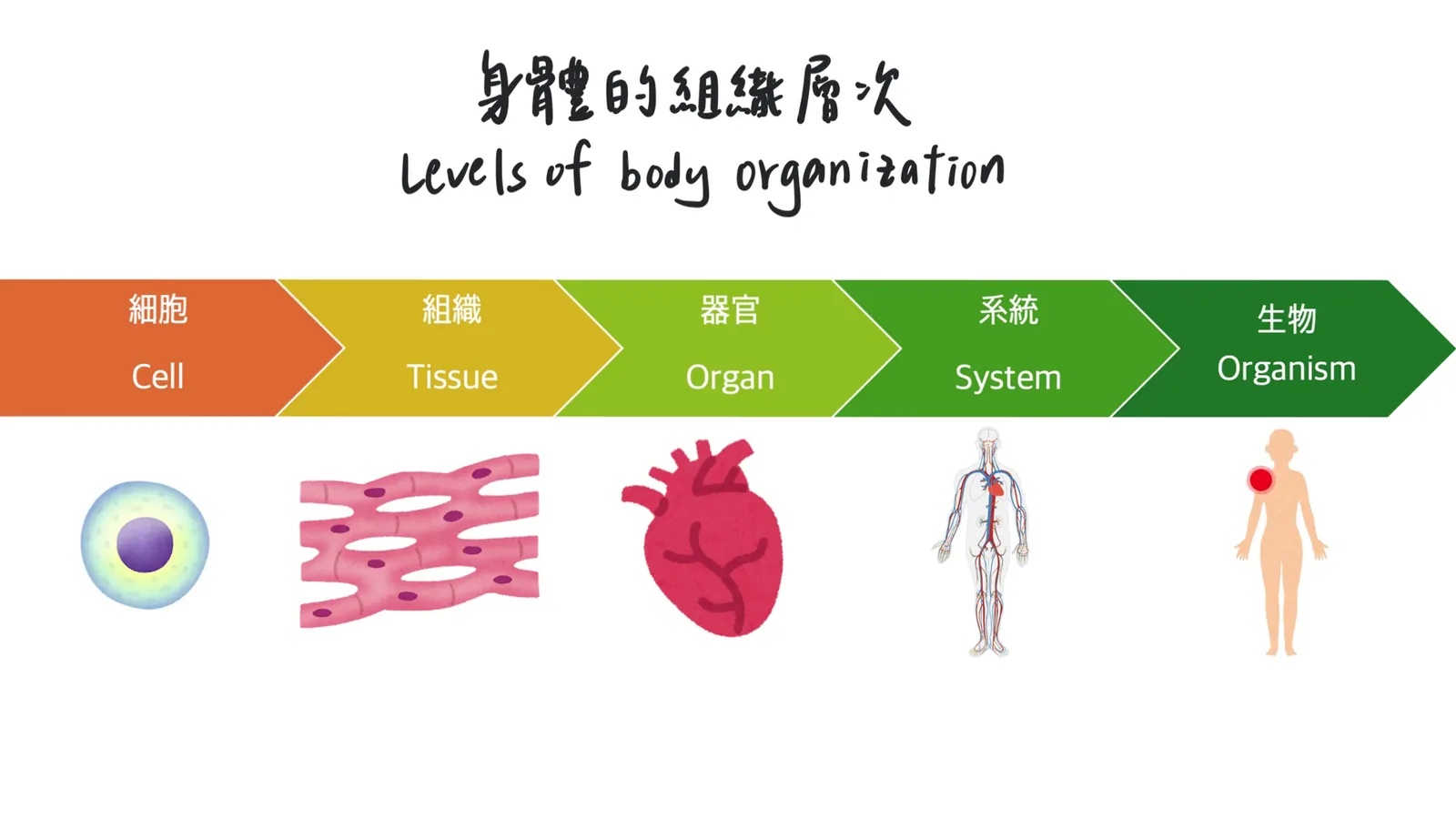
cells → tissues → organs → organ systems → organism S24 · 17:10
- many muscle cells 肌肉細胞 together form muscle tissue 肌肉組織
- different tissues (muscle, nerve…) combine into an organ 器官, such as the heart 心臟
- different organs (heart + blood vessels 血管) form the circulatory system 循環系統
- all the systems together (circulatory, digestive 消化系統 …) make up the whole organism 生物
五層由細到全:細胞 → 組織 → 器官 → 系統 → 生物。例:肌肉細胞→肌肉組織;(肌肉+神經等組織)→心臟;(心臟+血管)→循環系統;循環+消化等所有系統→成個生物。要識由 cells 一路寫到 organism,每層舉到例。
- TEM = internal + 2-D; SEM = external + 3-D — both black and white
- After switching to high power, use the fine adjustment knob only
- The image moves opposite to the slide
- The prokaryotic cell wall is not cellulose; animal cells do have small, few vacuoles
- The cell wall is fully permeable; the cell membrane is differentially permeable
五大陷阱:① TEM 內部 2D、SEM 外部 3D,都係黑白;② 轉高倍後只可用微調節器;③ 影像移動方向同玻片相反;④ 細菌細胞壁唔係纖維素、動物細胞其實有液泡(細而少);⑤ 細胞壁全透、細胞膜差異透性。