endocytosis→phagocytosis(吞噬作用)
課程文件 Topic I(c) 只列 phagocytosis,並無 endocytosis。endocytosis 是大學層面的上位詞,在 DSE 用來答「細胞吞噬」會被視為課外術語,可能失分。
出處 Source:HKEAA Biology Curriculum and Assessment Guide (S4–6), Topic I(c)
Every cell is separated from its surroundings by a differentially permeable(差異透性) cell membrane(細胞膜), so survival depends on moving the right substances in and the right ones out. This lesson supplies the four mechanisms that later topics (absorption in the small intestine(小腸), gas exchange, water regulation in plants) keep reusing. S01 · 0:00
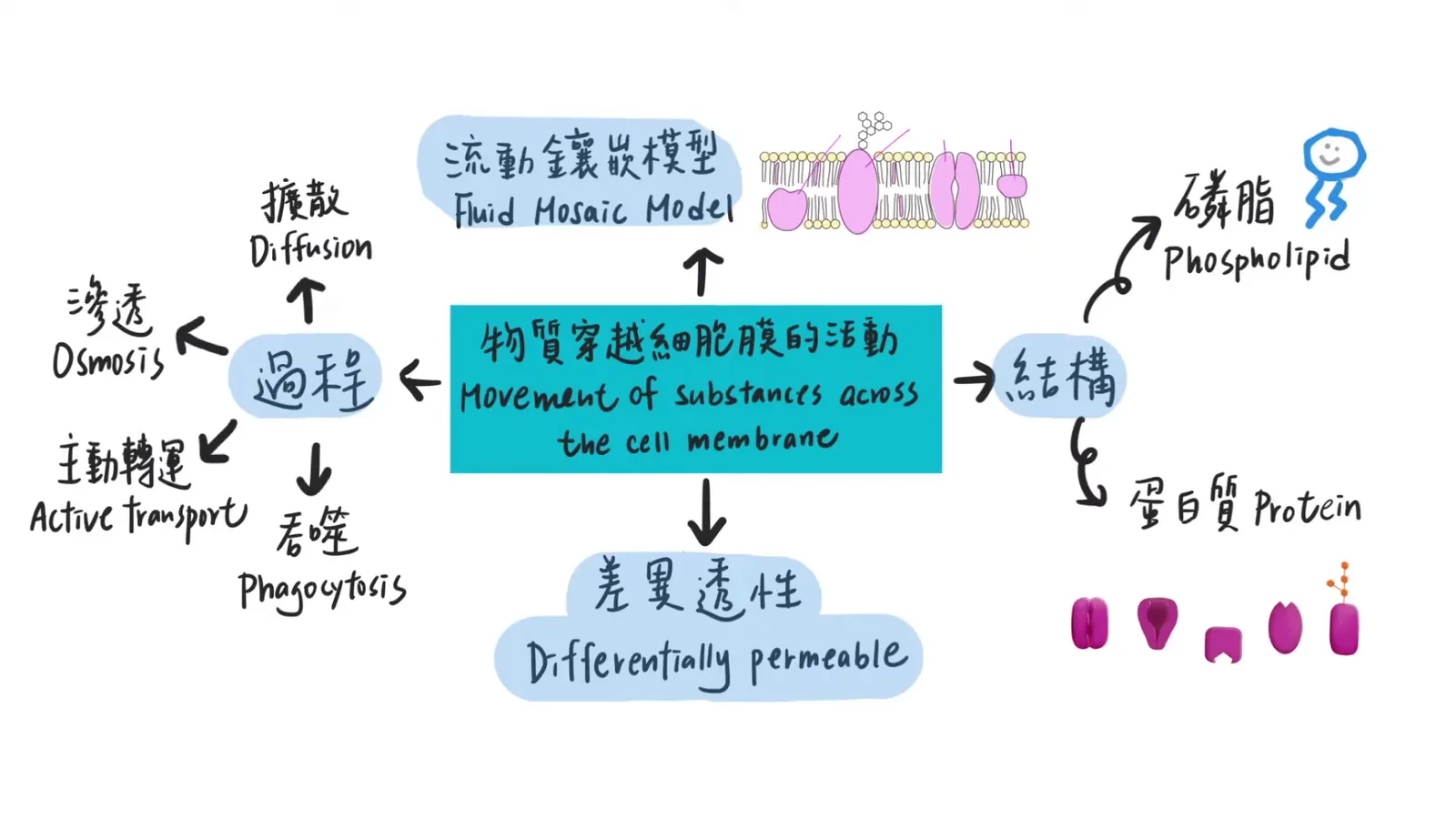
細胞膜是「差異透性」的,即有些物質過得、有些過不得。這一課給出四個機制:擴散、滲透、主動轉運、吞噬。之後講小腸吸收、氣體交換、植物水分調節,全部都會反覆用到這四個機制。
1. Membrane structure: the fluid mosaic model 流動鑲嵌模型 S02 · 0:50
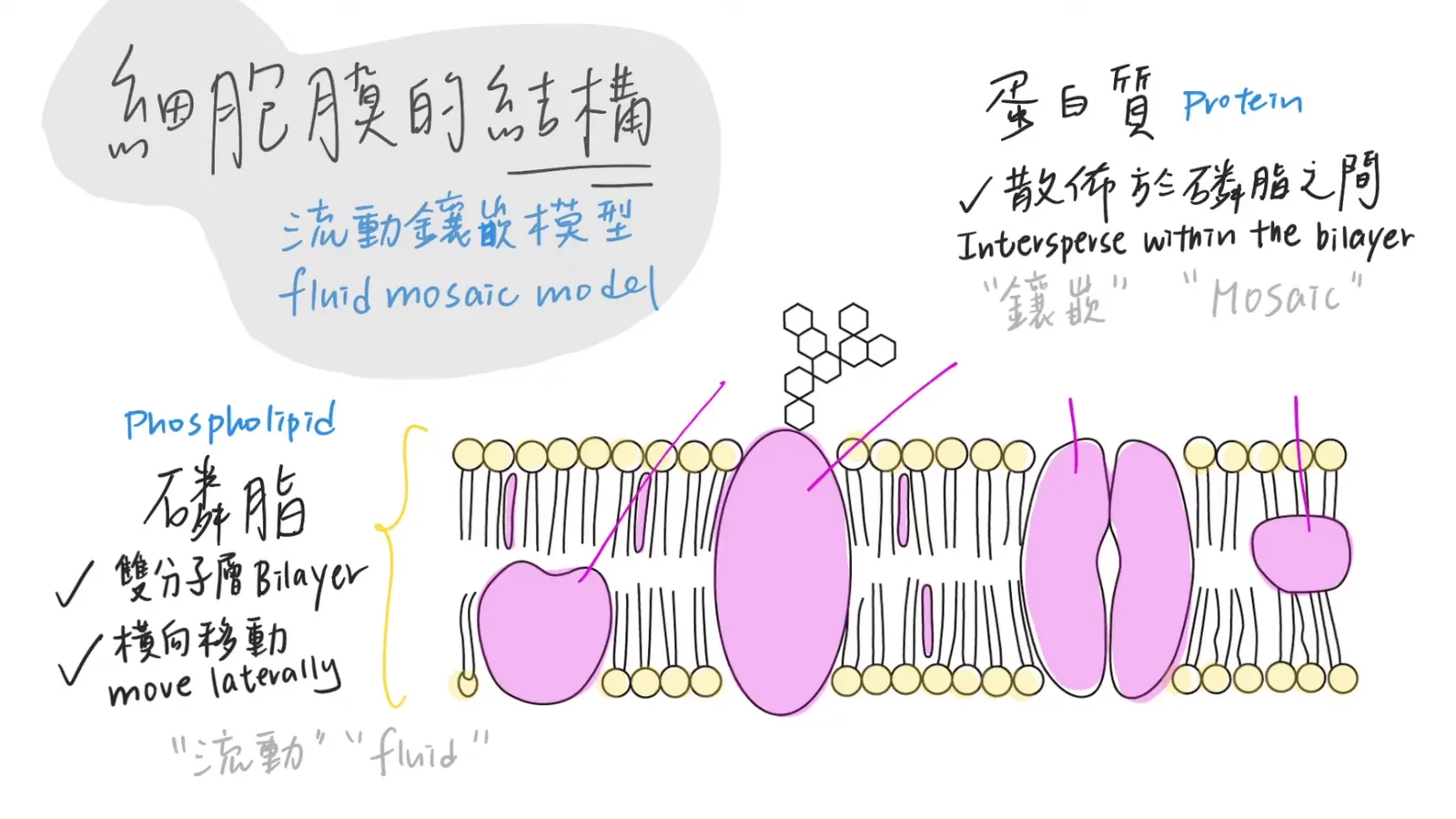
The model is a phospholipid bilayer(磷脂雙分子層) with proteins scattered through it. It carries two names because it describes two different components. S02 · 0:50
| Name in the model | Refers to | Evidence |
|---|---|---|
| Fluid 流動 | the phospholipid 磷脂 | phospholipids can move laterally(橫向移動) within their own layer |
| Mosaic 鑲嵌 | the protein 蛋白質 | proteins are scattered among the phospholipids like tiles in a mosaic |
The bilayer itself is one molecule thick on each side: hydrophilic head outward, hydrophobic tail inward. S04 · 6:15
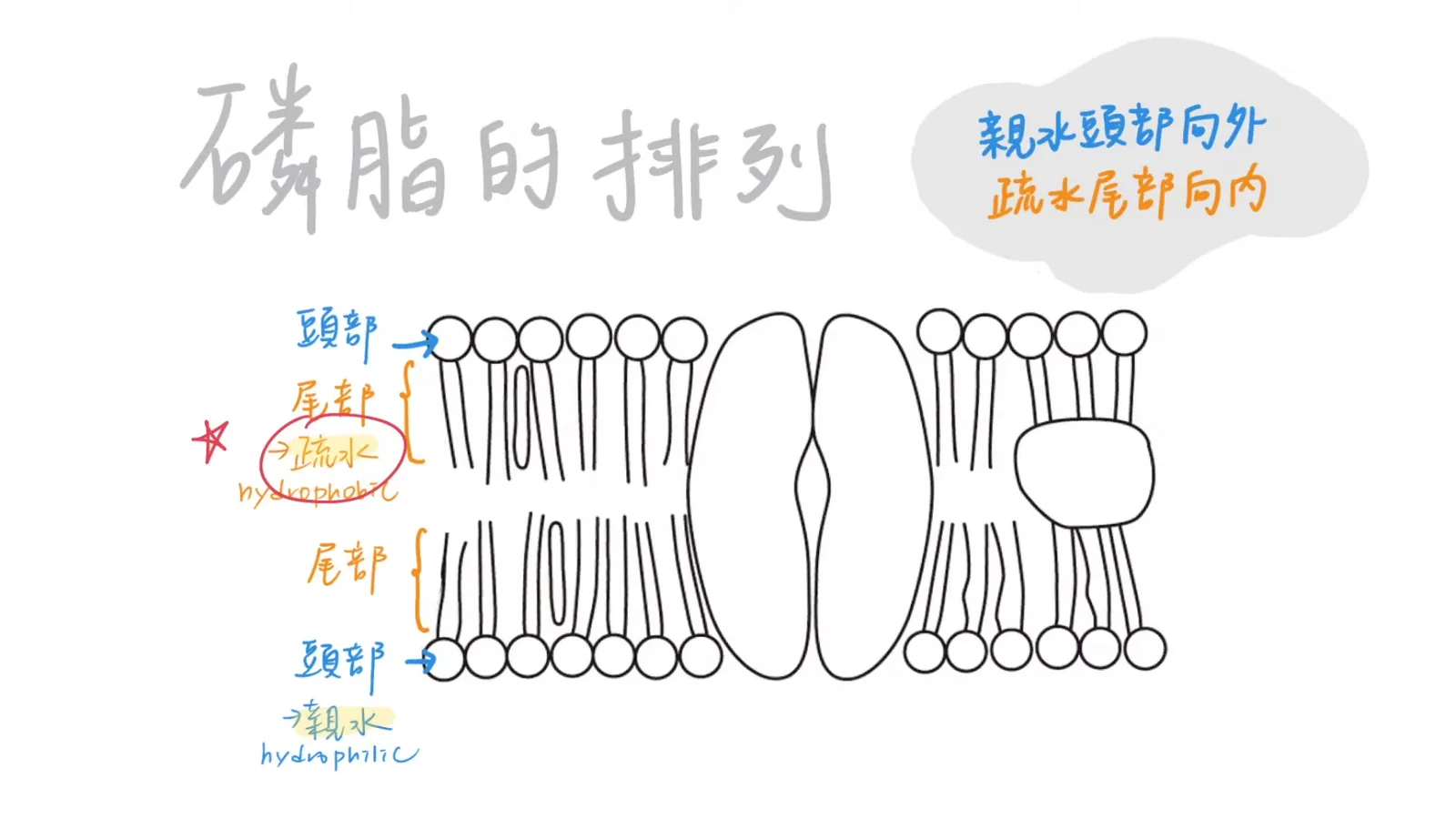
- Head is hydrophilic 親水, so it turns towards the watery exterior and the watery cytoplasm
- Tail is hydrophobic 疏水, so it turns away from water and packs into the middle
- This is also the reason for differential permeability: the hydrophobic core repels water-soluble substances, forcing them through proteins S05 · 7:36
Five membrane proteins 五種膜蛋白 S03 · 2:10
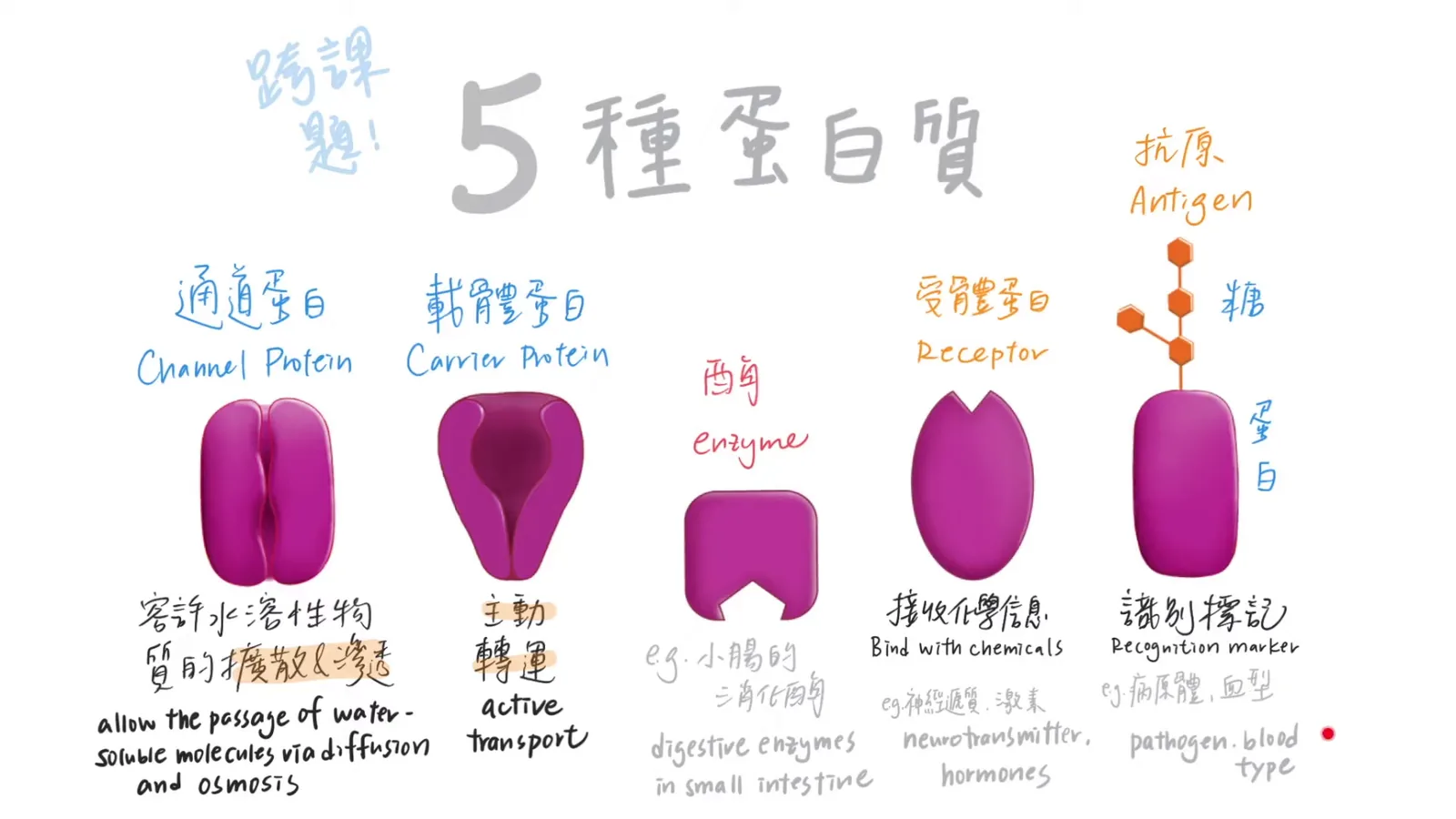
| Protein | Job on the membrane | Where it reappears |
|---|---|---|
| Channel protein 通道蛋白 | passage of water-soluble molecules by diffusion(擴散) and osmosis(滲透) | osmosis, kidney, root hair |
| Carrier protein 載體蛋白 | active transport(主動轉運) only | small intestine absorption |
| Enzyme 酶 | digestion at the membrane surface | digestive enzymes of the small intestine |
| Receptor 受體蛋白 | binds chemical messages | neurotransmitters, hormones (insulin) |
| Antigen 抗原 | recognition marker, a glycoprotein(糖蛋白) | pathogens, ABO blood groups |
通道蛋白負責「被動」的水溶性物質(水、葡萄糖、氨基酸、離子);載體蛋白只負責「主動轉運」。這個分工是全課最常考的分辨點:題目講主動轉運,答案一定要有載體蛋白+能量。
2. Which substance takes which route 物質走哪條路 S05 · 7:36
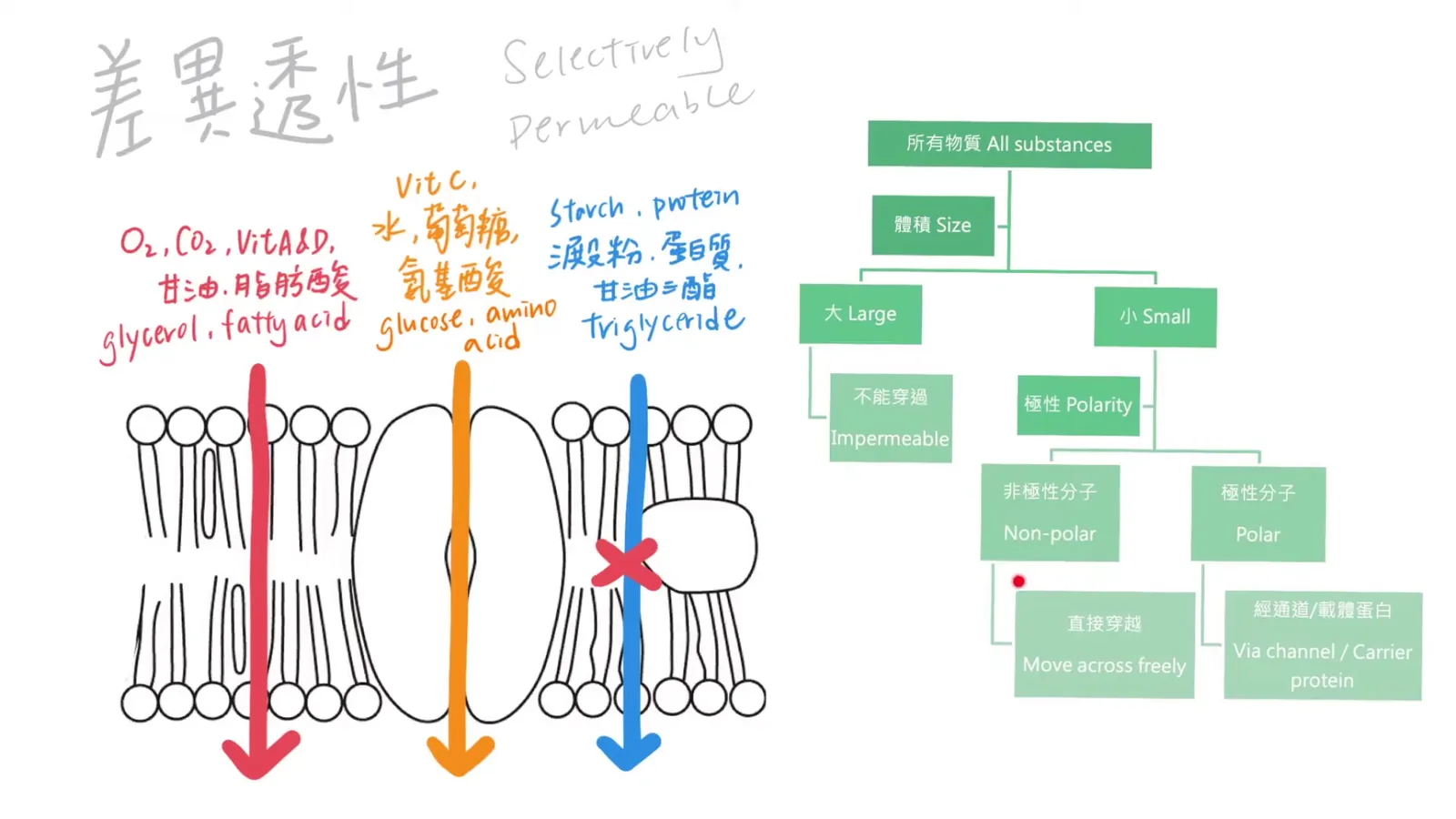
Because the membrane is differentially permeable, substances are sorted by size first, then polarity.
| Substance | Size / polarity | Route |
|---|---|---|
| starch, protein, triglyceride | large | cannot pass at all |
| O₂, CO₂ | small, non-polar(非極性) | straight through the bilayer |
| vitamin A, vitamin D, glycerol, fatty acid | small, lipid-soluble(脂溶性) | straight through the bilayer |
| water, glucose, amino acid, ions, vitamin C | small, polar(極性) | through channel or carrier protein |
- Starch and protein can never cross, no matter how much time or energy is given
- That is exactly why digestion exists: break them down until they are small enough
- Answering "it diffuses slowly" for starch loses the mark S05 · 7:36
3. Diffusion 擴散 S06 · 11:21
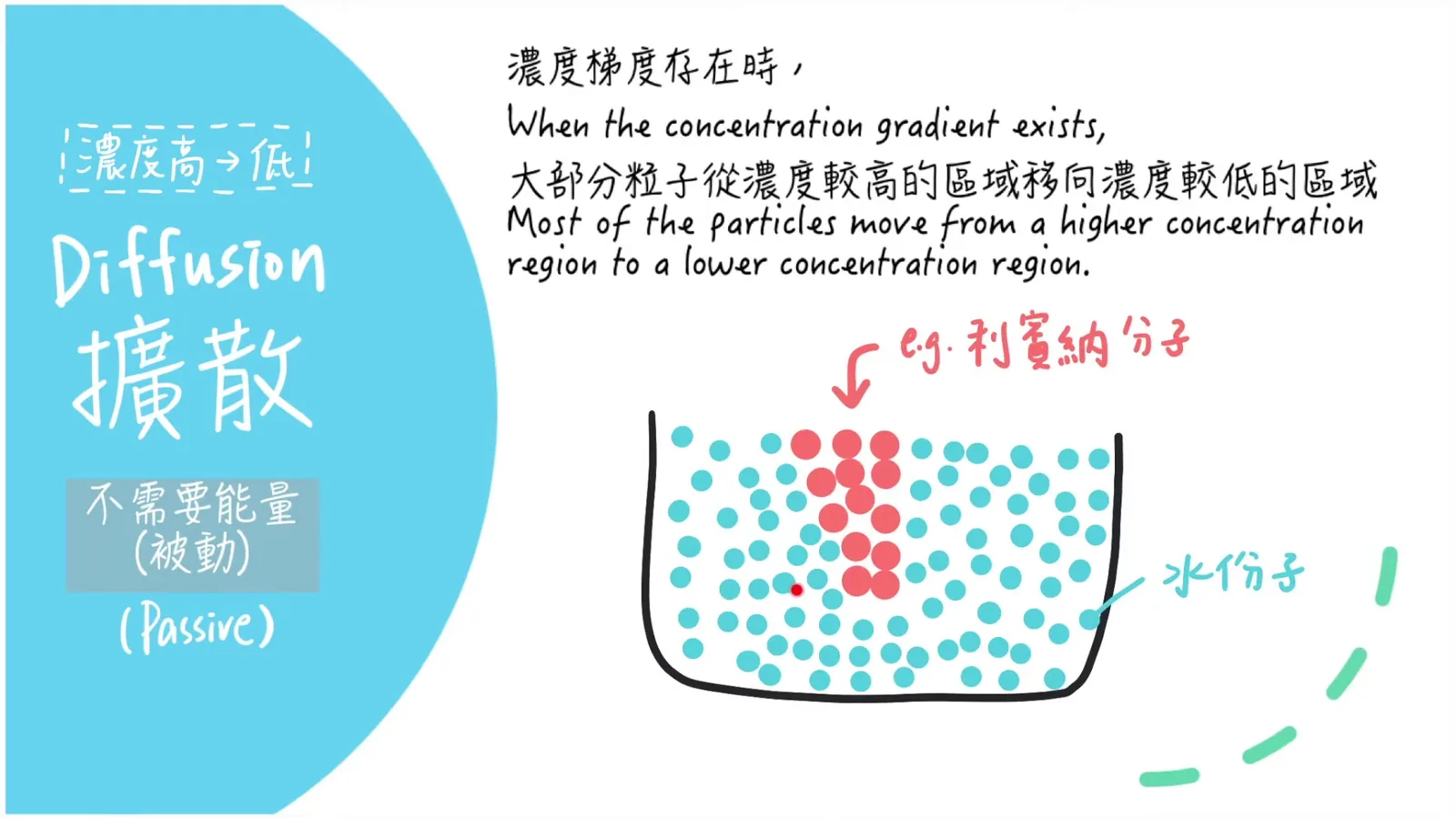
Diffusion is the net movement of particles from a region of higher concentration to a region of lower concentration, i.e. down a concentration gradient(濃度梯度). It is passive and needs no energy.
Five factors change the rate. S07 · 12:44
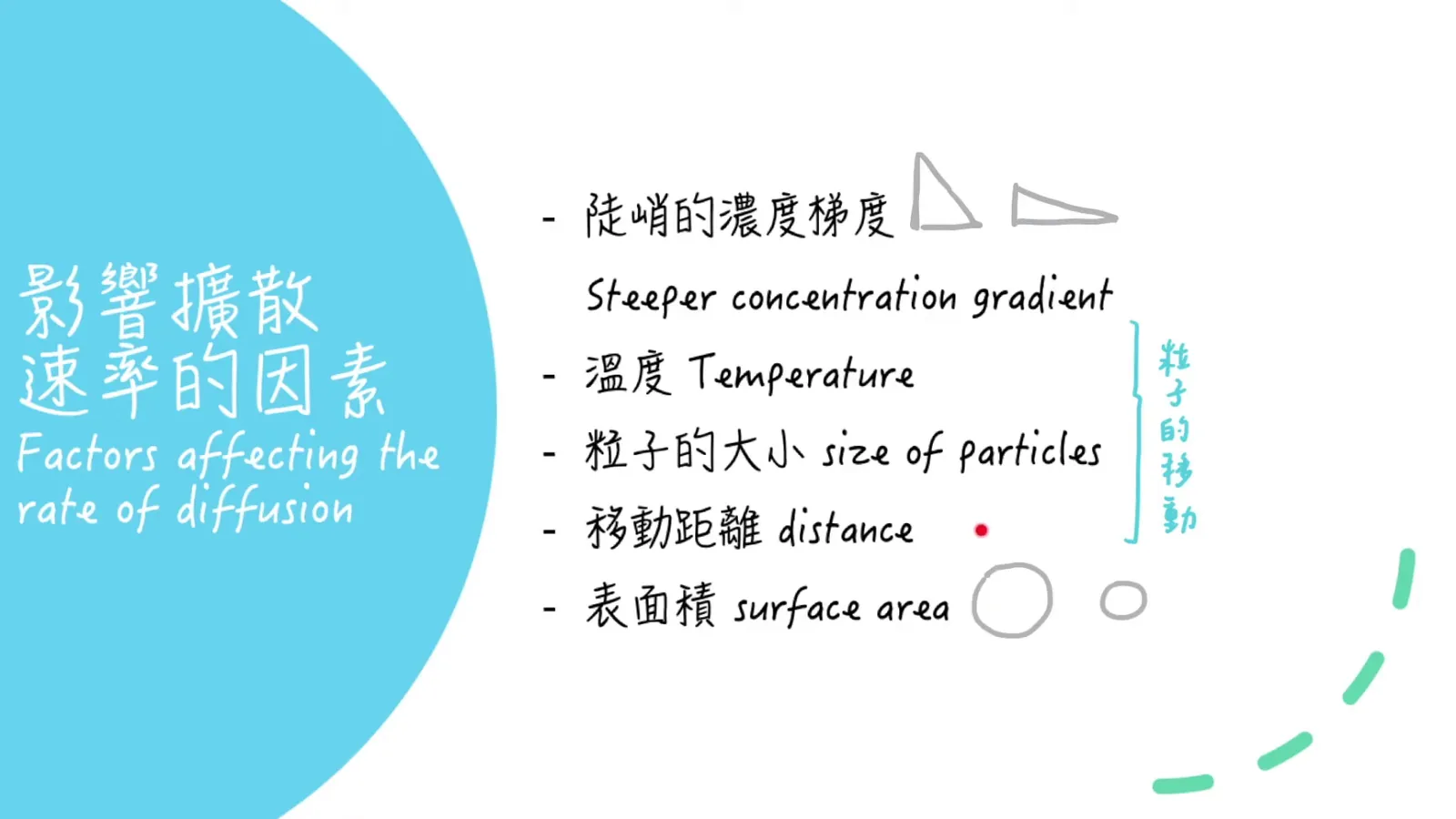
| Factor | Effect on rate |
|---|---|
| steeper concentration gradient 濃度梯度越陡 | faster |
| higher temperature | faster (particles move faster) |
| smaller particle size | faster |
| shorter distance 移動距離 | faster |
| larger surface area 表面積 | faster |
- Most questions give a change and ask "explain why the rate increases" — always name the factor and then say particles move faster / more area for exchange
- Distance and surface area(表面積) are the two that link to real structures: thin walls, villi, alveoli
- Temperature is the odd one out; it is about kinetic energy of the particles, not about the gradient
4. Osmosis 滲透 S08 · 14:18
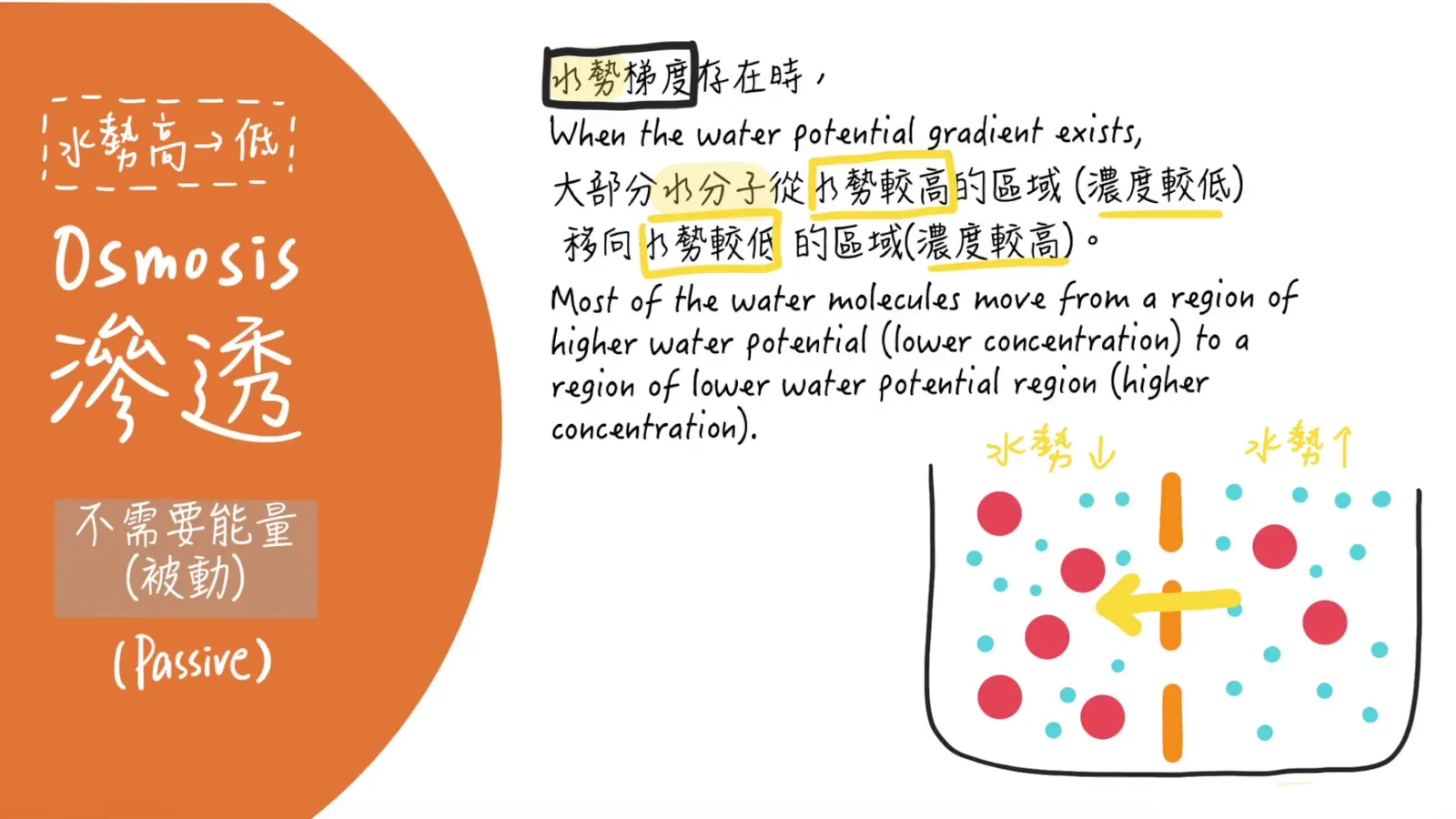
Osmosis is the net movement of water molecules from a region of higher water potential to a region of lower water potential, through a differentially permeable membrane. It is passive.
Water potential(水勢) is the tendency of water molecules to move. The rule that decides everything:
- More solute → lower water potential (water is held, less free to move)
- Less solute → higher water potential
- Distilled water(蒸餾水) has the highest water potential of all
- So "high concentration" and "low water potential" describe the same solution
這是最多人混淆的一點:溶質越多,水勢越低。題目講「高濃度溶液」,等於「低水勢」;講「蒸餾水」,就是水勢最高。答題時兩套用詞要對得上,否則方向會寫反。
Solutions and the cell 溶液與細胞 S09 · 16:36
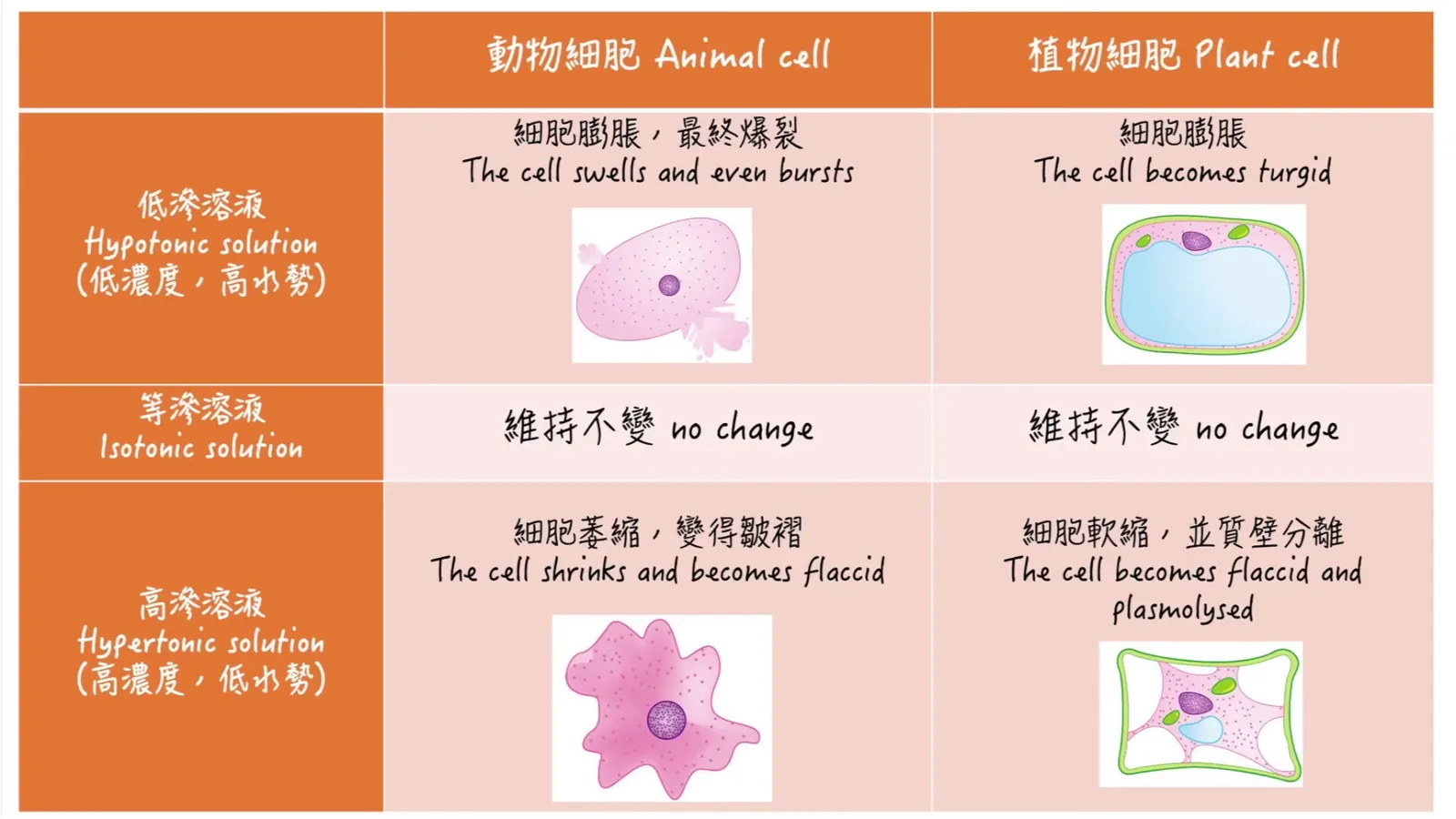
| Solution | Water potential | Animal cell | Plant cell |
|---|---|---|---|
| Hypotonic 低滲(低濃度,高水勢) | outside higher | swells and even bursts | becomes turgid(膨脹) |
| Isotonic 等滲(相同濃度) | equal | no change | no change |
| Hypertonic 高滲(高濃度,低水勢) | outside lower | shrinks and becomes flaccid(軟縮) | becomes flaccid and plasmolysed(質壁分離) |
- Plasmolysis 質壁分離: cytoplasm shrinks away from the cell wall — plant cells only, because the rigid wall stays put
- Haemolysis 溶血: a red blood cell swells until the membrane bursts — animal cells only, because there is no wall to stop them
- The plant wall is why one cell becomes turgid while the other explodes
- Diffusion is explained by concentration; osmosis must be explained by water potential
- If the question mentions water, answer in water potential, not concentration
- Water crossing still uses a channel protein; the bilayer alone is too hydrophobic
5. Active transport 主動轉運 S10 · 18:57
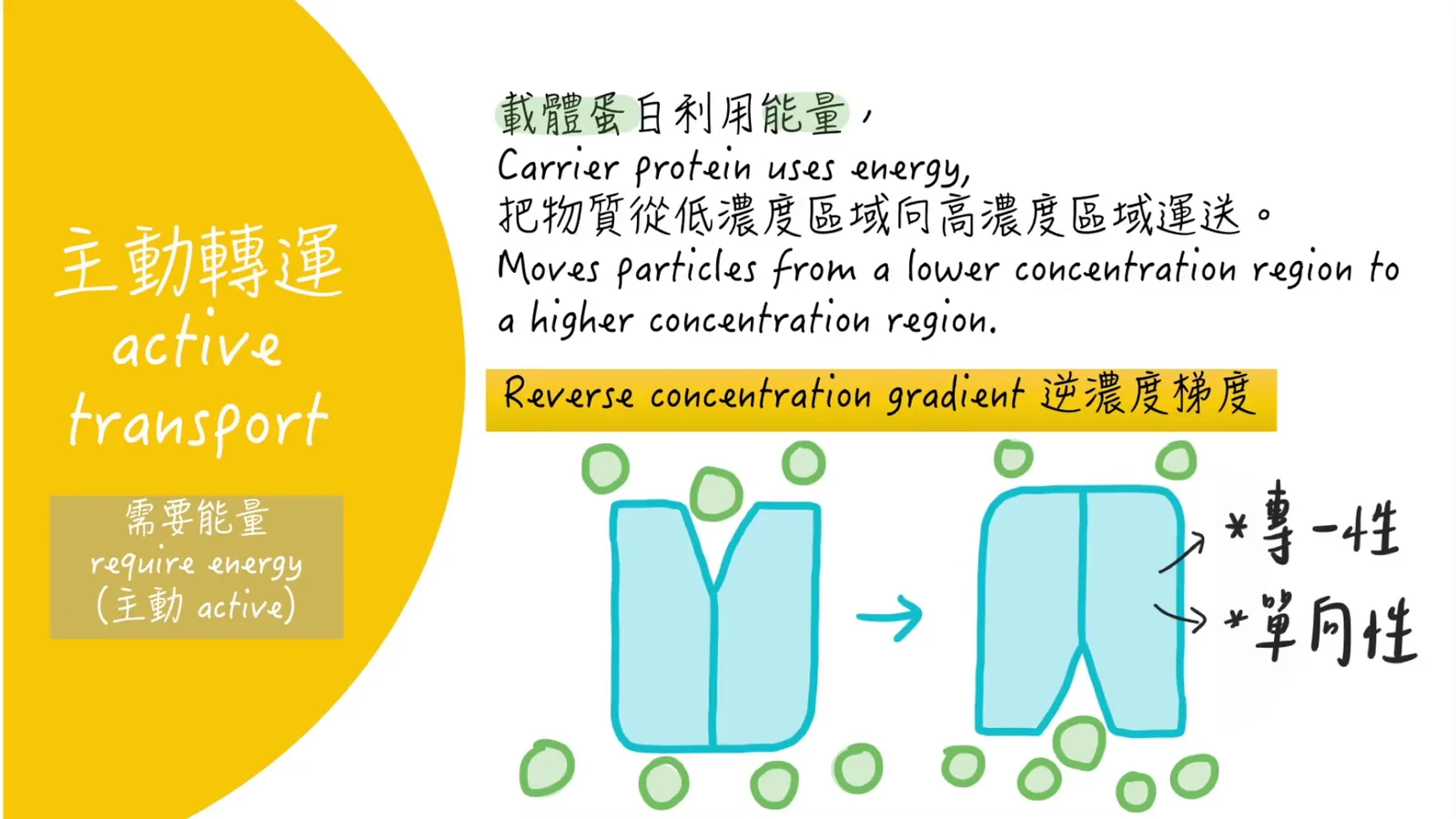
Active transport uses energy and a carrier protein to move particles from a lower concentration to a higher concentration region — against, or "reverse", the concentration gradient. It is an active process.
| Feature | Meaning |
|---|---|
| Requires energy 需要能量 | from respiration, so plenty of mitochondria nearby |
| Carrier protein 載體蛋白 | always involved, never a channel protein |
| Specificity 專一性 | one carrier handles one substance only |
| One-way 單向性 | moves in one direction only, never back |
The standard example is absorption in the small intestine: carrier proteins in the intestinal wall, powered by energy, take up nutrients even after the concentration inside has already exceeded the gut. This is how the body "takes everything".
主動轉運的關鍵在於「逆濃度梯度」。當腸道內營養濃度已經低過細胞內,擴散已經無法再吸收,但仍然要繼續吸收,就要靠載體蛋白+能量硬拉進去。所以小腸細胞有大量線粒體。
6. Phagocytosis 吞噬 S11 · 21:14
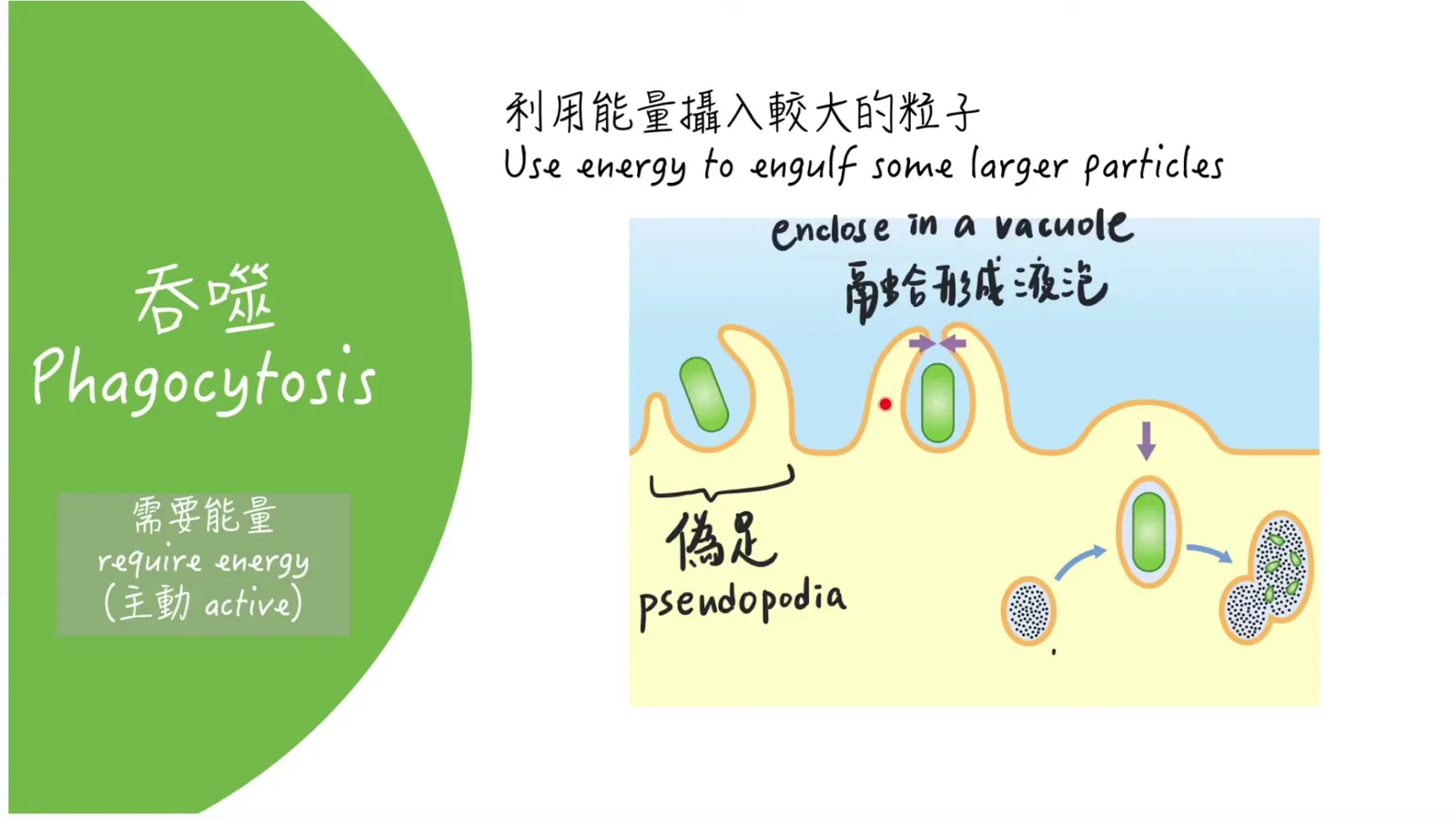
Phagocytosis(吞噬作用) uses energy, plus the fluidity of the membrane, to engulf particles that are too large to cross by any other route.
The sequence, in exam order:
- The membrane pushes out pseudopodia 偽足 around the particle.
- The pseudopodia meet and the membrane fuses, enclosing the particle in a vacuole(液泡).
- Enzymes are secreted into the vacuole to digest the particle.
- The digested products become small enough to enter the cytoplasm and be used by the cell.
| Example | What is engulfed |
|---|---|
| white blood cell 白血球 | pathogens |
| Amoeba 變形蟲 | food particles, as its way of feeding |
- The syllabus names phagocytosis, and the lesson slide prints Phagocytosis in the title
- endocytosis is the wider university-level umbrella term and is not in the syllabus
- Writing endocytosis where the marker expects phagocytosis may not be awarded
7. The four processes side by side
| Energy | Direction | Protein | Typical example | |
|---|---|---|---|---|
| Diffusion | no | down concentration gradient | none for non-polar substances | O₂ entering a cell |
| Osmosis | no | down water potential gradient(水勢梯度) | channel protein for water | root hair absorbing water |
| Active transport | yes | against concentration gradient | carrier protein | glucose uptake in small intestine |
| Phagocytosis | yes | not a gradient at all | membrane fluidity, not a protein | white blood cell engulfing a pathogen(病原體) |
- Energy needed? → active transport or phagocytosis
- Moving against a gradient with a carrier? → active transport
- Taking in a large particle? → phagocytosis
- No energy, and the question talks about water? → osmosis
- No energy, and the question talks about a gas or a lipid? → diffusion