儒濟生DSE 生物 · 溫習 物質穿越細胞膜的活動 儒濟生個人筆記
LESSON 03 · 23:39 · 11 張投影片 ▶ 原片

Movement of Substances Across the Cell Membrane

物質穿越細胞膜的活動

術語勘誤 Official term

endocytosis→phagocytosis(吞噬作用)

課程文件 Topic I(c) 只列 phagocytosis,並無 endocytosis。endocytosis 是大學層面的上位詞,在 DSE 用來答「細胞吞噬」會被視為課外術語,可能失分。

出處 Source:HKEAA Biology Curriculum and Assessment Guide (S4–6), Topic I(c)

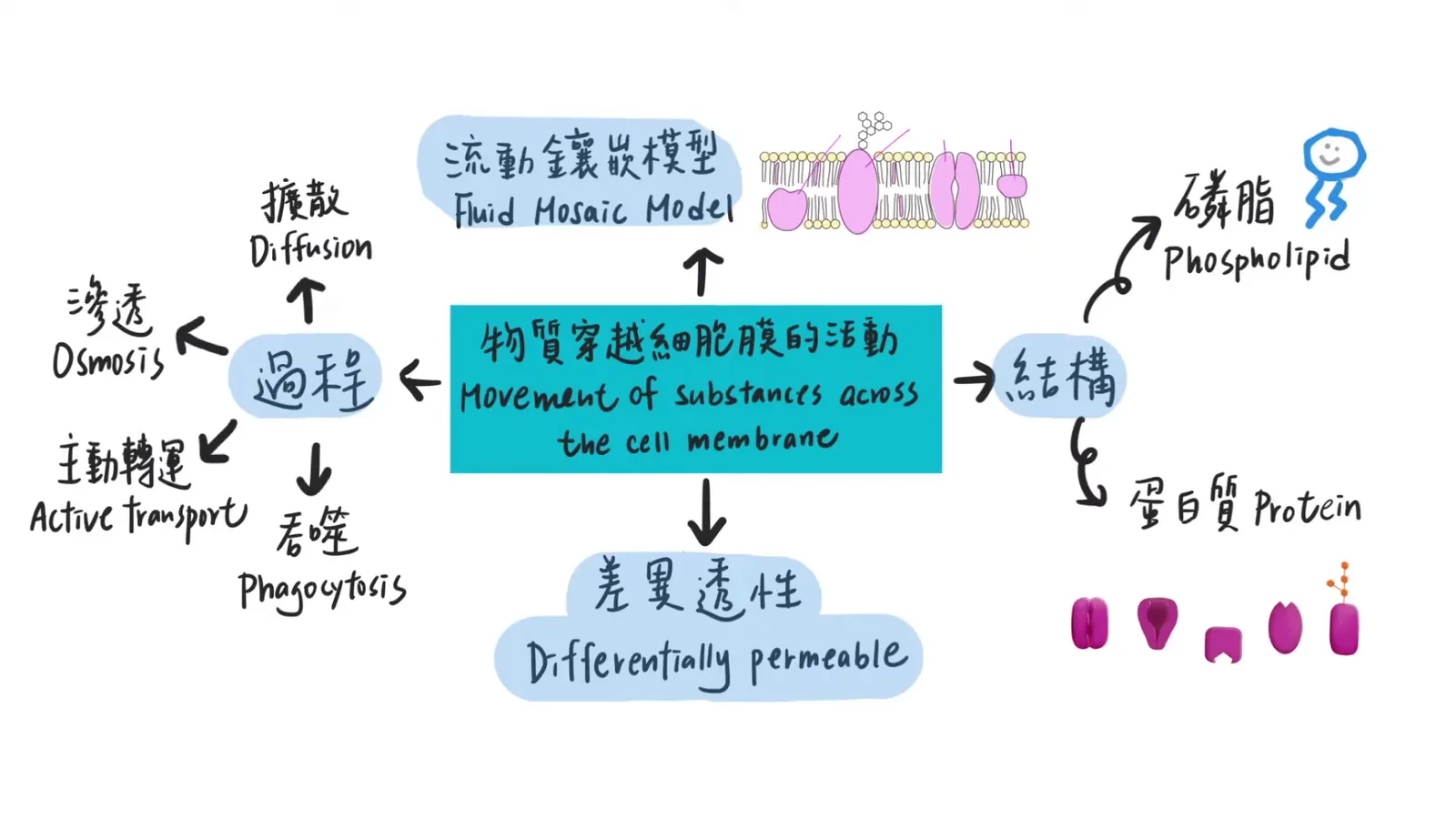
Every cell is separated from its surroundings by a differentially permeable(差異透性) cell membrane(細胞膜), so survival depends on moving the right substances in and the right ones out. This lesson supplies the four mechanisms that later topics (absorption in the small intestine(小腸), gas exchange, water regulation in plants) keep reusing. S01 · 0:00
投影片 S01
S010:00 – 0:50看影片
中文

細胞膜是「差異透性」的,即有些物質過得、有些過不得。這一課給出四個機制:擴散、滲透、主動轉運、吞噬。之後講小腸吸收、氣體交換、植物水分調節,全部都會反覆用到這四個機制。

1. Membrane structure: the fluid mosaic model 流動鑲嵌模型 S02 · 0:50
投影片 S02
S020:50 – 2:08看影片

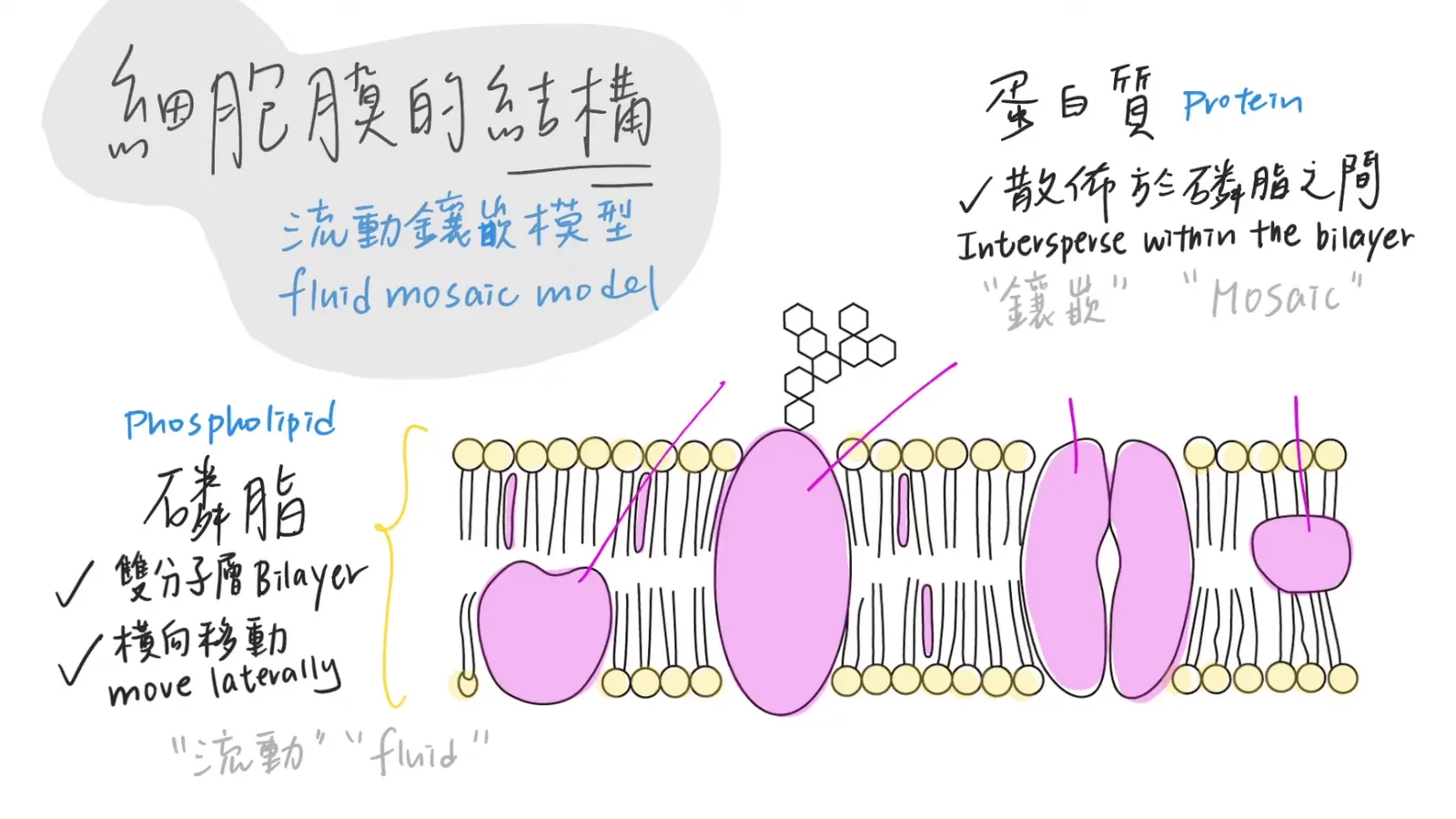
The model is a phospholipid bilayer(磷脂雙分子層) with proteins scattered through it. It carries two names because it describes two different components. S02 · 0:50

Name in the model Refers to Evidence
Fluid 流動 the phospholipid 磷脂 phospholipids can move laterally(橫向移動) within their own layer
Mosaic 鑲嵌 the protein 蛋白質 proteins are scattered among the phospholipids like tiles in a mosaic

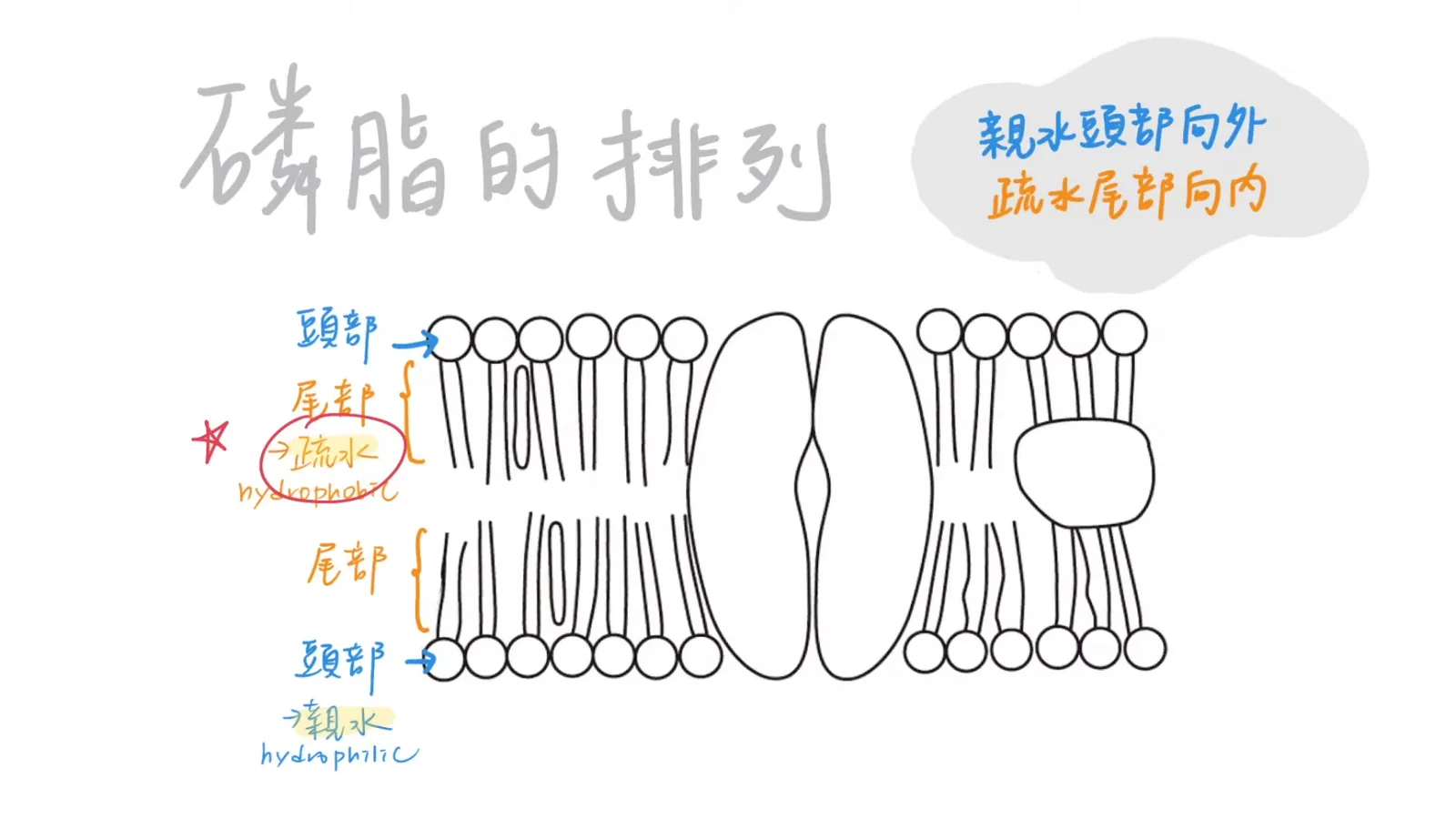
The bilayer itself is one molecule thick on each side: hydrophilic head outward, hydrophobic tail inward. S04 · 6:15
投影片 S04
S046:15 – 7:36看影片
投影片 S05
S057:36 – 11:13看影片
重點 Why the bilayer faces this way
  • Head is hydrophilic 親水, so it turns towards the watery exterior and the watery cytoplasm
  • Tail is hydrophobic 疏水, so it turns away from water and packs into the middle
  • This is also the reason for differential permeability: the hydrophobic core repels water-soluble substances, forcing them through proteins S05 · 7:36

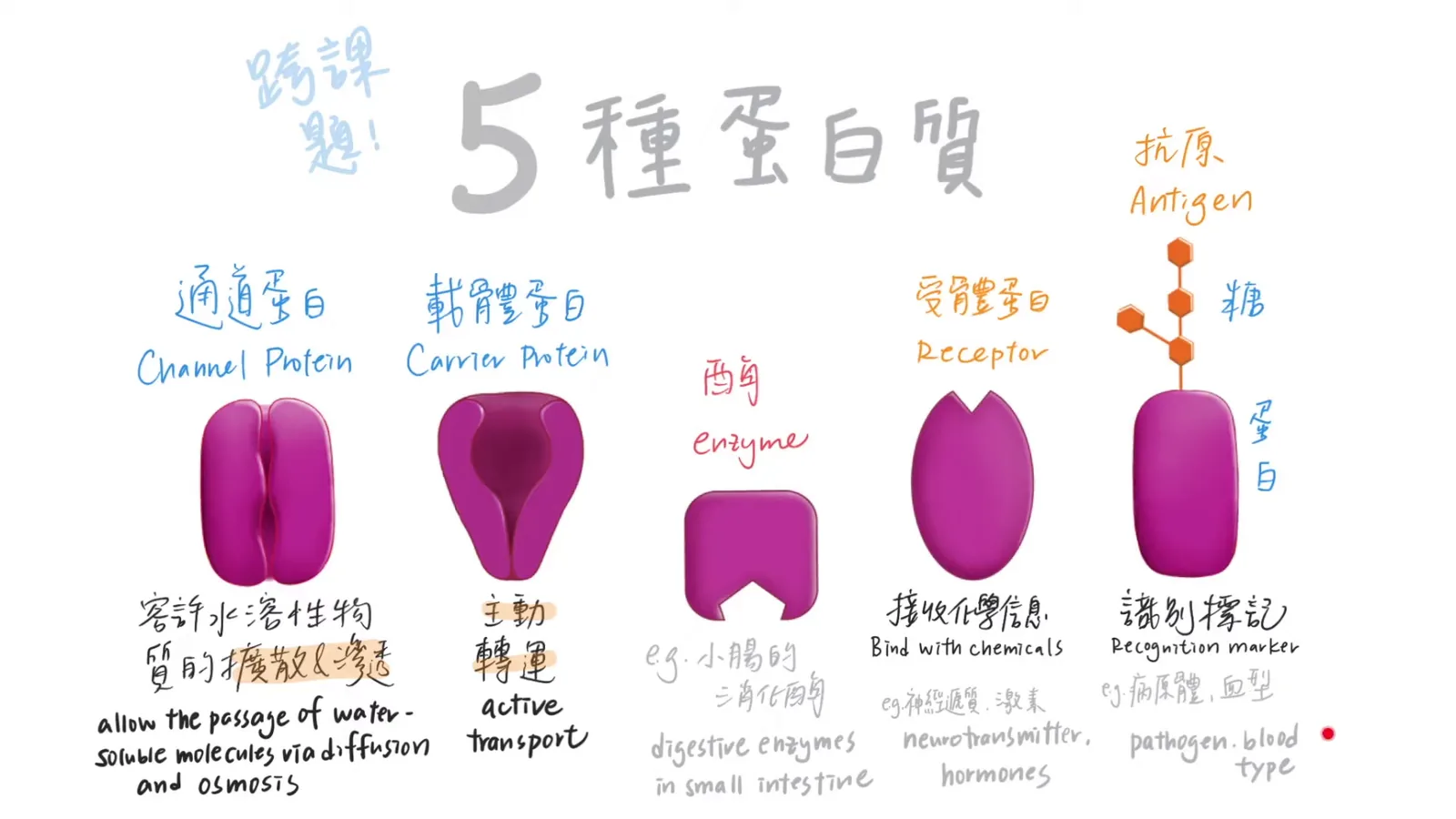
Five membrane proteins 五種膜蛋白 S03 · 2:10
投影片 S03
S032:10 – 6:15看影片
Protein Job on the membrane Where it reappears
Channel protein 通道蛋白 passage of water-soluble molecules by diffusion(擴散) and osmosis(滲透) osmosis, kidney, root hair
Carrier protein 載體蛋白 active transport(主動轉運) only small intestine absorption
Enzyme 酶 digestion at the membrane surface digestive enzymes of the small intestine
Receptor 受體蛋白 binds chemical messages neurotransmitters, hormones (insulin)
Antigen 抗原 recognition marker, a glycoprotein(糖蛋白) pathogens, ABO blood groups
中文

通道蛋白負責「被動」的水溶性物質(水、葡萄糖、氨基酸、離子);載體蛋白只負責「主動轉運」。這個分工是全課最常考的分辨點:題目講主動轉運,答案一定要有載體蛋白+能量。

2. Which substance takes which route 物質走哪條路 S05 · 7:36

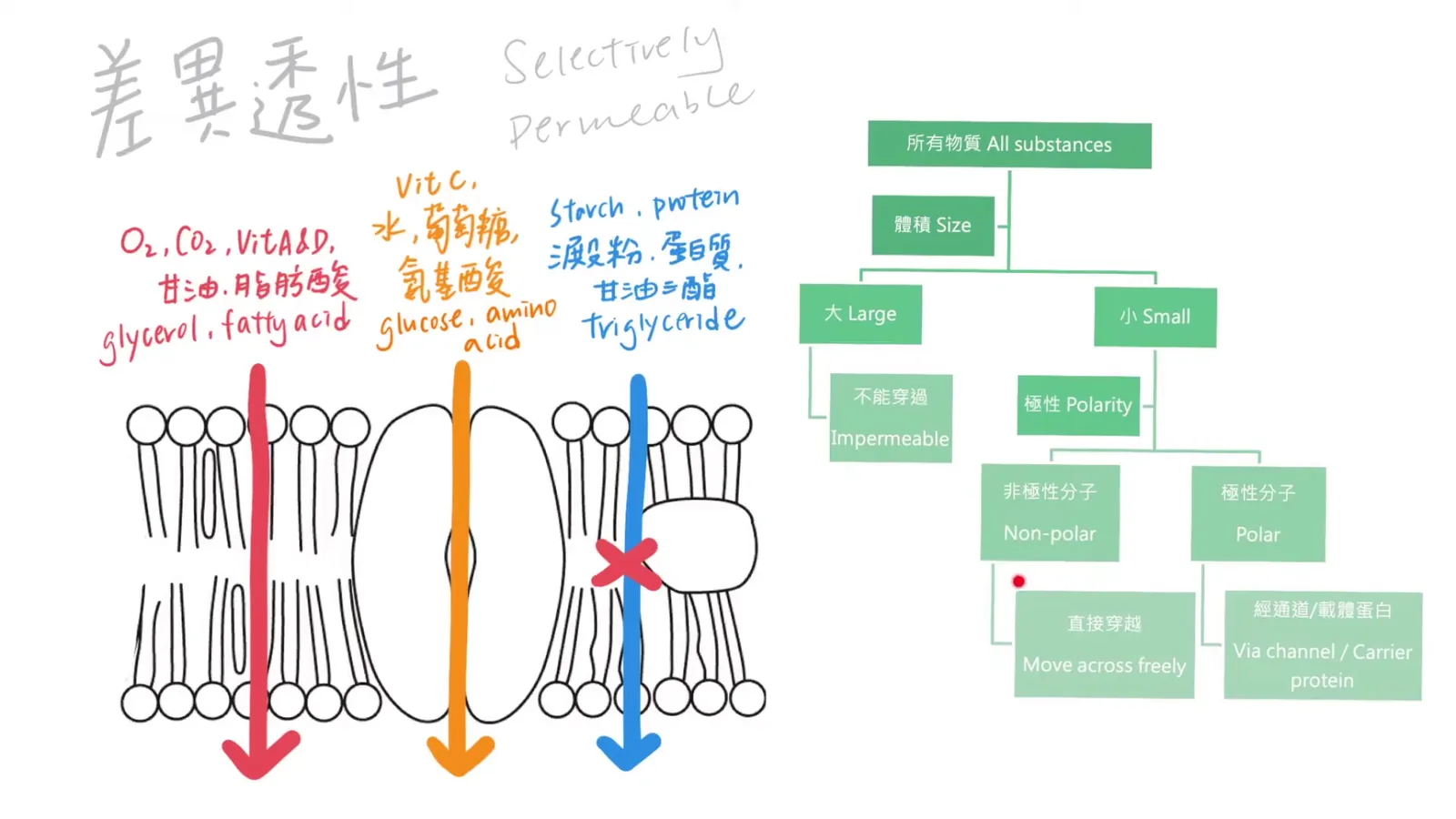
Because the membrane is differentially permeable, substances are sorted by size first, then polarity.

Substance Size / polarity Route
starch, protein, triglyceride large cannot pass at all
O₂, CO₂ small, non-polar(非極性) straight through the bilayer
vitamin A, vitamin D, glycerol, fatty acid small, lipid-soluble(脂溶性) straight through the bilayer
water, glucose, amino acid, ions, vitamin C small, polar(極性) through channel or carrier protein
陷阱 Large molecules are not "slow", they are impossible
  • Starch and protein can never cross, no matter how much time or energy is given
  • That is exactly why digestion exists: break them down until they are small enough
  • Answering "it diffuses slowly" for starch loses the mark S05 · 7:36

3. Diffusion 擴散 S06 · 11:21
投影片 S06
S0611:21 – 12:44看影片

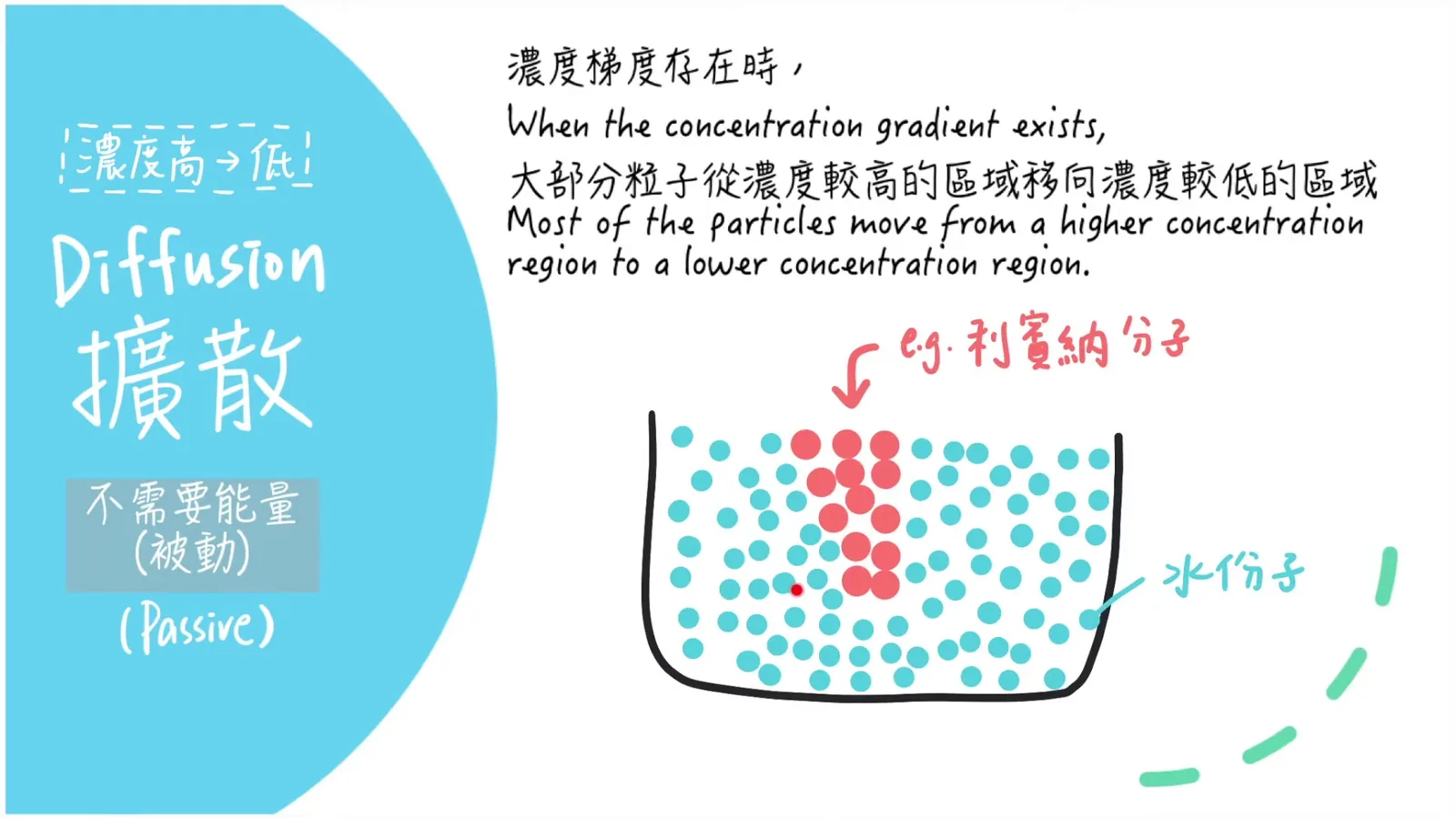
Diffusion is the net movement of particles from a region of higher concentration to a region of lower concentration, i.e. down a concentration gradient(濃度梯度). It is passive and needs no energy.

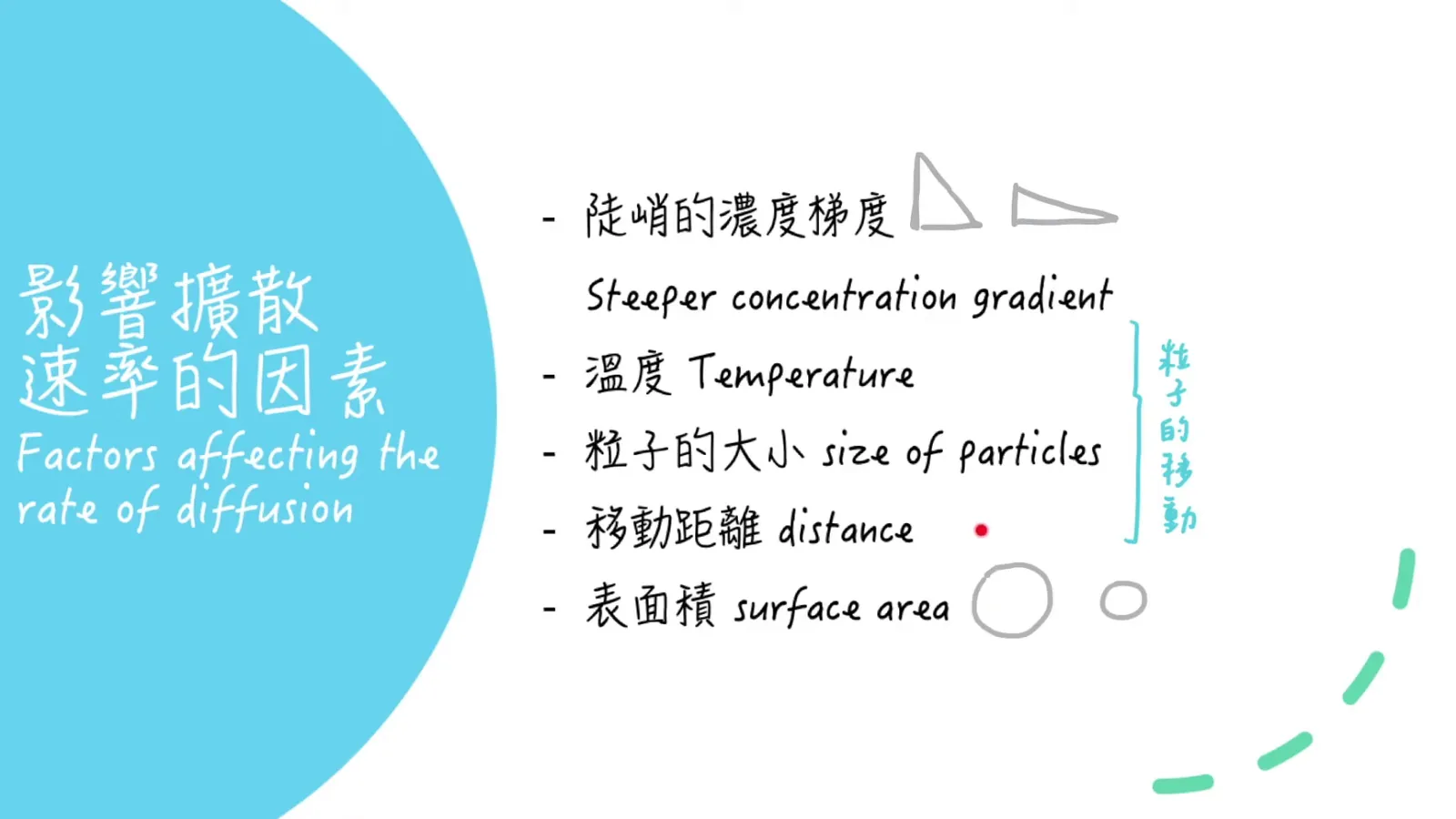
Five factors change the rate. S07 · 12:44
投影片 S07
S0712:44 – 14:18看影片
Factor Effect on rate
steeper concentration gradient 濃度梯度越陡 faster
higher temperature faster (particles move faster)
smaller particle size faster
shorter distance 移動距離 faster
larger surface area 表面積 faster
考試重點 How the factors are asked
  • Most questions give a change and ask "explain why the rate increases" — always name the factor and then say particles move faster / more area for exchange
  • Distance and surface area(表面積) are the two that link to real structures: thin walls, villi, alveoli
  • Temperature is the odd one out; it is about kinetic energy of the particles, not about the gradient

4. Osmosis 滲透 S08 · 14:18
投影片 S08
S0814:18 – 16:36看影片

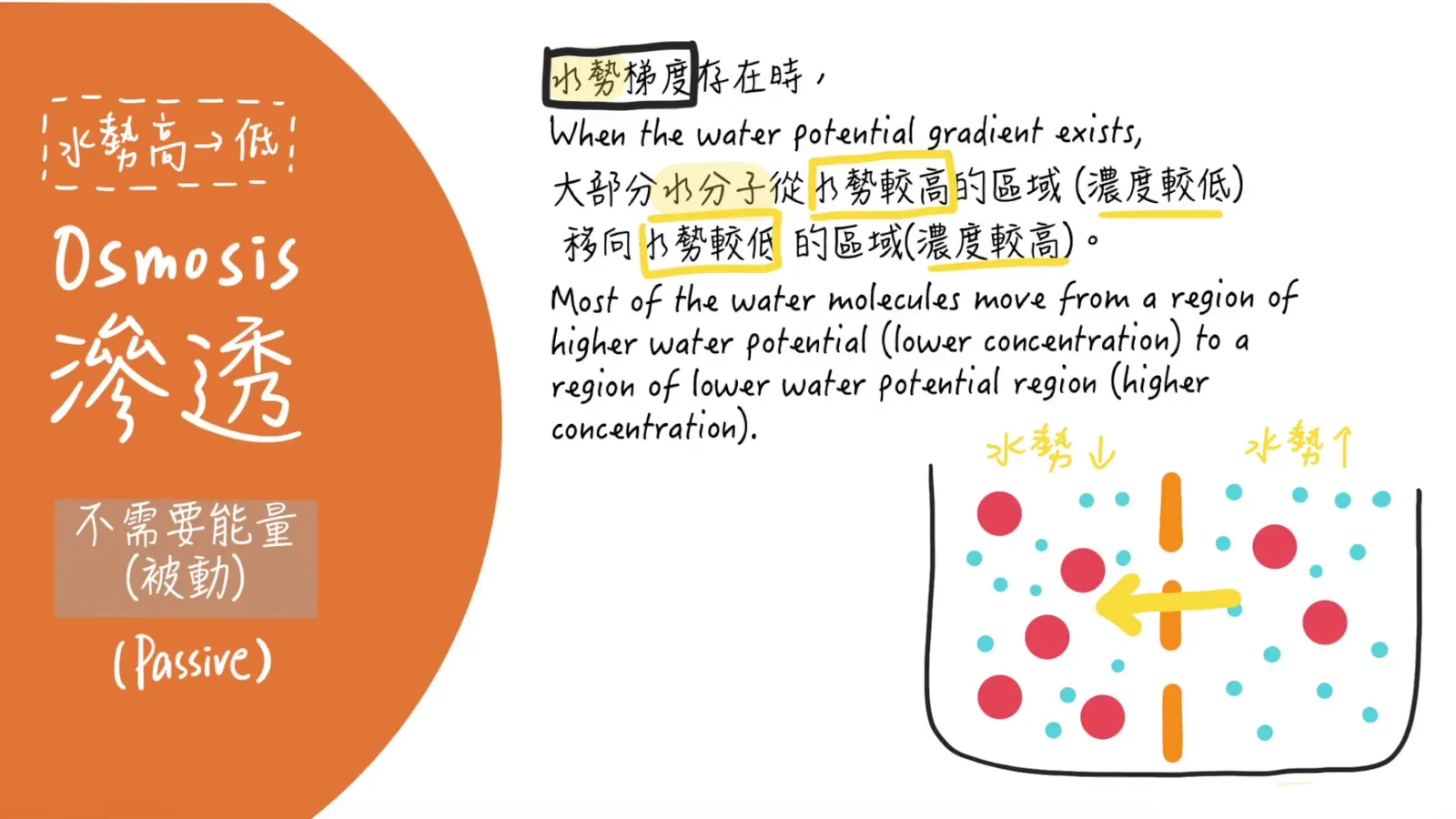
Osmosis is the net movement of water molecules from a region of higher water potential to a region of lower water potential, through a differentially permeable membrane. It is passive.

Water potential(水勢) is the tendency of water molecules to move. The rule that decides everything:

重點 Solute and water potential move in opposite directions
  • More solute → lower water potential (water is held, less free to move)
  • Less solute → higher water potential
  • Distilled water(蒸餾水) has the highest water potential of all
  • So "high concentration" and "low water potential" describe the same solution
中文

這是最多人混淆的一點:溶質越多,水勢越低。題目講「高濃度溶液」,等於「低水勢」;講「蒸餾水」,就是水勢最高。答題時兩套用詞要對得上,否則方向會寫反。

Solutions and the cell 溶液與細胞 S09 · 16:36
投影片 S09
S0916:36 – 18:57看影片
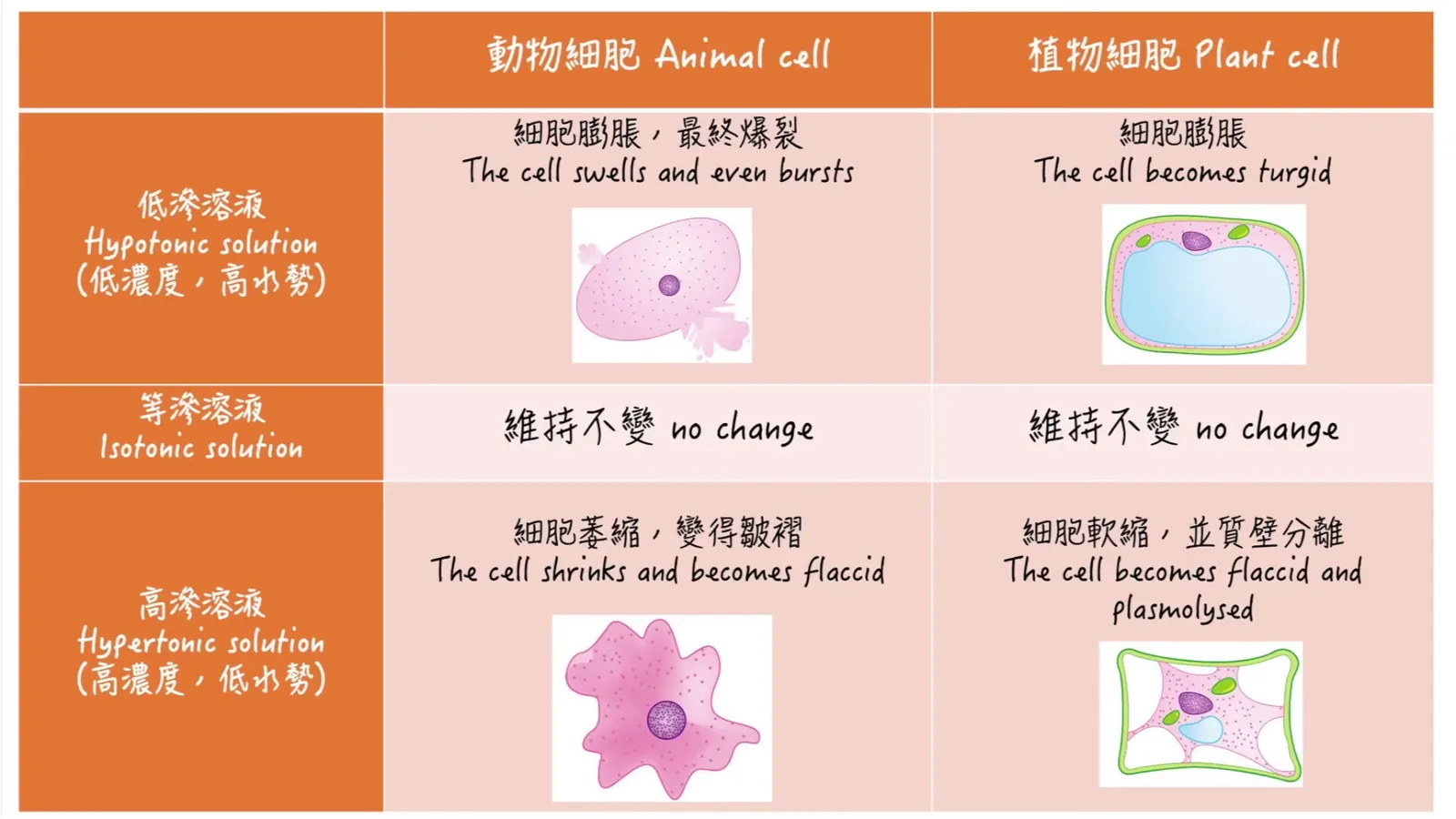
Solution Water potential Animal cell Plant cell
Hypotonic 低滲(低濃度,高水勢) outside higher swells and even bursts becomes turgid(膨脹)
Isotonic 等滲(相同濃度) equal no change no change
Hypertonic 高滲(高濃度,低水勢) outside lower shrinks and becomes flaccid(軟縮) becomes flaccid and plasmolysed(質壁分離)
重點 Two words the syllabus names by name
  • Plasmolysis 質壁分離: cytoplasm shrinks away from the cell wall — plant cells only, because the rigid wall stays put
  • Haemolysis 溶血: a red blood cell swells until the membrane bursts — animal cells only, because there is no wall to stop them
  • The plant wall is why one cell becomes turgid while the other explodes
陷阱 Osmosis is not "diffusion of water" and nothing more
  • Diffusion is explained by concentration; osmosis must be explained by water potential
  • If the question mentions water, answer in water potential, not concentration
  • Water crossing still uses a channel protein; the bilayer alone is too hydrophobic

5. Active transport 主動轉運 S10 · 18:57
投影片 S10
S1018:57 – 21:14看影片

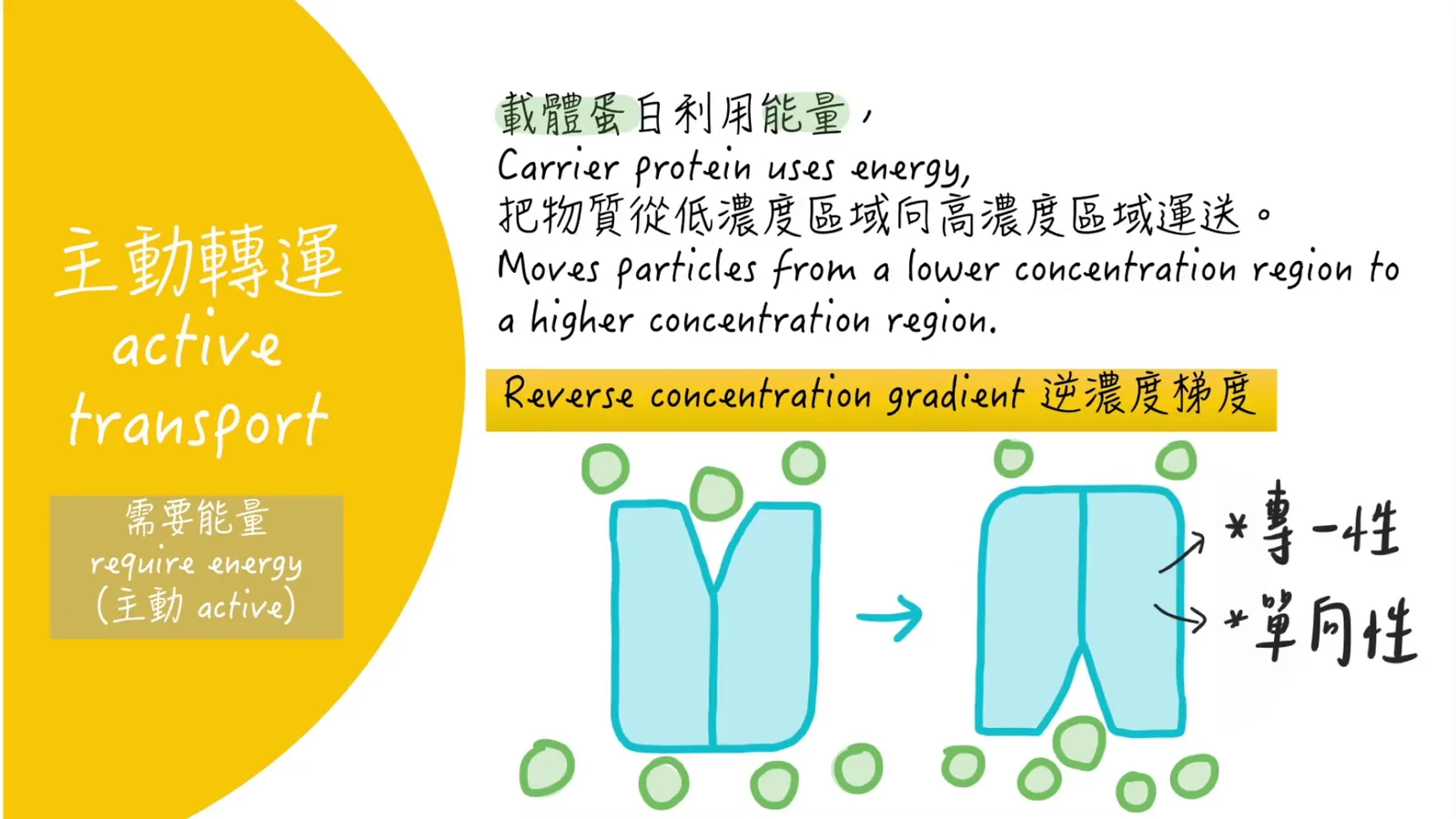
Active transport uses energy and a carrier protein to move particles from a lower concentration to a higher concentration region — against, or "reverse", the concentration gradient. It is an active process.

Feature Meaning
Requires energy 需要能量 from respiration, so plenty of mitochondria nearby
Carrier protein 載體蛋白 always involved, never a channel protein
Specificity 專一性 one carrier handles one substance only
One-way 單向性 moves in one direction only, never back

The standard example is absorption in the small intestine: carrier proteins in the intestinal wall, powered by energy, take up nutrients even after the concentration inside has already exceeded the gut. This is how the body "takes everything".

中文

主動轉運的關鍵在於「逆濃度梯度」。當腸道內營養濃度已經低過細胞內,擴散已經無法再吸收,但仍然要繼續吸收,就要靠載體蛋白+能量硬拉進去。所以小腸細胞有大量線粒體。

6. Phagocytosis 吞噬 S11 · 21:14
投影片 S11
S1121:14 – 23:38看影片

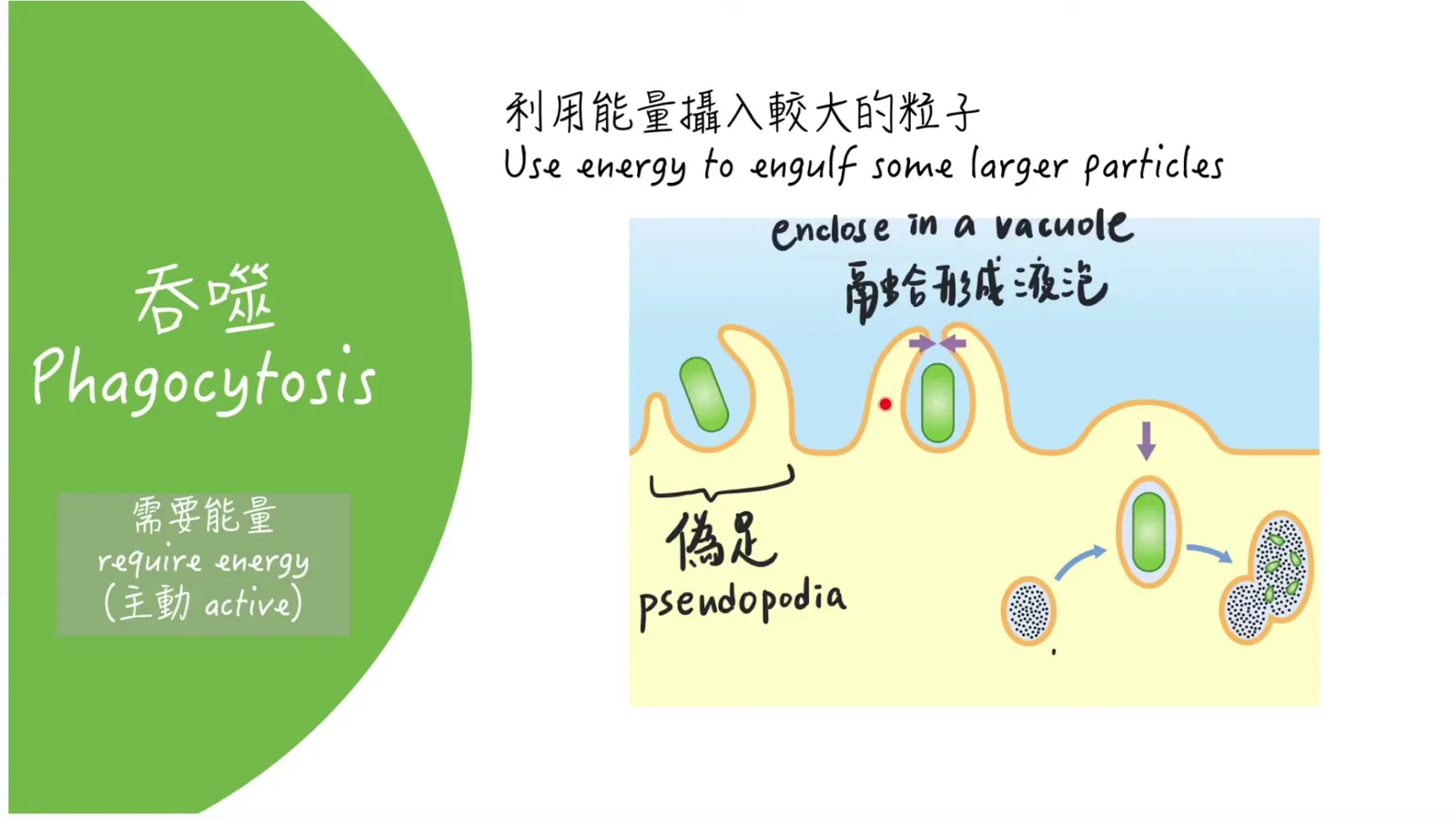
Phagocytosis(吞噬作用) uses energy, plus the fluidity of the membrane, to engulf particles that are too large to cross by any other route.

The sequence, in exam order:

  1. The membrane pushes out pseudopodia 偽足 around the particle.
  2. The pseudopodia meet and the membrane fuses, enclosing the particle in a vacuole(液泡).
  3. Enzymes are secreted into the vacuole to digest the particle.
  4. The digested products become small enough to enter the cytoplasm and be used by the cell.
Example What is engulfed
white blood cell 白血球 pathogens
Amoeba 變形蟲 food particles, as its way of feeding
陷阱 The official term is phagocytosis
  • The syllabus names phagocytosis, and the lesson slide prints Phagocytosis in the title
  • endocytosis is the wider university-level umbrella term and is not in the syllabus
  • Writing endocytosis where the marker expects phagocytosis may not be awarded

7. The four processes side by side

Energy Direction Protein Typical example
Diffusion no down concentration gradient none for non-polar substances O₂ entering a cell
Osmosis no down water potential gradient(水勢梯度) channel protein for water root hair absorbing water
Active transport yes against concentration gradient carrier protein glucose uptake in small intestine
Phagocytosis yes not a gradient at all membrane fluidity, not a protein white blood cell engulfing a pathogen(病原體)
考試重點 The one-line discriminator
  • Energy needed? → active transport or phagocytosis
  • Moving against a gradient with a carrier? → active transport
  • Taking in a large particle? → phagocytosis
  • No energy, and the question talks about water? → osmosis
  • No energy, and the question talks about a gas or a lipid? → diffusion

投影片 Slides

共 11 張,按時間順序。點圖可看原尺寸,點「看影片」在浮動視窗跳到該段。

投影片 S01
S010:00 – 0:50看影片
投影片 S02
S020:50 – 2:08看影片
投影片 S03
S032:10 – 6:15看影片
投影片 S04
S046:15 – 7:36看影片
投影片 S05
S057:36 – 11:13看影片
投影片 S06
S0611:21 – 12:44看影片
投影片 S07
S0712:44 – 14:18看影片
投影片 S08
S0814:18 – 16:36看影片
投影片 S09
S0916:36 – 18:57看影片
投影片 S10
S1018:57 – 21:14看影片
投影片 S11
S1121:14 – 23:38看影片

測驗 Quiz

10 題選擇、5 題是非、3 題短答。題目與解釋全部用英文,模擬考試處境;作答記錄只存在此瀏覽器。

MCQ
In the fluid mosaic model, the word "fluid" refers to which component of the membrane?
Answer: B "Fluid" describes the phospholipid component: phospholipid molecules can move laterally within the same layer, so the membrane behaves like a fluid. "Mosaic" describes the proteins, which are scattered among the phospholipids.
MCQ
Which membrane protein is responsible for active transport?
Answer: B Carrier proteins are the only membrane proteins that carry out active transport, because they can use energy to change shape and move particles against the concentration gradient. Channel proteins only allow passive movement by diffusion and osmosis.
MCQ
A receptor protein on the cell surface membrane functions to
Answer: C Receptor proteins bind with chemicals, for example neurotransmitters at a dendrite and insulin on a liver cell. Recognition markers are antigens, and digestive enzymes are a separate protein type.
MCQ
Which of the following can pass through the phospholipid bilayer without the help of any membrane protein?
Answer: D Oxygen is a small non-polar molecule, so it dissolves in and passes straight through the hydrophobic core of the bilayer. Glucose, amino acids and ions are polar and must use a channel or carrier protein.
MCQ
Starch molecules in the small intestine cannot enter the cells lining the intestine because
Answer: B Size is checked before polarity. Starch, protein and triglyceride are simply too large and can never cross the membrane, which is why digestion must break them down first. Saying that they diffuse slowly is a common error.
MCQ
Which statement correctly describes osmosis?
Answer: B Osmosis is the net movement of water molecules from higher water potential to lower water potential through a differentially permeable membrane. Option A describes diffusion of solute, and option C has the direction reversed.
MCQ
A solution contains a high concentration of solute. Which statement about this solution is correct?
Answer: C The more solute present, the lower the water potential, because water molecules are held by the solute and are less free to move. A high solute concentration is therefore a hypertonic solution with low water potential.
MCQ
A plant cell is placed in a hypertonic solution. What is observed?
Answer: C In a hypertonic solution the outside has a lower water potential, so water leaves the cell by osmosis. The cytoplasm shrinks away from the rigid cell wall, which is plasmolysis. The cell cannot burst because the wall prevents it.
MCQ
Which combination is required for active transport?
Answer: B Active transport always needs both a carrier protein and energy, because it moves particles from a lower to a higher concentration, against the concentration gradient. Channel proteins and gradients belong to passive processes.
MCQ
During phagocytosis by a white blood cell, which sequence is correct?
Answer: B The membrane first extends pseudopodia around the particle, the pseudopodia fuse so that the particle is enclosed in a vacuole, and enzymes are then secreted into the vacuole to digest it. No carrier protein is involved.
T/F
Osmosis requires energy from respiration.
Answer: False Osmosis is a passive process. Water moves down its water potential gradient and no energy is used.
T/F
A red blood cell placed in distilled water swells and eventually bursts.
Answer: True Distilled water has the highest water potential, so water enters the cell by osmosis. An animal cell has no cell wall, so it swells until the membrane bursts. This is haemolysis.
T/F
A plant cell placed in an isotonic solution becomes turgid.
Answer: False In an isotonic solution the water potential outside equals that inside, so there is no net movement of water and the cell shows no change. Turgidity occurs in a hypotonic solution.
T/F
Phagocytosis depends on the fluidity of the cell membrane.
Answer: True The membrane must be able to change shape and fuse in order to form pseudopodia and a vacuole, so membrane fluidity is essential.
T/F
The hydrophobic tails of the phospholipids face outwards, towards the watery surroundings.
Answer: False The hydrophilic heads face outwards towards the watery surroundings, and the hydrophobic tails face inwards, away from water. This arrangement is what makes the membrane differentially permeable.

短答題 Short Questions

SHORT QUESTION · 4 marks
A red blood cell and a plant cell are both placed in distilled water. Explain why the red blood cell bursts but the plant cell does not.
Model answer Distilled water has a higher water potential than the cell contents of both cells (1). Water therefore enters both cells by osmosis (1). The red blood cell has no cell wall, so it swells until the cell membrane bursts, i.e. haemolysis (1). The plant cell has a rigid cell wall that withstands the inward pressure, so the cell only becomes turgid and does not burst (1).
SHORT QUESTION · 4 marks
Describe the process by which a white blood cell engulfs a bacterium.
Model answer The cell membrane extends pseudopodia around the bacterium, and energy is required because membrane fluidity allows this shape change (1). The pseudopodia fuse so that the bacterium is enclosed in a vacuole formed from the cell membrane (1). Enzymes are secreted into the vacuole to digest the bacterium (1). The digested products are small enough to be absorbed into the cytoplasm and used by the cell (1).
SHORT QUESTION · 5 marks
Explain why the absorption of glucose by the cells of the small intestine requires active transport rather than diffusion.
Model answer Glucose is polar and cannot pass through the phospholipid bilayer directly, so a carrier protein is needed (1). As absorption continues, the glucose concentration inside the intestinal cell becomes higher than in the lumen, so the concentration gradient is reversed (1). Diffusion can only move glucose down a concentration gradient, so it can no longer absorb glucose (1). Active transport uses energy from respiration to move glucose from a lower to a higher concentration, against the concentration gradient (1). The intestinal cells therefore contain many carrier proteins and many mitochondria to supply the energy (1).

術語表 Glossary

考試以英文作答,術語必須認得英文。

English中文定義出處
Cell membrane細胞膜包圍細胞的薄膜,控制物質進出。S02
Fluid mosaic model流動鑲嵌模型以磷脂雙分子層為骨架、蛋白質散佈其間的細胞膜結構模型。S02
Phospholipid bilayer磷脂雙分子層兩層磷脂分子相對排列而成的膜骨架。S02
Phospholipid磷脂構成細胞膜的主要脂質,可橫向移動。S02
Fluid流動指磷脂可在同一層內橫向移動,使膜呈流動狀態。S02
Mosaic鑲嵌指蛋白質散佈於磷脂之間,如同馬賽克。S02
move laterally橫向移動磷脂在同一層內左右移動的能力。S02
Hydrophilic head親水頭部磷脂朝向膜外與細胞質的一面,喜歡水。S04
Hydrophobic tail疏水尾部磷脂藏在膜中間的一面,排斥水,造成差異透性。S04
Differentially permeable差異透性容許部分物質穿過、同時阻止其他物質穿過的性質。S05
Selectively permeable選擇透性與差異透性同義,投影片同時使用兩種寫法。S05
Channel protein通道蛋白讓水溶性物質以擴散、滲透方式通過的膜蛋白。S03
Carrier protein載體蛋白只負責主動轉運的膜蛋白,具專一性與單向性。S03
Enzyme酶部分酶位於膜上,例如小腸壁的消化酶。S03
Receptor protein受體蛋白結合化學訊息(神經遞質、激素)的膜蛋白。S03
Antigen抗原細胞表面的識別標記,屬糖蛋白,例如血型抗原。S03
Glycoprotein糖蛋白帶糖鏈的蛋白質,作為細胞的身份標記。S03
Neurotransmitter神經遞質由受體蛋白接收的化學訊息之一。S03
Pathogen病原體可被白血球吞噬的致病微生物。S03
Diffusion擴散粒子由高濃度區域淨移向低濃度區域,屬被動過程。S06
Concentration gradient濃度梯度兩區域之間的濃度差異;差異越大,梯度越陡。S06
Osmosis滲透水分子由高水勢區域淨移向低水勢區域,經差異透性膜,屬被動過程。S08
Water potential水勢水分子移動的傾向程度;溶質越多,水勢越低。S08
Water potential gradient水勢梯度兩區域之間的水勢差異,是滲透發生的條件。S08
Solute溶質溶解於水中的物質;溶質越多,水勢越低。S08
Distilled water蒸餾水不含任何溶質,水勢最高。S08
Hypotonic低滲低濃度、高水勢的溶液,細胞會吸水。S09
Isotonic等滲與細胞水勢相同,細胞體積不變。S09
Hypertonic高滲高濃度、低水勢的溶液,細胞會失水。S09
Turgid膨脹植物細胞吸水後,細胞壁受壓而挺立的狀態。S09
Flaccid軟縮細胞失水後變軟、皺褶的狀態。S09
Plasmolysis質壁分離植物細胞失水,細胞質與細胞壁分離。S09
Plasmolysed質壁分離形容已出現質壁分離的植物細胞。S09
Haemolysis溶血動物細胞(紅血球)吸水過多而脹破。S09
Active transport主動轉運用能量與載體蛋白把物質由低濃度移向高濃度,逆濃度梯度。S10
Reverse concentration gradient逆濃度梯度由低濃度移向高濃度,與擴散方向相反。S10
Specificity專一性一個載體蛋白只運送一種物質。S10
One-way單向性載體蛋白只朝一個方向運送,不會逆向。S10
Small intestine小腸主動轉運的典型例子,吸收營養素入血管。S10
Phagocytosis吞噬作用用能量與膜的流動性把大型粒子包入液泡。S11
Pseudopodia偽足細胞膜伸出的臨時突起,用來包圍粒子。S11
Vacuole液泡吞噬後由細胞膜形成、包裹粒子的囊泡。S11
Amoeba變形蟲以吞噬方式進食的單細胞生物。S11
Surface area表面積影響擴散速率的因素之一,表面積越大擴散越快。S07
Non-polar非極性不帶正負電荷,可直接穿過磷脂雙分子層。S05
Polar極性帶正負電荷,須經通道蛋白或載體蛋白通過。S05
Lipid-soluble脂溶性可溶於脂質,因此能直接穿過細胞膜。S05